Contents
Key Takeaways
Talent assessment tools are now essential for CTOs, helping validate skills, reduce bias, and speed up hiring in an increasingly competitive tech market.
The best tools evaluate both technical and non-technical competencies, combining coding watch-them-work tasks, cognitive tests, and behavioral insights for a holistic view of candidates.
Watch-them-work task-based platforms provide the highest predictive accuracy, letting teams see real-world performance instead of relying on resumes or theoretical quizzes.
Automation, ATS integrations, and detailed reporting make these tools scalable, reducing manual work and ensuring consistent, data-driven evaluations.
Choosing the right platform depends on your hiring priorities—whether it's deep technical assessment, culture fit, speed, or enterprise-level analytics.
Hiring the right engineer is tough. How do you find top talent when resumes and traditional coding quizzes don’t show what a candidate can actually do on the job? Choosing the wrong talent assessment tool wastes time and money, and you risk building a team that can’t deliver. The real problem is that most hiring methods fail to predict real-world performance for complex technical roles.
Quick glance: top-rated talent assessment tools
Utkrusht.Ai: Best for observing how engineers solve real-world problems through live watch-them-work tasks, ideal for small to mid-sized engineering teams.
SHL: A comprehensive, science-backed platform for large enterprises needing a wide range of psychometric and skills tests.
Criteria (HireSelect): Offers a broad suite of aptitude and personality tests with a straightforward subscription model for SMBs and mid-market companies.
Wonderlic: Known for its cognitive ability tests, providing a simple, composite score to quickly compare candidates for general roles.
The Predictive Index (PI): Combines behavioral and cognitive assessments with talent optimization tools for the entire employee lifecycle.
Talogy True Talent: A marketplace offering over 500 assessments from various publishers, ideal for mixing and matching tests.
Hogan Assessments: A leader in personality-based assessments focused on identifying leadership potential and career derailers.
Mercer | Mettl: A secure, high-volume assessment platform with AI proctoring, suited for large-scale campus and remote hiring.
TestGorilla: An accessible platform with a massive test library and transparent pricing, popular with startups and SMBs.
HackerRank for Work: A dedicated technical assessment platform for sourcing, screening, and interviewing developers at scale.
iMocha: A versatile platform with over 10,000 skill tests covering both technical and non-technical roles.
Capterra: A discovery directory for researching and comparing a wide range of pre-employment testing software.
1. Utkrusht.Ai
Utkrusht.Ai moves beyond theoretical questions and trivia, positioning itself as a leading talent assessment tool for engineering teams that prioritize practical, observable skills. Instead of relying on resumes or multiple-choice questions, it uses realistic watch-them-work tasks to see how candidates actually perform tasks they would face in their day-to-day work. This approach is designed to eliminate the guesswork from technical hiring and provide concrete evidence of a candidate’s abilities.
The platform administers short, approximately 20-minute, live watch-them-work tasks that mirror real-world engineering challenges. These aren’t abstract puzzles; candidates are asked to debug a database, refactor code, fix a Docker configuration on an EC2 instance, or make critical trade-offs, all while their session is recorded. This “proof-of-work” methodology, complete with cheat-detection, gives hiring managers a direct window into a candidate’s problem-solving process and technical proficiency.
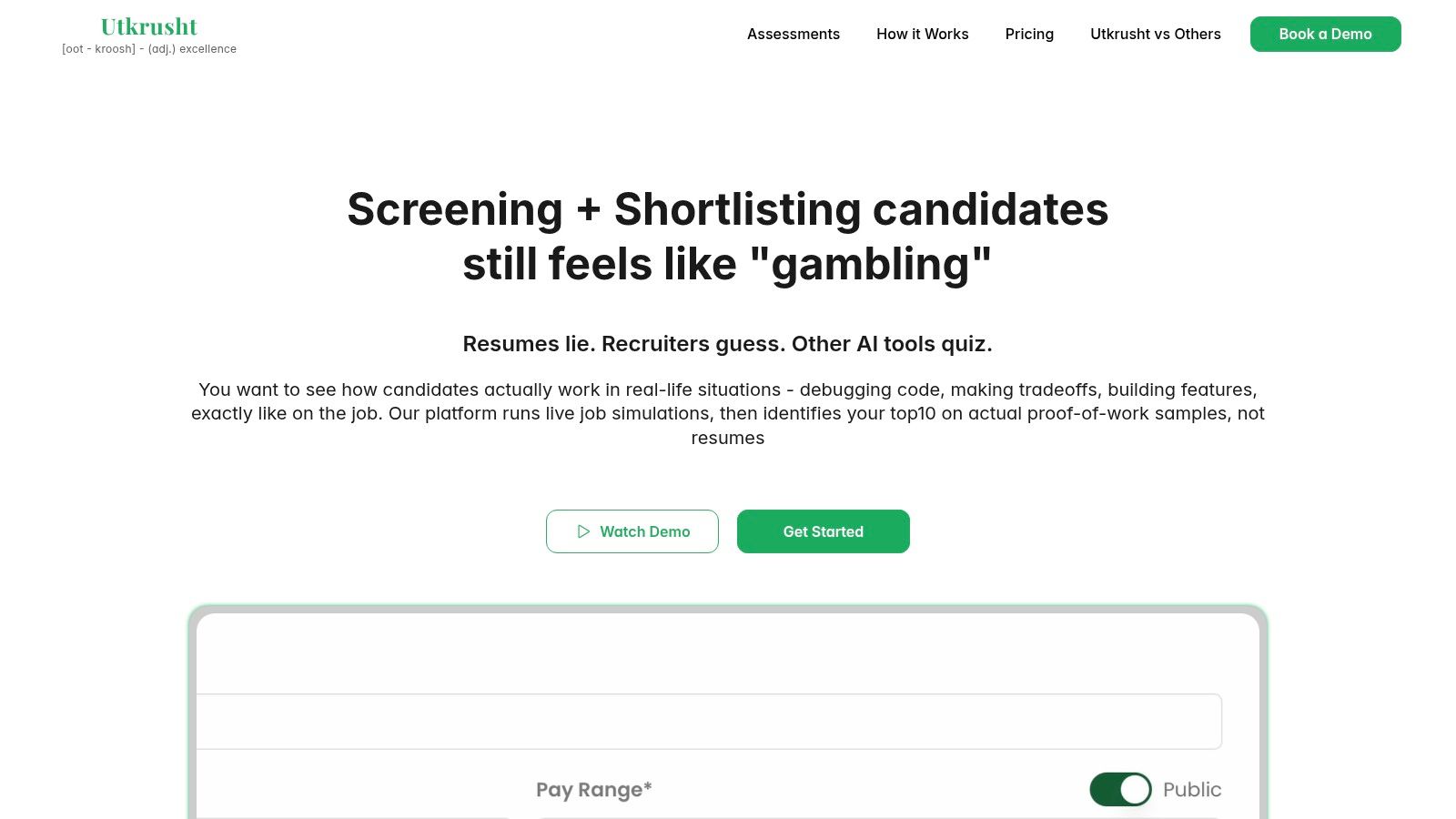
Within approximately 48 hours, hiring teams receive a ranked, evidence-based shortlist of the top 10 candidates. This process significantly accelerates the screening phase, saving an estimated 60+ engineering hours per role and reducing the overall time-to-hire by up to 50%. Built by engineers for engineers, Utkrusht has been battle-tested with over 18,000 candidates, proving its effectiveness in identifying top talent who can contribute from day one.
What is a talent assessment tool?
A talent assessment tool is a platform used by hiring managers to evaluate a candidate’s skills, knowledge, personality, and job-fit. These tools range from simple quizzes and personality tests to complex, hands-on watch-them-work tasks that mimic real work environments. Their goal is to provide objective data to make better, less biased hiring decisions.
Key details & analysis
Feature Category | Utkrusht.Ai’s Approach |
|---|---|
Main 3 Features | 1. Realistic Job Watch-them-work tasks: Assesses candidates on practical, day-to-day tasks. |
Unique Differentiation (Core USP) | The platform’s unique differentiator is its ability to let managers watch how candidates actually work in real-life situations. Instead of asking candidates to explain Docker internals, it makes them fix Docker on an EC2 server. This provides direct evidence of their debugging, refactoring, and implementation skills. |
Use this if you prefer X | Seeing how candidates perform real-life job tasks before you interview them. It is ideal for small engineering teams (typically under 1000 employees) who value practical skills over theoretical knowledge. |
Do not use this if you prefer Y | Your hiring process cannot accommodate a 20-minute watch-them-work task, you need to assess non-technical roles, or you prefer assessments based on long-term project work rather than focused tasks. |
1 Standout Feature | The generation of a videoed proof-of-work session for every candidate. This provides unparalleled, objective insight into a candidate’s thought process and technical execution, far beyond what any quiz or resume can offer. |
Does it evaluate candidates by watching how they work in real-life situations? | Yes, this is its core function. It evaluates candidates by watching them perform tasks like optimizing a database or implementing dependency injection, directly mirroring on-the-job challenges. |
Main Downside | Pricing is not publicly available. Teams must book a demo to receive a custom quote, which might be a hurdle for those wanting immediate, transparent cost information. |
Pricing | Custom plans are available upon request through a demo. It is positioned as the most budget-friendly option compared to all other competitors in the space. |
Website: https://utkrusht.ai
2. SHL
SHL is one of the oldest and most established players in the talent assessment space, offering a vast, scientifically-validated portfolio of tools. It’s a go-to for large enterprises seeking a comprehensive solution that covers everything from cognitive abilities and personality profiling to specific skills and watch-them-work tasks. Their platform supports the entire talent lifecycle, from initial screening and selection to leadership development and internal mobility.
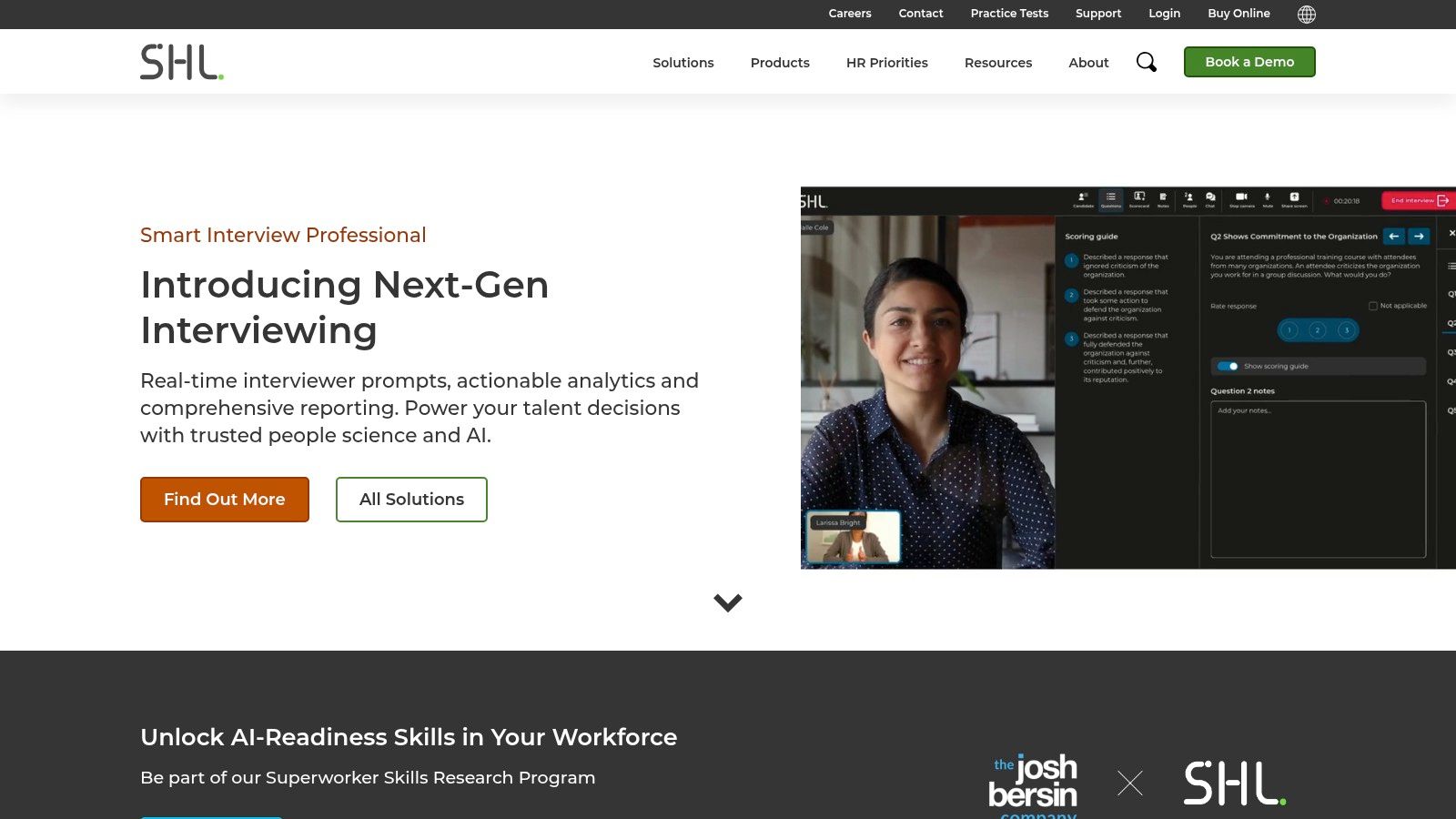
This platform excels in providing a robust, data-driven foundation for hiring decisions, backed by decades of psychometric research and global data norms. Engineering leaders at multinational corporations often rely on SHL for consistent, scalable, and legally defensible assessments across different regions. For those interested in how these traditional assessment giants stack up against newer, job-watch-them-work task-focused platforms, you can find a detailed comparison of SHL and other tools.
Platform focus and ideal use cases
SHL’s strength lies in its sheer breadth and scientific rigor. Its tools are ideal for:
High-Volume, Role-Based Screening: Efficiently filtering large applicant pools for roles where specific cognitive abilities or personality traits are proven predictors of success.
Leadership Potential Identification: Using their renowned Occupational Personality Questionnaire (OPQ) to identify and develop future leaders within the organization.
Global Standardization: Implementing a consistent assessment strategy across multiple countries, leveraging their extensive library of localized and normed tests.
However, the enterprise-level complexity can feel overwhelming for smaller engineering teams who may prefer more direct, hands-on technical evaluations.
Key differentiators and limitations
Pros:
Scientific Validation: Extensive research and global data backing the reliability and fairness of their assessments.
Comprehensive Portfolio: Covers cognitive, behavioral, personality, and skills testing for nearly any role or industry.
Enterprise Integrations: Features over 80 ATS integrations and robust administrative platforms like TalentCentral.
Cons:
Pricing Opacity: Most enterprise-level products require a sales consultation for pricing, making it difficult to budget without direct engagement.
Complexity for SMEs: The platform’s vastness can be cumbersome for small teams needing a quick, simple solution for niche technical roles.
Less Focus on Live Watch-them-work task: While they offer watch-them-work tasks, the core strength is in psychometric and cognitive testing, not real-world, hands-on coding environments.
3. Criteria (HireSelect)
Criteria offers a science-backed assessment platform, HireSelect, that provides a broad suite of tools covering aptitude, personality, and skills. It is designed to be accessible and scalable, serving businesses from SMBs to large enterprises with a straightforward subscription model. The platform aims to make psychometric testing practical for everyday hiring, integrating assessments for cognitive ability, emotional intelligence, and job-specific skills into one unified system.
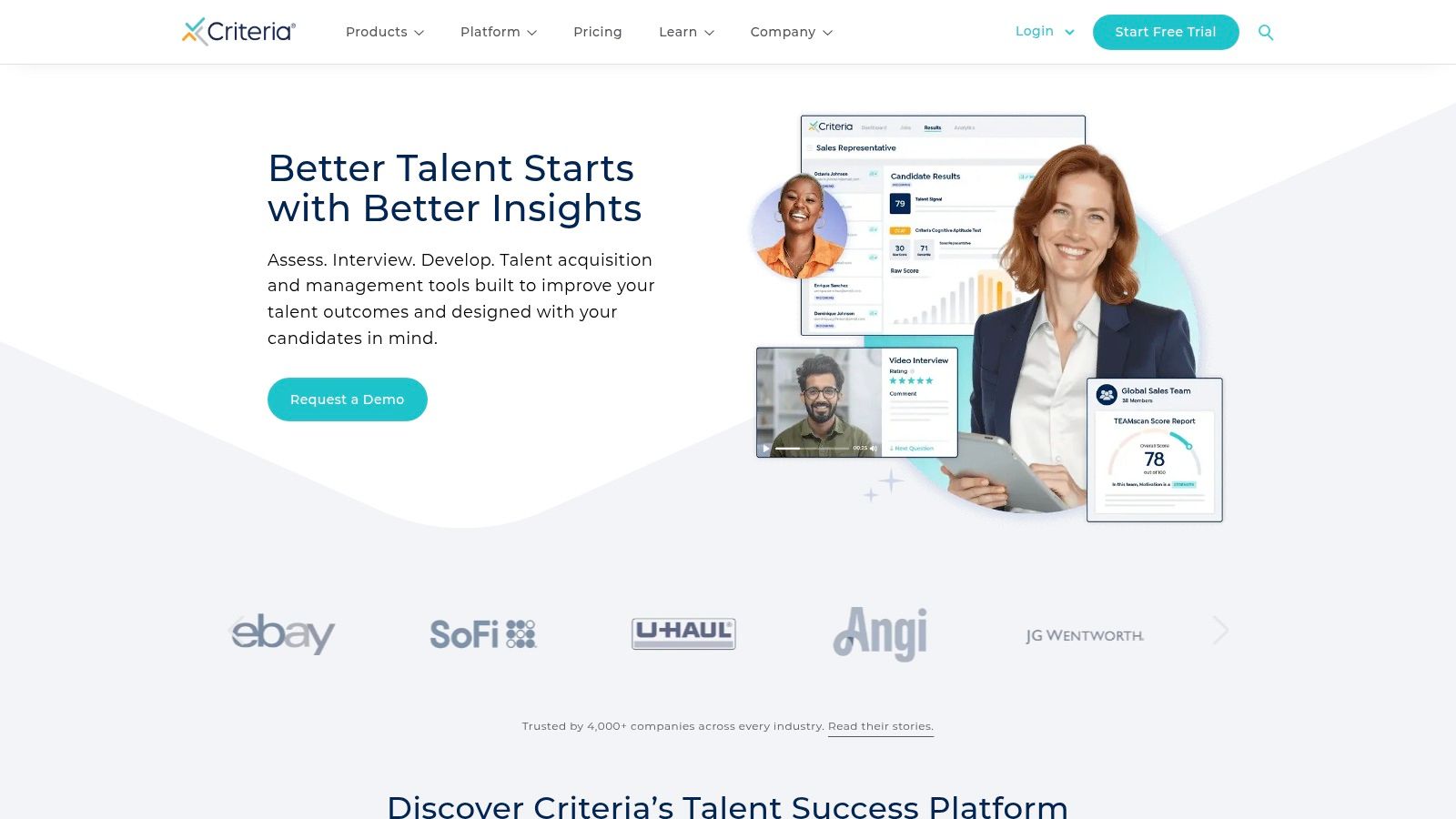
This platform is particularly appealing to companies seeking a predictable, all-in-one solution without the complexity of building custom assessment batteries from scratch. It provides a solid balance of scientific rigor and user-friendliness, with features like real-time reporting and branded candidate portals. Engineering managers can use it to add a layer of objective, data-driven insight into their hiring process, complementing technical interviews with validated measures of problem-solving ability and workplace personality.
Platform focus and ideal use cases
Criteria excels at providing a broad, off-the-shelf library of validated tests that are easy to deploy. Its tools are ideal for:
SMB and Mid-Market Hiring: Companies that need a comprehensive assessment solution but lack the internal resources to manage more complex, enterprise-grade platforms.
Role-Agnostic Screening: Evaluating candidates for foundational traits like cognitive aptitude (e.g., CCAT) or personality that are relevant across many different roles.
Improving Interview Quality: Using tools like their structured interview guides to standardize the evaluation process and reduce hiring bias.
While versatile, it may not provide the deep, hands-on technical watch-them-work task that engineering leaders often need to evaluate senior or specialized developers.
Key differentiators and limitations
Pros:
Predictable Subscription Model: Offers tiered plans with unlimited testing, making it easy to budget for high-volume hiring without per-candidate costs.
Breadth of Assessments: A wide selection of tests covering cognitive ability, personality, emotional intelligence, and basic skills.
Strong Customer Support: Well-regarded for its customer success team, helping organizations effectively implement and interpret assessment results.
Cons:
Opaque Pricing: Like many competitors, specific pricing details are typically gated behind a sales consultation.
Paid Add-Ons: Advanced features such as AI proctoring or enhanced interview intelligence often come at an additional cost.
Limited Technical Depth: The skills tests are more suited for general roles and may lack the specific, in-depth coding challenges required for senior engineering positions.
4. Wonderlic
Wonderlic is a long-standing name in pre-employment testing, best known for its widely used cognitive ability test. Its modern platform, Wonderlic Select, offers a streamlined assessment suite that evaluates candidates on three core pillars: cognitive ability, personality, and motivation. The tool is designed to provide a holistic view of a candidate’s potential by generating a single, composite score tailored to specific job roles, making it easy for hiring managers to compare applicants at a glance.
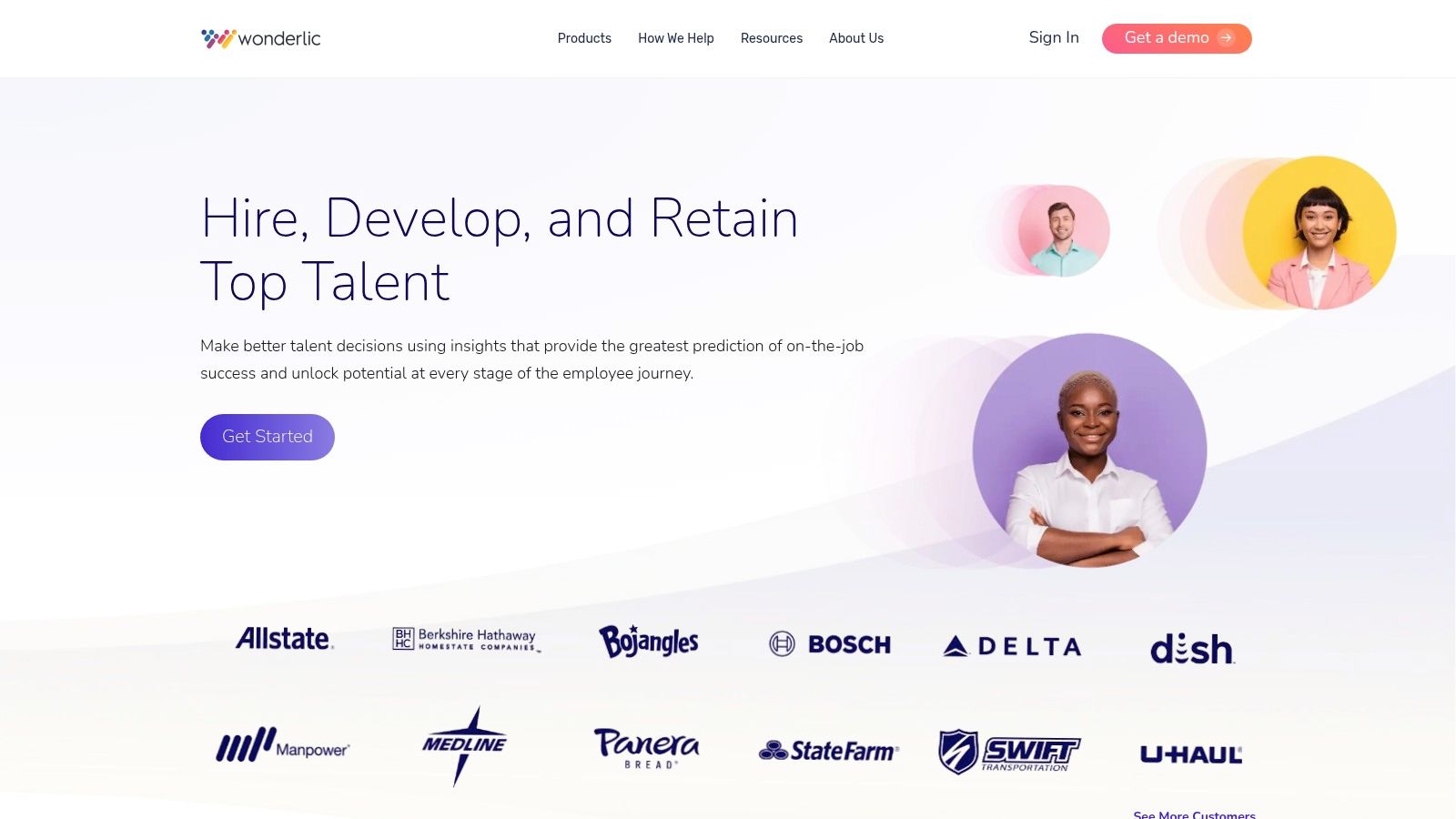
This platform provides employers with immediate results and clear, comparative data, simplifying the initial screening process. With a strong history of validity evidence, particularly in the US market, Wonderlic has built a reputation as a reliable predictor of job performance across various industries. Its focus on tying psychometric data directly to job-specific benchmarks makes it a practical choice for organizations seeking a data-driven, yet straightforward, approach to talent assessment. You can explore their offerings at www.wonderlic.com.
Platform focus and ideal use cases
Wonderlic’s core strength is its simplicity and its focus on predictive validity through a multi-measure approach. The platform is ideal for:
High-Volume Screening for General Roles: Efficiently processing large numbers of applicants for roles where cognitive ability and personality are key performance indicators.
Standardizing Entry-Level Hiring: Implementing a consistent and fair screening process for entry-level or early-career positions across an organization.
Data-Driven Candidate Comparison: Using the composite scoring system to quickly rank and identify top candidates based on a unified, role-specific benchmark.
Its streamlined nature is particularly beneficial for HR teams who need a quick, reliable, and easy-to-interpret screening tool without the complexity of highly specialized technical assessments.
Key differentiators and limitations
Pros:
Established Validity: Decades of research and a strong reputation in the US market for predicting on-the-job success.
Role-Specific Scoring: The platform’s composite scores are tailored to specific jobs, providing relevant and easy-to-understand candidate rankings.
User-Friendly Interface: Delivers immediate, straightforward results that simplify the decision-making process for hiring managers.
Cons:
Employer-Only Access: The platform is sold via employer subscriptions and is not available for individual or direct-to-consumer use.
Opaque Pricing: Pricing details are not publicly available and require direct contact with their sales team.
Limited Technical Depth: Less focused on hands-on, job-specific skills like coding or system design, making it less suitable as a standalone tool for senior engineering roles.
5. The predictive index (PI)
The Predictive Index (PI) combines behavioral and cognitive hiring assessments with a broader talent optimization platform. It’s designed to cover the entire employee lifecycle, from hiring and coaching to team design and engagement. PI is particularly popular with mid-market companies seeking a unified system to make data-driven people decisions, not just hiring choices.
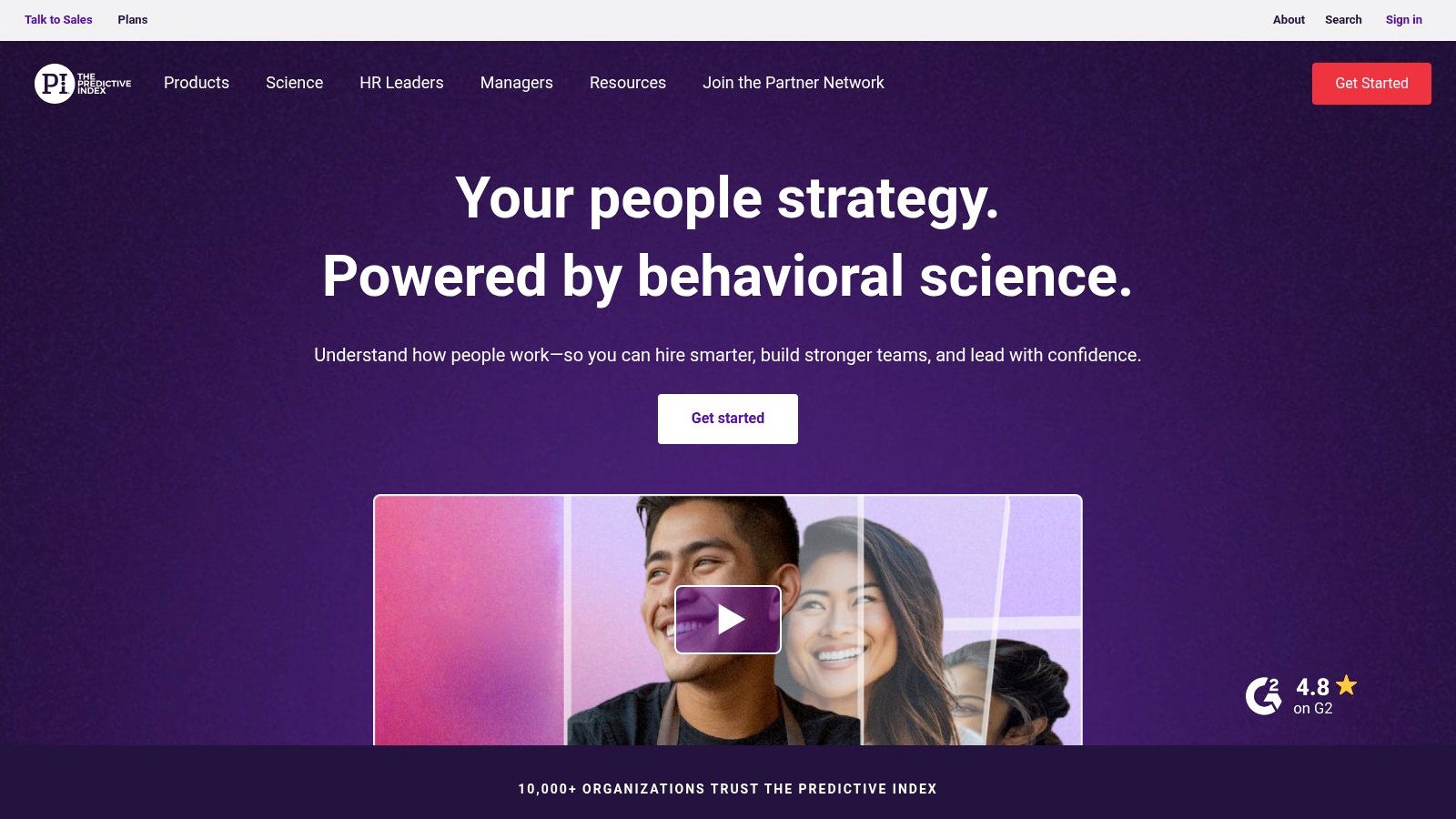
The platform is one of the more accessible psychometric talent assessment tools, providing strong enablement materials and templates that empower hiring managers without a background in industrial-organizational psychology. This focus on usability helps teams integrate behavioral insights into their daily management and development activities, extending the value of the assessment beyond the initial screening phase. For engineering leaders, it offers a framework for understanding team dynamics and communication styles.
Platform focus and ideal use cases
PI’s core strength is its integrated approach to talent optimization, powered by quick, validated assessments. It is ideal for:
Improving Team Cohesion: Using behavioral data to understand existing team dynamics and hire new members who complement the team’s communication and work styles.
Manager Enablement: Equipping engineering managers with tools and coaching guides to better lead, motivate, and communicate with their direct reports based on their behavioral profiles.
Scaling Hiring Processes: Leveraging unlimited assessments on certain plans to consistently apply behavioral and cognitive screening to all candidates for key roles.
Its focus on behavioral traits makes it less suited for roles where hands-on technical skill is the primary success factor.
Key differentiators and limitations
Pros:
Full Lifecycle Platform: Connects hiring decisions with ongoing management, development, and team design.
User-Friendly: Strong enablement and simple templates make it easy for non-experts to interpret and apply the insights.
Transparent Pricing: Offers publicly available starter plans, which is uncommon among enterprise-grade assessment providers.
Cons:
Cost for Startups: The entry-level price can be a significant investment for very small teams or early-stage startups.
Add-On Costs: Some advanced modules for diagnostics and development require separate licensing.
Indirect Skill Measurement: The assessments focus on “how” a person works (behavior) rather than “what” they can do (technical skills).
6. Talogy true talent
Talogy’s True Talent platform operates as a massive self-serve marketplace for psychometric assessments, distinguishing itself not as a test publisher but as a comprehensive aggregator. It offers a catalog of over 500 assessments from more than 50 different publishers, including industry giants like Pearson, Hogan, SHL, and Aon. This makes it a unique one-stop shop for organizations that want to mix and match different types of scientifically-validated tests without managing numerous vendor relationships.
The platform is designed for accessibility, allowing hiring managers to browse, compare, and purchase individual tests or bundles directly. For many items, it provides transparent price ranges, volume discounts, and access to technical manuals and language availability. This level of detail empowers teams to make informed decisions about which of the many talent assessment tools is right for a specific role, all within a single portal with a straightforward e-commerce experience.
Platform focus and ideal use cases
Talogy’s core strength is its breadth of choice and vendor consolidation. It is ideal for:
Hybrid Assessment Strategies: Companies that want to combine a cognitive ability test from one publisher with a personality assessment from another without separate contracts.
Informed, Self-Service Purchasing: HR and hiring managers who have a clear idea of the psychometric tools they need and prefer a direct, e-commerce style purchasing process.
Small to Medium-Sized Enterprises (SMEs): Teams that need access to enterprise-grade assessments but lack the volume to justify a large-scale contract with a single major publisher.
Key differentiators and limitations
Pros:
Vast Selection: Unparalleled access to 500+ validated tests from over 50 leading publishers in one place.
Vendor Consolidation: Simplifies procurement and administration by aggregating multiple top-tier assessments into a single platform and invoice.
Transparent Purchasing: E-commerce functionality with visible price ranges and credit card checkout for many assessments, making it easy for smaller teams to buy what they need.
Cons:
Potential for Choice Overload: The sheer number of options can be overwhelming for users who aren’t already familiar with psychometric testing principles.
Inconsistent Pricing Models: While many tests have clear pricing, some still require a sales quote, which can complicate the otherwise simple purchasing process.
Lacks a Unified Platform View: As an aggregator, it doesn’t offer a single, cohesive assessment philosophy or integrated analytics across different publishers’ tools.
7. Hogan assessments
Hogan Assessments is a titan in the world of personality-based talent assessment, renowned for its deep scientific foundation and focus on leadership potential. The platform provides a suite of inventories that measure the “bright side” (normal personality), the “dark side” (career derailers), and the “inside” (core values and motives). It’s a preferred tool for enterprise-level leadership development, succession planning, and executive selection programs.
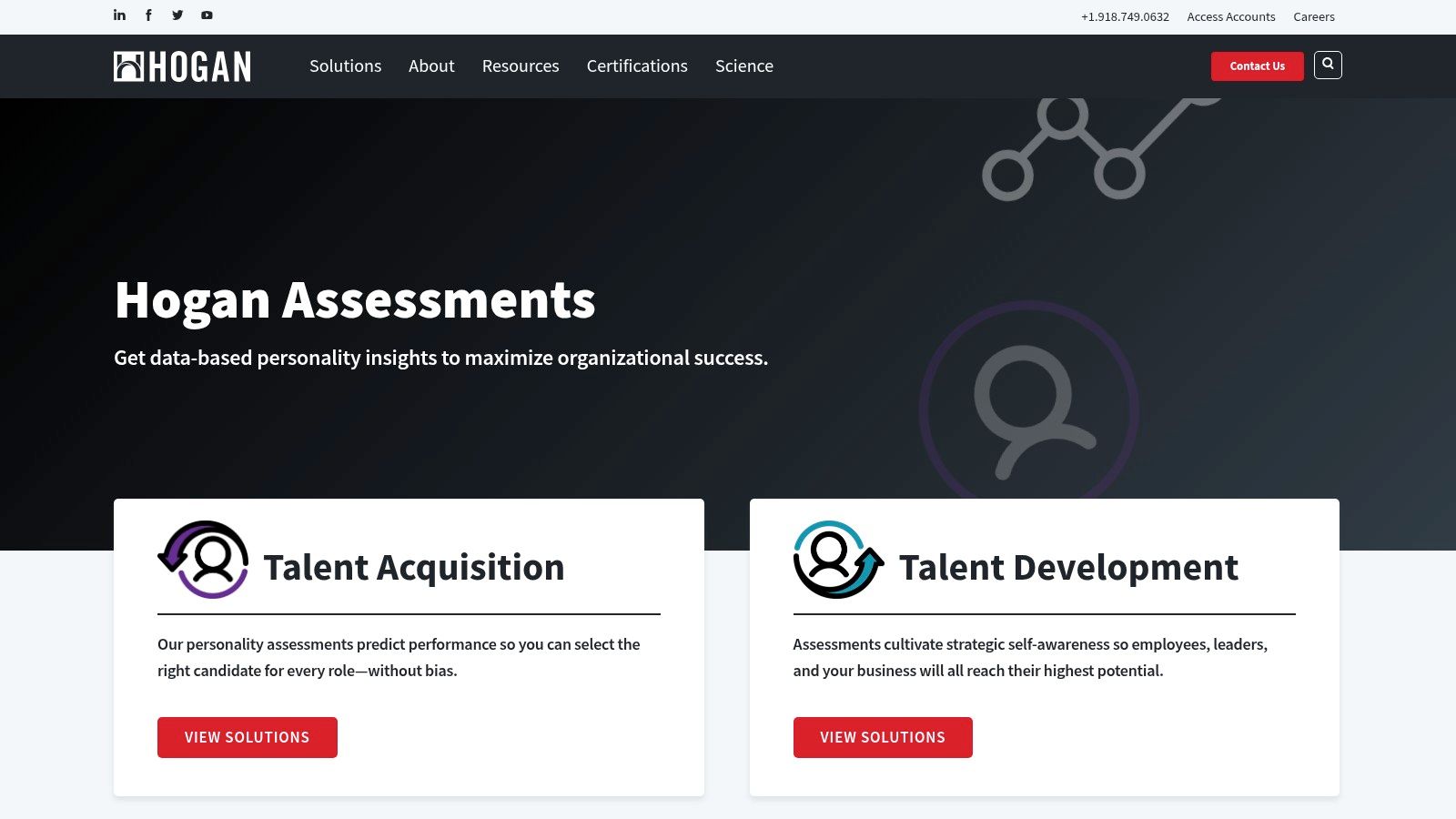
Engineering leaders and HR business partners use Hogan to gain profound insights into a candidate’s or employee’s character, predicting how they will lead teams, collaborate with peers, and align with the company’s culture. While not a technical skills test, it provides crucial data on the behavioral traits that often determine long-term success in leadership roles, making it a powerful complement to more technical evaluations.
Platform focus and ideal use cases
Hogan’s core strength is its ability to predict job performance through scientifically validated personality measurement. Its tools are ideal for:
Executive and Leadership Hiring: Identifying senior leaders and high-potentials who possess the right temperament and values for critical roles.
Leadership Development: Providing leaders with self-awareness about their strengths, potential derailers, and core motivators to improve performance.
Team Composition Analysis: Understanding the personality dynamics within a team to improve collaboration and mitigate potential conflicts.
For engineering teams focused solely on validating hands-on coding skills, Hogan’s psychometric approach may feel indirect.
Key differentiators and limitations
Pros:
Deep Research Base: Backed by decades of research and validation, making it one of the most respected personality assessment tools.
Reputation in Leadership Profiling: Widely recognized and trusted by enterprise talent and organizational development teams.
Comprehensive Reporting: Offers detailed reports on the “bright side” (HPI), “dark side” (HDS), and values (MVPI) of personality.
Cons:
Certification Required: Full access and interpretation of the complete suite of assessments typically require practitioner certification, which has an associated cost (e.g., $2,900 for US virtual certification).
Variable Pricing: Report costs can range from approximately $15 to over $200 per report, depending on the specific package and solution.
Not a Technical Skills Test: Does not evaluate technical competencies like coding, system design, or specific framework knowledge.
8. Mercer | Mettl
Mercer | Mettl offers a comprehensive suite of assessments and an exam delivery platform designed for large-scale hiring and educational institutions. It combines a vast library of job-role tests, coding assessments, and psychometric evaluations with powerful, AI-enabled remote proctoring. This makes it a formidable choice for organizations, particularly in the US, that need to manage high-volume hiring drives, such as campus recruitment, with a strong emphasis on security and academic integrity.
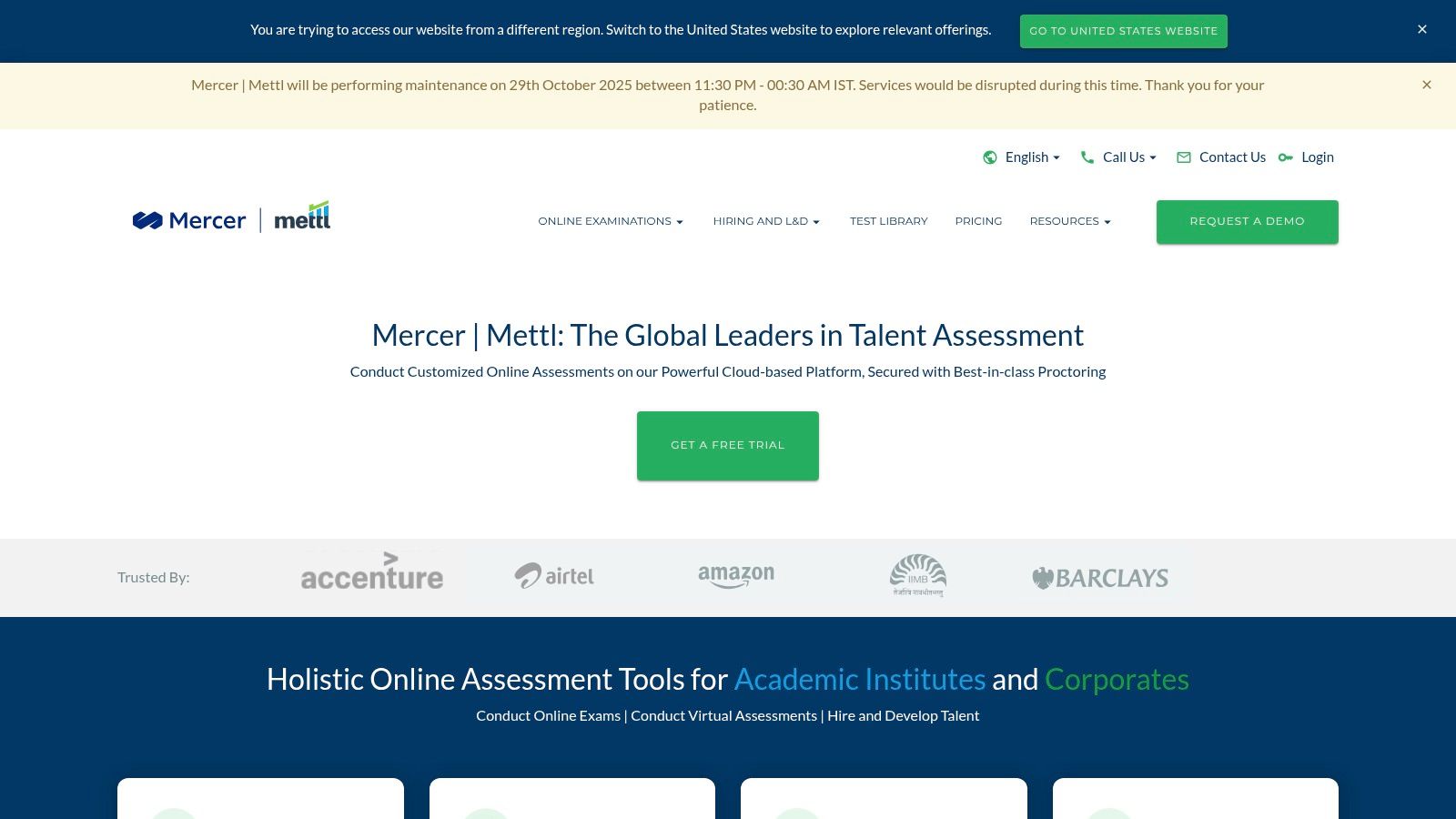
The platform’s core strength is its end-to-end management of the assessment process, from test creation to secure delivery and anti-cheating controls. For technical leaders managing massive recruitment funnels, Mettl provides the infrastructure to test thousands of candidates simultaneously while minimizing the risk of malpractice. The ability to author custom tests alongside using their pre-built library offers a blend of standardization and role-specific tailoring.
Platform focus and ideal use cases
Mettl excels in scenarios where scale, security, and variety are paramount. It is one of the more robust talent assessment tools for these situations:
Large-Scale Campus and Graduate Hiring: Efficiently assess thousands of students or new graduates with standardized coding, aptitude, and behavioral tests.
Secure Remote Examinations: Conduct high-stakes technical certifications or entrance exams using advanced proctoring and ID verification.
Global Talent Benchmarking: Utilize a wide range of assessments to create a consistent hiring bar across different geographies and departments.
However, its enterprise-grade focus might feel overly complex for smaller engineering teams that require quick, agile, and watch-them-work task-based technical evaluations.
Key differentiators and limitations
Pros:
Anti-Cheating Technology: AI-powered remote proctoring and secure browser features are central to the platform, ensuring test integrity.
Extensive Test Library: A massive collection of pre-built tests for various roles, cognitive skills, and behavioral traits.
Customization and Control: Strong test authoring capabilities and granular control over the exam delivery environment.
Cons:
Opaque Pricing: Requires direct contact with their sales team to get a quote, making it difficult for teams to evaluate budget fit upfront.
Global Support Focus: Support and service-level agreements (SLAs) may be geared toward a global customer base, so US-based teams should confirm specifics.
Less Emphasis on Job Watch-them-work task: While it offers coding assessments, the platform’s strength lies more in traditional testing and proctoring than in immersive, real-world task watch-them-work tasks.
9. TestGorilla
TestGorilla has quickly become a favorite among SMBs and startups for its straightforward, skills-first approach to hiring. The platform offers an extensive library of over 350 pre-employment tests, covering everything from cognitive ability and programming skills to personality and culture fit. Its main appeal lies in its transparent, self-service model, allowing teams to sign up and start sending assessments in minutes without needing to talk to a sales representative.
This platform is designed for speed and ease of use, enabling hiring managers to quickly build relevant assessments by combining multiple tests into a single evaluation. For engineering leaders at fast-growing companies, TestGorilla provides a simple and cost-effective way to screen a high volume of candidates for baseline skills, allowing them to focus their technical interview time on the most promising applicants. To understand how its features compare with more specialized, hands-on evaluation platforms, you can review this comparison of Utkrusht.ai and other tools.
Platform focus and ideal use cases
TestGorilla’s core strength is its vast test library and accessibility, making it one of the most versatile talent assessment tools for non-enterprise clients. It’s ideal for:
SMB and Startup Screening: Companies needing a quick, affordable, and easy-to-implement tool to filter candidates for a wide variety of roles.
Multi-Skill Role Assessments: Building assessments that test a combination of hard skills (like a specific coding language), soft skills, and cognitive abilities simultaneously.
Standardizing Early-Stage Screening: Creating a consistent and fair first step in the hiring process before candidates move to more intensive interviews.
Key differentiators and limitations
Pros:
Transparent Pricing: Clear, public pricing with a free tier and affordable paid plans, making it easy for SMBs to budget and get started instantly.
Extensive Test Library: A massive collection of 350+ validated tests allows for highly customized assessments for almost any job role.
User-Friendly Interface: The platform is intuitive and simple to navigate for both recruiters and candidates.
Cons:
Annual Billing Requirement: Paid plans require an upfront annual commitment, which might be a barrier for companies with fluctuating hiring needs.
Limited Advanced Features on Lower Tiers: Critical features like ATS integrations and in-depth analytics are reserved for higher-priced plans.
Less Focus on In-Depth Watch-them-work tasks: While it has coding tests, it primarily relies on quiz-based formats rather than complex, real-world watch-them-work tasks.
10. HackerRank for work
HackerRank for Work is a widely recognized technical assessment platform dedicated to sourcing, screening, and interviewing developers. It provides a massive library of coding challenges and real-world project scenarios, making it a staple for companies of all sizes looking to standardize and scale their engineering hiring process. The platform is known for its robust Integrated Development Environment (IDE) that supports both automated screening and live, collaborative interviews.
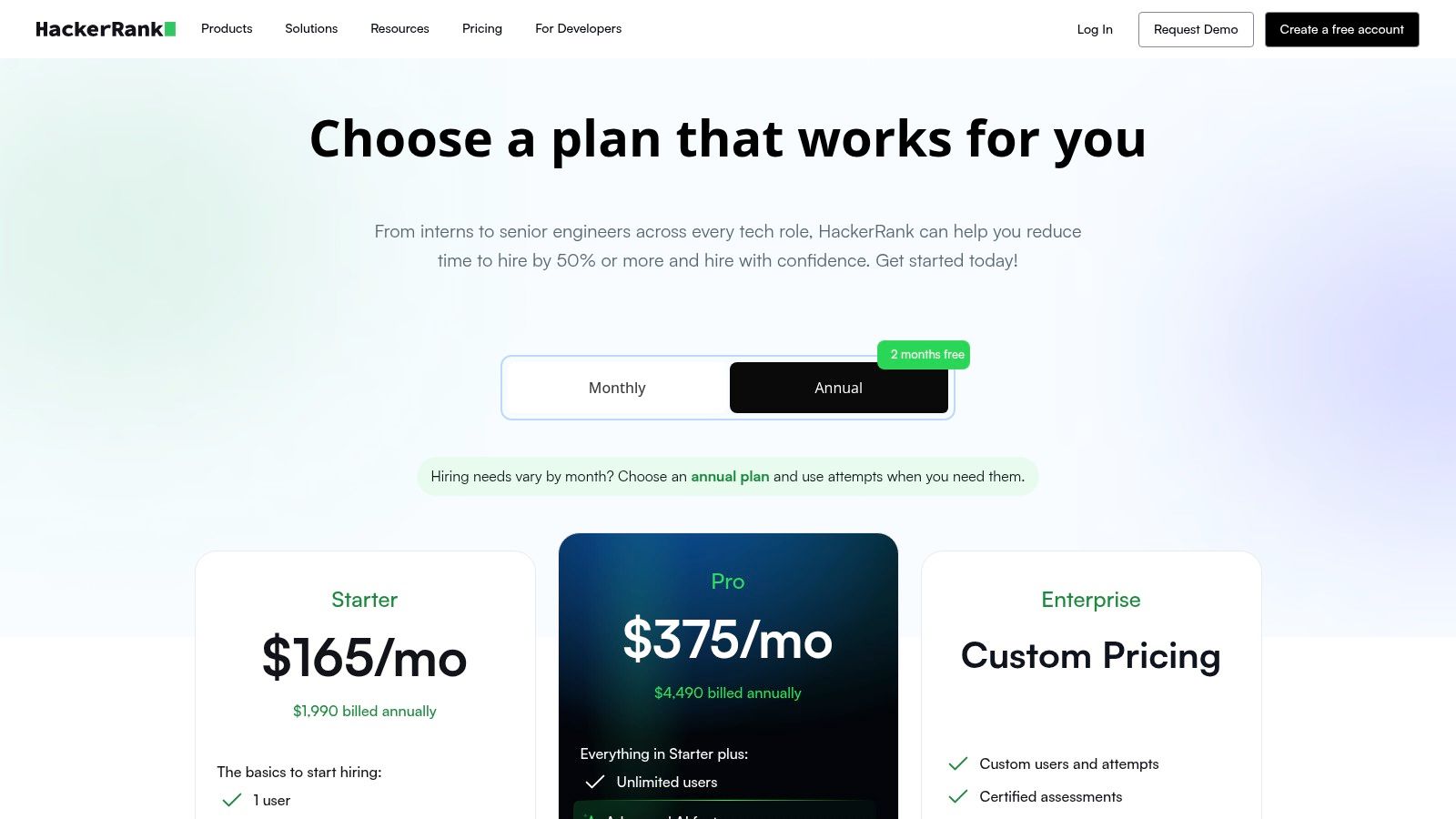
This platform’s primary value is in creating a consistent, skill-based filter at the top of the hiring funnel, helping engineering managers quickly identify qualified candidates from large applicant pools. Its AI-enabled proctoring and identity verification features also add a layer of integrity to remote assessments. For a deeper understanding of how platforms like HackerRank for Work fit into the broader landscape of talent assessment tools, it’s useful to compare their approach to others.
Platform focus and ideal use cases
HackerRank for Work is laser-focused on assessing core computer science fundamentals and coding proficiency. Its tools are ideal for:
High-Volume Technical Screening: Efficiently processing thousands of applicants for software engineering roles using standardized coding tests.
Standardized Live Interviews: Conducting remote technical interviews within a collaborative IDE, ensuring a consistent experience for all candidates.
Role-Specific Skills Validation: Using a vast library of questions to build custom tests for specific roles like front-end, back-end, DevOps, and data science.
The platform is especially powerful for organizations looking to establish a scalable and repeatable technical hiring process from the ground up.
Key differentiators and limitations
Pros:
Mature Platform: A well-established tool with a large question bank, strong brand recognition, and a user-friendly interface.
Transparent Pricing: Offers clear plan tiers (Starter, Pro, Enterprise), making it accessible for teams of different sizes.
Strong Integrations: Provides seamless integrations with major Applicant Tracking Systems (ATS) and scheduling tools.
Cons:
Engineering Focus Only: The platform is purpose-built for technical roles and is not suitable for assessing non-technical skills.
Attempt-Based Quotas: Lower-tier plans have limits on the number of assessment attempts, which can be restrictive for high-volume hiring without upgrading.
11. iMocha
iMocha positions itself as a comprehensive skills assessment platform, offering a massive library of tests that go far beyond just technical roles. With over 10,000 skill tests covering tech, digital skills, business English, cognitive abilities, and soft skills, it aims to be a one-stop-shop for organizations looking to standardize their evaluation process across various departments. The platform combines these assessments with live interview tools, creating a unified workflow from initial screening to later-stage evaluation.
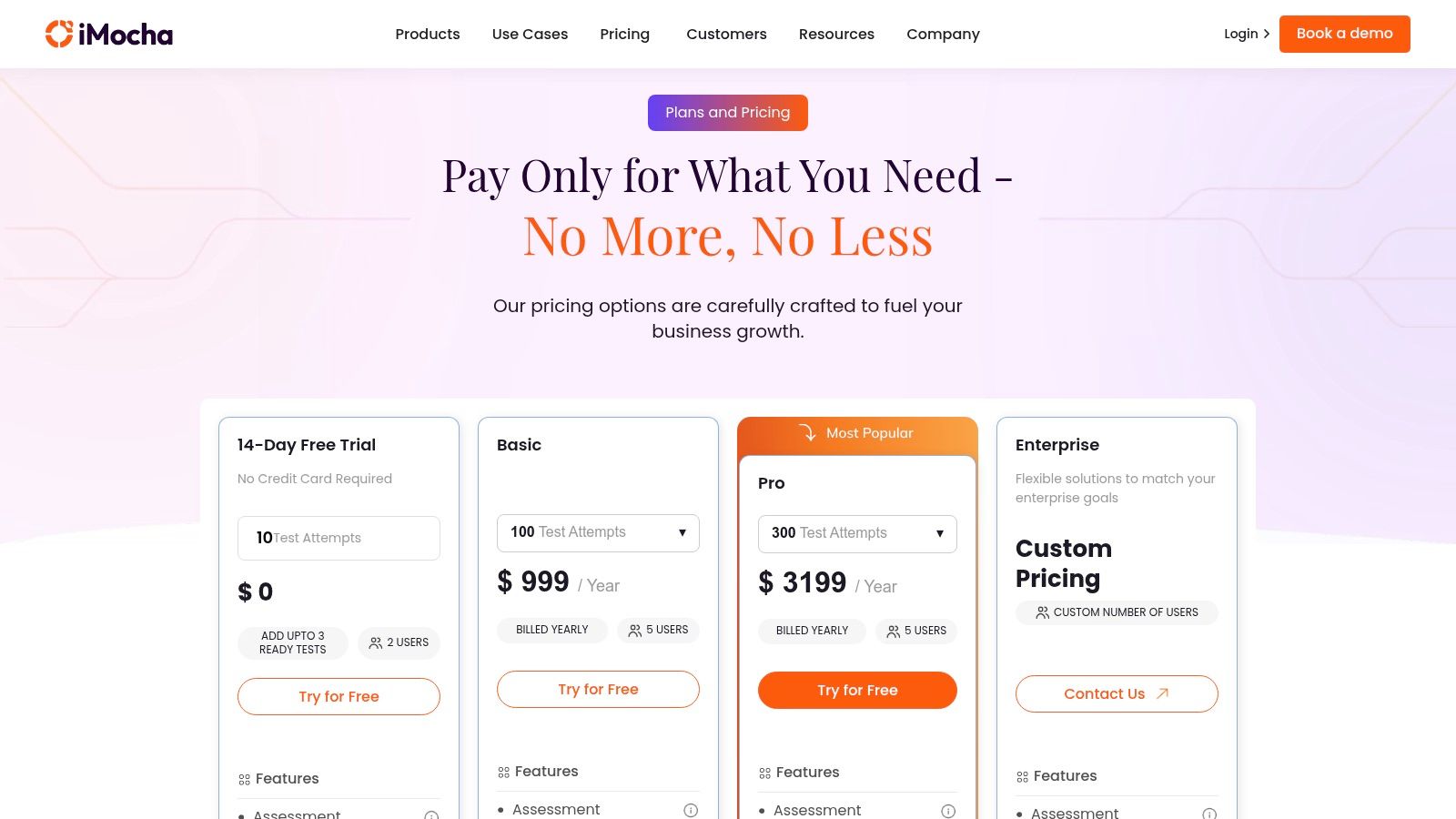
The platform is designed to be accessible, offering self-serve options and public pricing for smaller businesses, which is a notable departure from the enterprise-only model of many legacy talent assessment tools. This makes it a practical choice for teams that need a broad testing solution without committing to a lengthy sales process. For those evaluating a wide range of technical skills, you can see examples of specific test structures, such as this breakdown of a Python beginner assessment.
Platform focus and ideal use cases
iMocha’s core value is its vast library and combined assessment-plus-interview functionality. It is particularly well-suited for:
Diverse Role Screening: Companies hiring for a mix of technical and non-technical roles can use a single platform to assess everything from Java developers to marketing specialists.
End-to-End Remote Hiring: Teams can screen candidates with skills tests, then conduct live coding interviews, whiteboard sessions, and AI-proctored video interviews all within iMocha.
Standardized Global Assessments: Leveraging its extensive library to create consistent, role-based tests that can be deployed across different teams and locations.
Key differentiators and limitations
Pros:
Extensive Skills Library: A massive collection of over 10,000 skills tests provides unparalleled breadth for diverse hiring needs.
Transparent Pricing: Offers public pricing for SMB tiers and a 14-day free trial, making it easy to get started and evaluate.
Integrated Interview Tools: Combines asynchronous assessments and live interview features (coding, whiteboarding) in one platform.
Cons:
Gated Advanced Features: Deeper ATS integrations and more advanced features are often reserved for higher-priced, custom enterprise plans.
Credit-Based System: The use of credits or attempt limits on lower-tier plans can be restrictive for high-volume hiring surges.
Breadth Over Depth: While the library is vast, some highly specialized engineering teams may find the technical watch-them-work tasks less immersive than platforms focused solely on real-world coding environments.
12. Capterra — pre‑employment testing software category
Rather than being a single talent assessment tool, Capterra serves as a comprehensive discovery directory. It lists a wide range of pre-employment and talent assessment software, complete with user ratings, detailed feature filters, and vendor pages. For engineering leaders at the start of their research phase, it’s an invaluable resource for creating a shortlist of potential vendors based on crowd-sourced reviews and direct comparisons.
Capterra excels at aggregating information, saving leaders significant time during the initial discovery and shortlisting process. In addition to researching specific tools, you can explore the broader category of pre-employment assessment tools to understand market trends and options. The platform provides a bird’s-eye view of the landscape, allowing you to filter by features, business size, and user ratings to quickly identify solutions that align with your team’s specific needs.
Platform focus and ideal use cases
Capterra’s core function is as a B2B software marketplace. It is not an assessment provider itself but a starting point for your research. It is ideal for:
Initial Market Research: Quickly getting a sense of the available talent assessment tools, their features, and general user sentiment.
Vendor Shortlisting: Using filters to narrow down a large pool of vendors to a manageable number for further evaluation and demos.
Social Proof and Validation: Reading verified user reviews to understand the real-world pros and cons of different platforms before committing time to a sales call.
Key differentiators and limitations
Pros:
Time-Saving Discovery: Aggregates dozens of vendors in one place, making it easy to compare features and read reviews side-by-side.
Social Proof: Verified user reviews offer valuable, unbiased insights into a platform’s strengths and weaknesses.
Broad Coverage: Lists a wide variety of tools, from enterprise psychometric suites to niche technical assessment platforms.
Cons:
Sponsored Placements: Vendor rankings can be influenced by paid placements, so it’s not always a purely merit-based list.
Not a Direct Seller: You cannot purchase or trial software directly; you must click through to the vendor’s official website.
Surface-Level Data: While great for initial research, deep technical details often require a direct visit to the vendor’s site or a product demo.
How to pick the right talent assessment tool for your requirement: a simple checklist
Follow this decision-making checklist to choose the best tool for your engineering team.
[ ] Define the Core Problem: Are you trying to screen out unqualified candidates, or identify top performers? Is your goal to test for specific technical skills (e.g., debugging a SQL query) or broader traits (e.g., problem-solving)? Your primary goal dictates the type of tool you need.
[ ] Prioritize Real-World Watch-them-work task: Does the tool assess candidates with tasks they will actually perform on the job? Abstract coding challenges often fail to predict performance. Look for platforms that let you see how a candidate works, not just what they know.
[ ] Evaluate the Candidate Experience: Is the assessment process straightforward and respectful of the candidate’s time? A poor experience can deter top talent. Short, relevant, and engaging assessments perform best.
[ ] Check for Bias and Fairness: Does the platform provide objective, evidence-based results? Ensure the tool minimizes human bias by focusing on demonstrated skills rather than resumes or backgrounds.
[ ] Consider Integration and Workflow: How easily does the tool fit into your existing hiring process? Check for integrations with your Applicant Tracking System (ATS) and assess how much time it will save your engineering managers.
[ ] Analyze the ROI: Will the tool save engineering hours, reduce time-to-hire, and improve the quality of your hires? The best tools provide a clear return on investment by streamlining the top of your hiring funnel and increasing hiring accuracy.
[ ] Request a Demo with a Real Role: Don’t just watch a generic sales demo. Ask to run a trial for a real, open position on your team. This is the best way to see if the tool delivers on its promises and meets your specific needs.
Top 12 talent assessment tools comparison
Vendor | Assessment approach | Output / evidence | Best for / target audience | Key strength / USP | Pricing / access |
|---|---|---|---|---|---|
Utkrusht.Ai | Short (~20–30m) live watch-them-work tasks mirroring real engineering tasks | Recorded proof-of-work sessions, ranked shortlist (~48h), cheat-detection | CTOs, VPs Eng, Eng Managers, Technical Leads hiring engineers | Observe how candidates actually work (debug, refactor, tradeoffs); fast, evidence-based shortlists | Demo/trial roles; tailored pricing (contact sales) |
SHL | Broad validated tests + interactive watch-them-work tasks | Standardized scores with global norms | Large enterprises, cross-role hiring | Deep science base, enterprise integrations (80+ ATS) | Contact sales; enterprise pricing |
Criteria (HireSelect) | Aptitude, personality, EI, skills + structured interviews | Real-time reports, branded candidate experience | SMB → Enterprise needing predictable subscriptions | Subscription tiers with uncapped usage within plan | Tiered subscription; quote required |
Wonderlic | Cognitive, personality, motivation composites | Position-specific composite scores, immediate results | US-focused employers evaluating cognitive fit | Long-standing validity in US markets | Employer subscriptions; contact sales |
The Predictive Index (PI) | Behavioral + cognitive assessments + talent optimization tools | Behavioral/cognitive profiles and team-design outputs | Mid-market firms; people ops + hiring managers | Hire-to-develop lifecycle tools; strong enablement | Public plan starters; add-ons may cost extra |
Talogy True Talent | Marketplace of 500+ tests from many publishers | Test manuals, price ranges, language options per test | Buyers comparing multiple publishers / SMEs | Aggregate many publishers in one catalog with e‑commerce | Price ranges visible; some items require quotes |
Hogan Assessments | Personality inventories (HPI, HDS, MVPI) | Leadership and development reports | Leadership development, OD teams | Deep leadership research; widely recognized | Practitioner certification often required; report pricing varies |
Mercer | Mettl | Role tests, coding, proctoring, exam delivery | High-volume hiring (campus, global assessments) | End-to-end exam delivery with AI proctoring | Contact sales; enterprise quoting |
TestGorilla | Large library (350+ tests), credit-based model | Auto-scoring, role packs, candidate reports | SMBs, startups needing clear self-serve pricing | Transparent pricing, instant signup, credit model | Public pricing; Free tier and paid plans |
HackerRank for Work | Coding question bank + real projects + live IDE | Code submissions, live interview session recordings | Tech companies hiring developers at scale | Mature coding platform, collaborative IDE, transparent tiers | Tiered plans (Starter/Pro/Enterprise); public pricing |
iMocha | 10,000+ skill tests, live coding, AI interviews | Extensive skill reports, proctoring, ID verification | Broad hiring across tech and non-tech roles | Massive skill library and integrations | Public SMB pricing; higher-tier limits apply |
Capterra (directory) | Vendor comparison & reviews, buyer guides | Crowd-sourced ratings and side-by-side comparisons | Recruiters/buyers researching assessment vendors | Quick discovery and social proof for shortlisting | Free to use; redirects to vendor pages |
FAQ on talent assessment tools
1. What is the most significant flaw in traditional technical assessments like HackerRank?
The main flaw is that they often test for abstract, algorithm-heavy problem-solving that doesn’t reflect the day-to-day work of a software engineer. A candidate might be great at solving complex algorithmic puzzles but struggle with practical tasks like debugging a legacy codebase, refactoring for maintainability, or fixing a broken CI/CD pipeline. These tools test for knowledge, whereas modern tools test for the application of that knowledge in a realistic setting.
2. How do watch-them-work task tools prevent cheating compared to online coding tests?
Watch-them-work task tools like Utkrusht.Ai prevent cheating by creating a controlled, recorded environment that mimics a real work desktop. They monitor a candidate’s entire process—how they use the terminal, what files they access, and their problem-solving sequence—not just the final code output. This “proof-of-work” video makes it nearly impossible to pass off copied code as one’s own, a common issue with platforms that only evaluate the final answer.
3. Why should a CTO care about behavioral assessments if they’re hiring for technical skills?
While technical skills are crucial, they are only part of the equation. Behavioral assessments, like those from Hogan or The Predictive Index, provide insight into a candidate’s soft skills, work style, and potential for leadership. A brilliant engineer who cannot collaborate, communicate effectively, or handle pressure can be detrimental to a team. For a CTO building a cohesive and high-performing organization, understanding these behavioral dynamics is critical for long-term success.
4. Can a small startup with a limited budget effectively use talent assessment tools?
Absolutely. Many modern talent assessment tools, including Utkrusht.Ai and TestGorilla, are designed with startups and small businesses in mind. Utkrusht.Ai is budget-friendly and offers a high ROI by saving significant engineering hours in the screening process. The key is to choose a tool that solves your most immediate problem—accurately identifying skilled candidates—without the enterprise-level cost and complexity.
5. How do you measure the ROI of implementing a talent assessment tool?
Measure ROI by tracking key metrics before and after implementation. Key indicators include:
Time-to-Hire: A good tool should significantly reduce the time it takes to fill a role.
Engineering Hours Saved: Calculate the time your engineers spend on screening resumes and conducting initial technical interviews. A platform that provides a reliable shortlist saves dozens of hours per hire.
Quality of Hire: Track the performance of new hires within their first 6-12 months. An effective tool should lead to better-performing employees who ramp up faster.
Offer Acceptance Rate: A positive and engaging assessment experience can improve your employer brand and increase the likelihood that top candidates accept your offer.
Final thoughts
Navigating the crowded market of talent assessment tools can feel overwhelming. We’ve explored a wide spectrum of platforms, from behavioral giants like Hogan to skills-focused powerhouses like HackerRank. Each tool offers a unique lens through which to view candidate potential, but the core challenge for engineering leaders remains the same: how to move beyond theoretical knowledge and accurately predict on-the-job performance.
The key takeaway is that the “best” tool is entirely contextual. It hinges on your specific hiring needs, the roles you’re filling, your team’s size, and your budget. A large enterprise might prioritize psychometric depth, while a fast-moving startup needs a tool that directly mirrors the hands-on coding challenges their engineers face daily. The most significant shift in technical hiring is the move away from abstract problem-solving and toward practical, job-watch-them-work task-based assessments.
Your path forward: from information to implementation
As you move from reading this guide to making a decision, remember the evaluation checklist we discussed. Your goal is not just to buy software; it is to fundamentally improve your hiring accuracy, reduce bias, and enhance the candidate experience. This requires a strategic approach.
Start by clearly defining what a “great hire” looks like for a specific role on your team. Is it raw coding speed, debugging finesse, or the ability to make sound architectural trade-offs? Once you have that profile, you can map it directly to the features of the talent assessment tools we’ve covered. A platform that excels at assessing personality traits might not be the right fit if your primary need is to validate a senior developer’s ability to refactor legacy code.
Finally, consider the implementation process and its impact on your team. The right tool should not add friction to your hiring workflow. Instead, it should integrate seamlessly, providing your hiring managers with clear, actionable insights that save them time and lead to more confident decisions. The ultimate objective is to build a high-performing engineering team, and the right assessment platform is a critical piece of that puzzle.
Frequently Asked Questions
What is the most significant flaw in traditional technical assessments like HackerRank?
How do watch-them-work task tools prevent cheating compared to online coding tests?
Why should a CTO care about behavioral assessments if they're hiring for technical skills?
Can a small startup with a limited budget effectively use talent assessment tools?
How do you measure the ROI of implementing a talent assessment tool?
Stop relying on outdated hiring methods.
Utkrusht gives CTOs a clear, data-backed view of talent through realistic assessments built for modern teams. Get started now and transform your hiring pipeline.

Want to hire
the best talent
with proof
of skill?
Shortlist candidates with
strong proof of skill
in just 48 hours


