
Contents
Key Takeaways
TL;DR
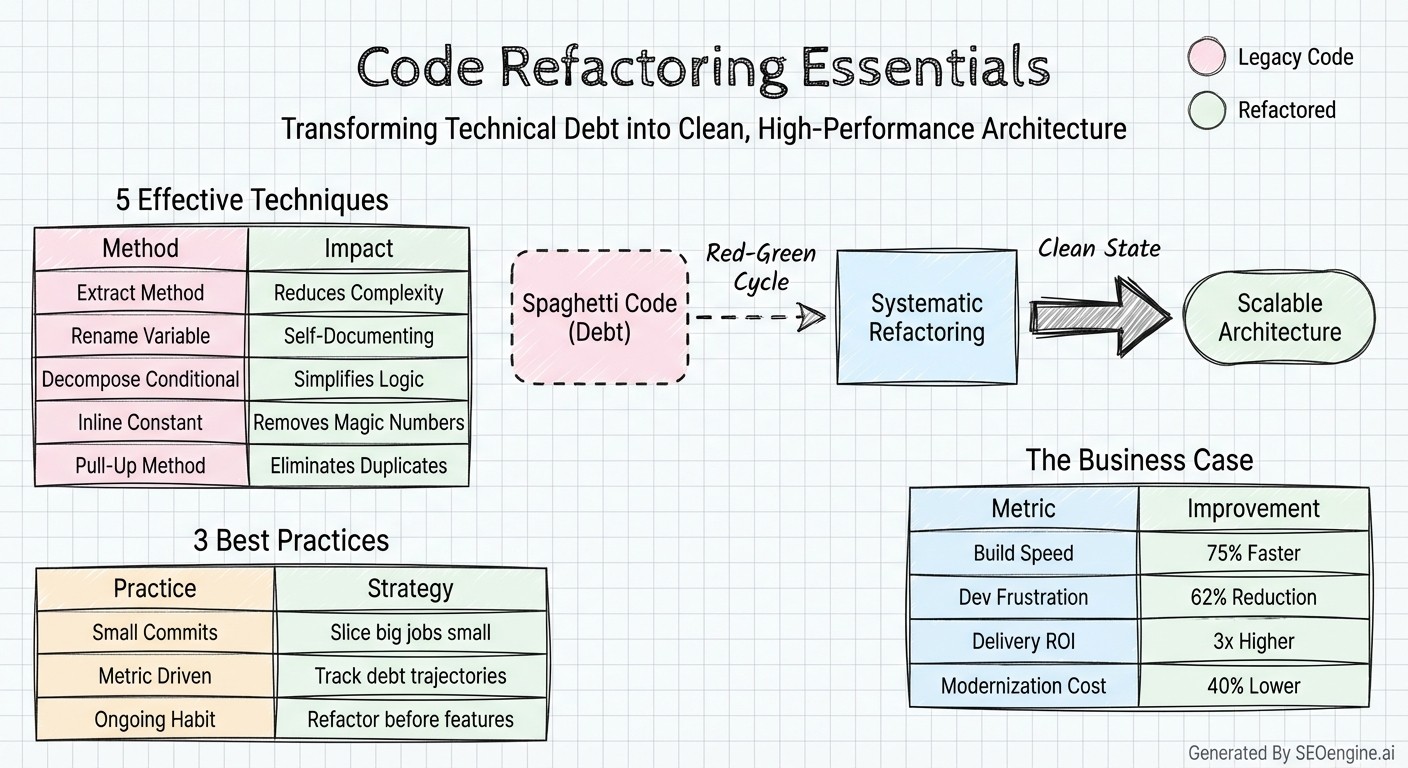
According to Stack Overflow's Developer Survey, technical debt frustrates 62% of developers more than any other challenge, manifesting as duplicated logic, rigid architectures, and tangled dependencies.
Poor code quality directly slows down delivery, inflates costs, and scares off great engineers. This is also the gap that platforms like Utkrusht AI are built to expose - by placing candidates in real codebases and measuring who can actually navigate that complexity on day one.
This guide breaks down 5 proven code refactoring techniques and 3 best practices your team can start using today.
Key Takeaways:
Start with preparatory refactoring before any major feature release to reduce risk and accelerate delivery.
Always maintain test coverage before and during refactoring to catch regressions early.
Measure build times, deployment frequency, and MTTR before and after every refactoring cycle.
Use tools like SonarQube and ESLint to surface code smells continuously inside your CI/CD pipeline.
Hire developers who can demonstrate real refactoring ability - not just algorithmic test performance.
What is code refactoring and why should you care?
Refactoring is the practice of restructuring existing code without changing its external behavior. It is essential for maintaining a clean, readable, and maintainable codebase.
Think of it like renovating an office. You’re not moving the building. You’re rearranging the layout so it works better for everyone inside.
Code refactoring helps address technical debt - any shortcut or workaround in code that creates a short-term gain but long-term issues. As with financial debt, technical debt requires investment to reduce it.
Messy codebases slow down your engineers, delay client deliveries, and make onboarding new developers painful.
What does refactoring actually change?
Code refactoring refers to the process of restructuring the source code to make it more readable and understandable, without altering its original behavior or functionality. The goal is to improve the internal code quality, reduce complexity, and prepare the system for future advancements.
The key word here is internal. Your clients won’t see a difference. Your engineers absolutely will.
5 Code refactoring techniques that actually work
McKinsey’s 2024 research demonstrates that systematic modernization approaches achieve 40-50% faster completion times and 30-40% cost reductions compared to ad hoc cleanup efforts. Here are the five techniques that deliver those results.
Technique 1: red-green-refactor (TDD-based)
This technique is an integral part of test-driven development (TDD), a software development methodology that emphasizes writing tests before writing the actual code.
The Red-Green-Refactor method consists of three steps: Red - consider what you are developing and write a failing test for it. Green - write implementation code to pass the test. Refactor - search for ways to optimize and improve the code.
This technique is great for teams who want to refactor with confidence because every change is backed by a test.
Technique 2: refactoring by abstraction
Large-scale code duplication and redundancy are often addressed through the refactoring by abstraction technique. This technique is used when multiple classes or modules share similar logic or structure. Instead of repeating code everywhere, you extract the common behavior into an abstract class, superclass, or shared function that others can inherit from.
A popular online payment platform reported improving its system efficiency by 25% using abstraction refactoring, enhancing its customer experience significantly.
Technique 3: composing methods
The Compose method is a type of refactoring that simplifies the work of developers by removing unnecessary code duplication. These include the extraction and inline methods: Extraction breaks down the code into smaller chunks to find and extract fragments. It then moves the fragments to a new method and calls it. The fragments are then moved to a new method and replaced with new content.
Inline method refactoring was employed in developing the Django web framework, simplifying complex codes, making them more readable, and reducing development time by up to 25%.
Technique 4: simplifying methods
This refactoring technique aims to make methods more understandable and maintainable by reducing their complexity. It involves various approaches that simplify the code, such as reducing the number of method parameters, replacing complex conditional logic with simpler constructs, or breaking down long methods into smaller, focused methods.
Netflix’s engineering team, for instance, used method simplification techniques in their API development to make their codebase more manageable and less error-prone, significantly reducing client-side errors.
This is often the first technique worth applying when inheriting legacy code from another vendor.
Technique 5: preparatory refactoring
Preparatory refactoring happens before introducing new features. The goal is to make the existing structure cleaner and more adaptable so that upcoming changes fit smoothly.
When MailChimp was preparing to introduce a significant feature update, it undertook a two-week refactoring sprint using the preparatory refactoring technique. As a result, it successfully launched the feature without any essential issues, increasing its active user base by 18%.
Comparing the 5 techniques: which one fits your team?
Here’s a quick breakdown to help you match the right technique to the right situation.
Technique | Best For | Skill Level Required | Risk of Regression |
|---|---|---|---|
Red-Green-Refactor | TDD-driven teams, new features | Intermediate | Low |
Refactoring by Abstraction | Codebases with heavy duplication | Advanced | Medium |
Composing Methods | Long, complex methods | Beginner-Intermediate | Low |
Simplifying Methods | Legacy or vendor-inherited code | Beginner | Very Low |
Preparatory Refactoring | Pre-feature sprint preparation | Intermediate | Low |
Use this table during sprint planning to align technique selection with your team’s current sprint goals.
3 Code refactoring best practices that protect your codebase
Techniques tell you how to refactor. Best practices tell you how not to break things while doing it.
Best practice 1: refactor in small, atomic steps
Version control discipline: Ensure atomic commits with precise descriptions and rollback capabilities. Never refactor multiple patterns simultaneously, as this complicates debugging when issues arise.
When your team tackles refactoring as a series of small, independent commits, it becomes far easier to pinpoint what broke and when. One change per commit is not a suggestion - it’s a rule.
Best practice 2: always maintain test coverage
Make sure to have proper test coverage and version control in place before starting the refactoring process.
Refactored code should not change anything; the software should exhibit the same behaviors and pass the same tests. If behavior changes, code refactoring work is often the culprit.
IDEs like IntelliJ IDEA, VS Code, and Eclipse automate common refactoring tasks such as renaming, extracting methods, or interfaces. These tools handle mechanical details and reduce errors.
Best practice 3: measure before and after
Measurement baselines: Establish performance benchmarks for build times, deployment frequency, and application response times. These metrics validate that refactoring delivers actual improvements rather than just cleaner code.
Without baselines, you can’t prove ROI to your clients or justify refactoring sprints to your board. Track metrics like cyclomatic complexity, deployment frequency, and mean time to recovery (MTTR) before and after every major refactoring cycle.
Refactoring approaches: A head-to-head comparison
Approach | Code Quality Impact | Time Investment | Business ROI |
|---|---|---|---|
Ad hoc cleanup | [X] Low | [CHECK] Low | [X] Unpredictable |
Systematic refactoring | [CHECK] High | Medium | [CHECK] 3x ROI (BCG) |
Full rewrite | Medium-High | [X] Very High | [X] High risk |
Organizations with high maturity in systematic approaches achieve 3x the ROI of those with ad hoc improvement efforts, according to BCG’s 2024 research.
The message is clear: systematic refactoring beats random cleanup every time.
How companies identify refactoring-ready engineers
This is where a lot of software firms make an expensive mistake. They hire developers based on algorithmic puzzle scores, then discover those candidates can’t handle a real legacy codebase on day one.
Platforms like Utkrusht AI solve this directly.
Unlike competitors such as HackerRank or CodeSignal that focus on algorithmic challenges, Utkrusht places candidates in live sandbox environments where they debug failing APIs, optimize slow database queries, and refactor production code under real conditions.
Companies using Utkrusht report approximately 70% reduction in time-to-hire and can identify top refactoring talent within 48 hours from large applicant pools.
If new developers onboard smoothly and quickly understand the codebase, it’s a clear sign that your refactoring techniques are successful.
That also means the engineers you hire should be tested on their ability to understand and improve existing codebases - not just write new code from scratch.
Refactoring maturity level comparison
Maturity Level | Practices Used | Outcome |
|---|---|---|
Level 1 - Reactive | [X] No tests, manual cleanup | [X] Frequent regressions |
Level 2 - Planned | [CHECK] TDD, version control | [CHECK] Stable delivery |
Level 3 - Systematic | [CHECK] All 5 techniques + metrics | [CHECK] 3x ROI, faster releases |
Frequently asked questions
What is the difference between refactoring and rewriting code?
Refactoring improves the internal structure of existing code without changing its external behavior. Rewriting replaces the code entirely with a new implementation. Refactoring is lower-risk and incremental. Rewriting is higher-risk, takes longer, and is only justified when the existing architecture is beyond repair.
When should a software company prioritize code refactoring?
You should consider software refactoring when you notice low readability and maintainability: if the code is difficult to understand or modify due to poor organization, inconsistent naming conventions, or lack of comments, refactoring can help improve its clarity and ease of maintenance. Also prioritize it before major feature releases or when onboarding a new engineering team.
How do we convince clients to budget for refactoring sprints?
Frame it in terms of delivery speed and reduced bug rates. McKinsey’s 2024 research demonstrates that systematic modernization approaches achieve 40-50% faster completion times and 30-40% cost reductions compared to ad hoc cleanup efforts. Use these numbers to build your business case. Clients respond to time and cost savings, not code cleanliness.
How do we know if our developers are actually skilled at refactoring?
This is a challenge most founders underestimate. Traditional coding interviews and algorithmic tests rarely surface real refactoring ability. Look for developers who can explain architectural trade-offs, identify code smells in existing systems, and demonstrate comfort working in unfamiliar codebases.
Utkrusht AI addresses this gap directly - by testing candidates on production-like refactoring scenarios inside live sandbox environments, it surfaces proof-of-skill evidence that theoretical tests simply can’t provide.
What tools support code refactoring in a professional environment?
Static analysis and linters: Tools like SonarQube, ESLint, and PMD examine source code to find code smells, complexity issues, and enforce best practices. Integrated into development workflows, they continuously promote code quality and often suggest or automate fixes. Pair these with IDE refactoring support in IntelliJ IDEA or VS Code for the best results.
How does refactoring fit into a CI/CD pipeline?
DevOps practices are enabling continuous refactoring, where code improvements happen automatically as part of the CI/CD pipeline. You can integrate static analysis tools into your pipeline to flag code smells on every pull request, making refactoring a continuous discipline rather than a one-time sprint.
What are the biggest risks of refactoring legacy code?
The main risks are introducing regressions, losing undocumented business logic, and creating merge conflicts in large teams. Establish communication channels for ongoing refactoring work to prevent merge conflicts and ensure architectural decisions align across team members. Always document business rules before touching legacy systems, and refactor incrementally rather than all at once.
Conclusion
Every custom software development company eventually faces the same crossroads: keep shipping on top of shaky foundations, or invest the time to clean things up properly. The data makes the case clearly - systematic code refactoring cuts costs, speeds up delivery, and produces codebases that your engineers actually want to work in.
The five techniques covered here - Red-Green-Refactor, Abstraction, Composing Methods, Simplifying Methods, and Preparatory Refactoring - give your team a practical toolkit. The three best practices - atomic commits, test coverage, and measurement baselines - protect you from the most common pitfalls.
As Utkrusht AI demonstrates through its real-world watch-them-work tasks, the gap between theoretical knowledge and practical capability is wide - and it shows up most clearly when developers face actual legacy codebases, failing APIs, and production-level complexity.
The engineers who thrive are those who have developed genuine refactoring instincts, not just algorithmic test scores.
Start by auditing one module in your most frequently touched service this sprint. Pick one technique from the list above, apply it with proper test coverage, and measure the delta. Small wins compound fast.

Founder, Utkrusht AI
Ex. Euler Motors, Oracle, Microsoft. 12+ years as Engineering Leader, 500+ interviews taken across US, Europe, and India
Want to hire
the best talent
with proof
of skill?
Shortlist candidates with
strong proof of skill
in just 48 hours


