
Tech Hiring in the Age of AI

Why Small Engineering teams and Software Dev Companies Need a Different Approach

We've been in tech long enough to watch hiring trends come and go like fashion seasons.

First, everyone was obsessed with ATS-filtering mechanisms. Then came the rise of tests, MCQ-quizzes and questions. Then all about whiteboard coding. After that came algorithm tests, and then take-home assignments.


The methods keep changing, but the goal stays the same: find tech people who can actually ship quality code and build things that work.

Here's the thing—there's always been a gap between what we test for in interviews and what people actually do on the job.


Right now? That gap is bigger than ever.

AI tools, ChatGPT, Claude, etc. have completely changed how we work, but most companies are still interviewing like it's 2019. It's like preparing for a horse race when everyone else has moved on to cars.


And if you're running a small engineering team or a software development shop? This problem is 10x worse.


The 4S Problem for Small Engineering Teams and Software Development Companies


Let’s paint a picture. You're running a 30-person dev shop or leading a small engineering team.

You post a job opening for a senior developer. Within 3 days, you have 200+ applications. You now have 0 idea to assess who is good, weak, bad, etc. from this pile!


These are some of the subtle, nuanced, and extreme pain points we repeatedly heard from small engineering teams. The problem isn't getting/sourcing candidates. It's how we accurately assess to find the best 5 ones from the pool .


Why Traditional Hiring Methods are (still) Failing


We're in age of AI, yet tech hiring has the same set of problems. We've engineering background ourselves, taken 500+ tech interviews globally. The pattern is the consistently same across small engineering teams.

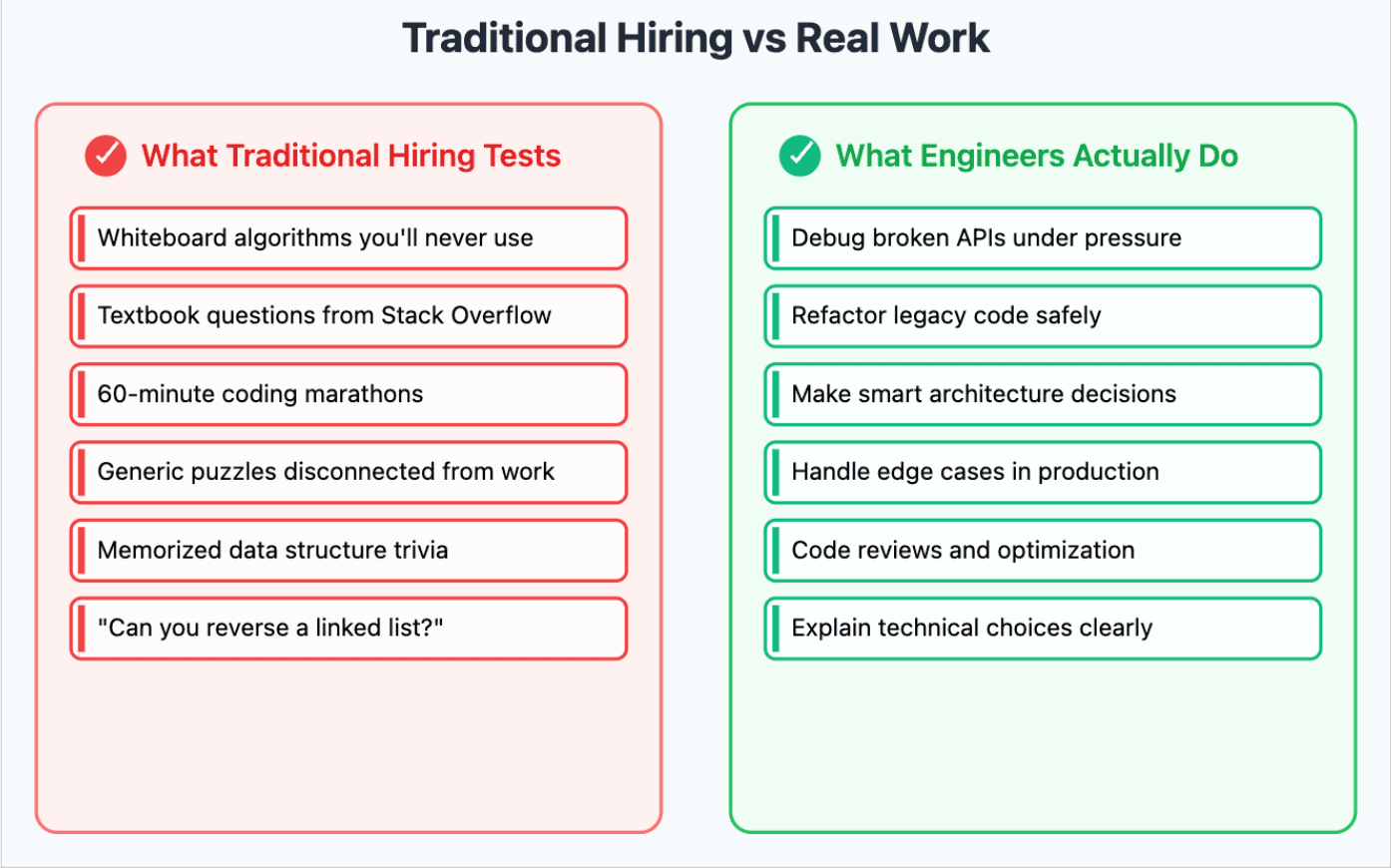
The main reason is — companies still test candidates on completely wrong parameters. We even surveyed 100+ engineering teams and found the same pattern everywhere: the hiring methods and process today tests everything in a candidate, except the job itself.
What Actually Matters Now


The signals we should be looking for have changed. Here's what really matters when AI is everywhere.

Strong Fundamentals

Real fundamentals are the building blocks that work regardless of which framework is trendy this month. Think of it like knowing how to cook versus just following recipes:

Recipe followers can make one dish perfectly—as long as they have the exact ingredients and instructions. Change one thing, and they're lost.

People with fundamentals understand heat, seasoning, and technique. They can adapt any recipe, work with what's available, and still create something good.

You can't afford specialists who only know one framework. When a client says "we need to switch from React to Vue," or "can you add this feature in Python instead of JavaScript," you need people who can adapt.


What strong fundamentals actually look like:

Instead of: "I'm a React expert" (what happens when React becomes obsolete?)
You want: "I understand component architecture, state management, and browser rendering—I can work in any modern framework"


Instead of: "I've memorized 50 SQL queries"
You want: "I understand how databases work, what indexes do, and when to denormalize—I can write efficient queries in any SQL database"


Instead of: "I know Python syntax perfectly"
You want: "I understand data structures, algorithms complexity, and when to use which approach—I can pick up any language quickly"


Why fundamentals matter more in the AI era:

AI can generate code in any language or framework you want. What it can't do reliably is:

  • Know when the generated code will scale badly

  • Understand the tradeoffs between different approaches

  • Recognize when you're solving the wrong problem

  • Catch subtle bugs that look correct but aren't


That requires fundamentals.

Structured Reasoning with Good Judgment

Judgment is like having a good BS detector—you can tell when something makes sense and when it doesn't.

AI will confidently give you answers. Sometimes they're brilliant. Sometimes they're completely wrong but sound smart. The hard part? Knowing which is which.


You can't test judgment directly. If you ask someone "do you have good judgment?" everyone says yes. The only way to see it is to watch them work.


Give them a real problem. Let them use whatever tools they want. Then watch:

  • Do they just copy-paste the first AI answer they get?

  • Or do they look at it critically and think "wait, something's off here"?

  • Can they explain WHY a solution is wrong?

  • Or do they just shrug and try random things until something works?


Example: At Stripe, they noticed their best engineers weren't the ones who used AI the most—they were the ones who questioned AI outputs the most. They could spot when ChatGPT was hallucinating or when Claude missed an edge case.


Systematic Thinking

This is what separates people who use AI effectively from people who just get lucky sometimes.

You can see systematic thinking when someone takes a messy problem and leaves a clear trail of breadcrumbs:

  • They explain their plan out loud

  • They take notes you can review later

  • They mark the things they're not sure about

  • They measure results whenever possible


Companies like Anthropic and OpenAI (ironic, I know) hire specifically for this. They give candidates messy, open-ended problems and watch how they approach them. 

The Utkrusht Hiring Framework You Can Easily Apply


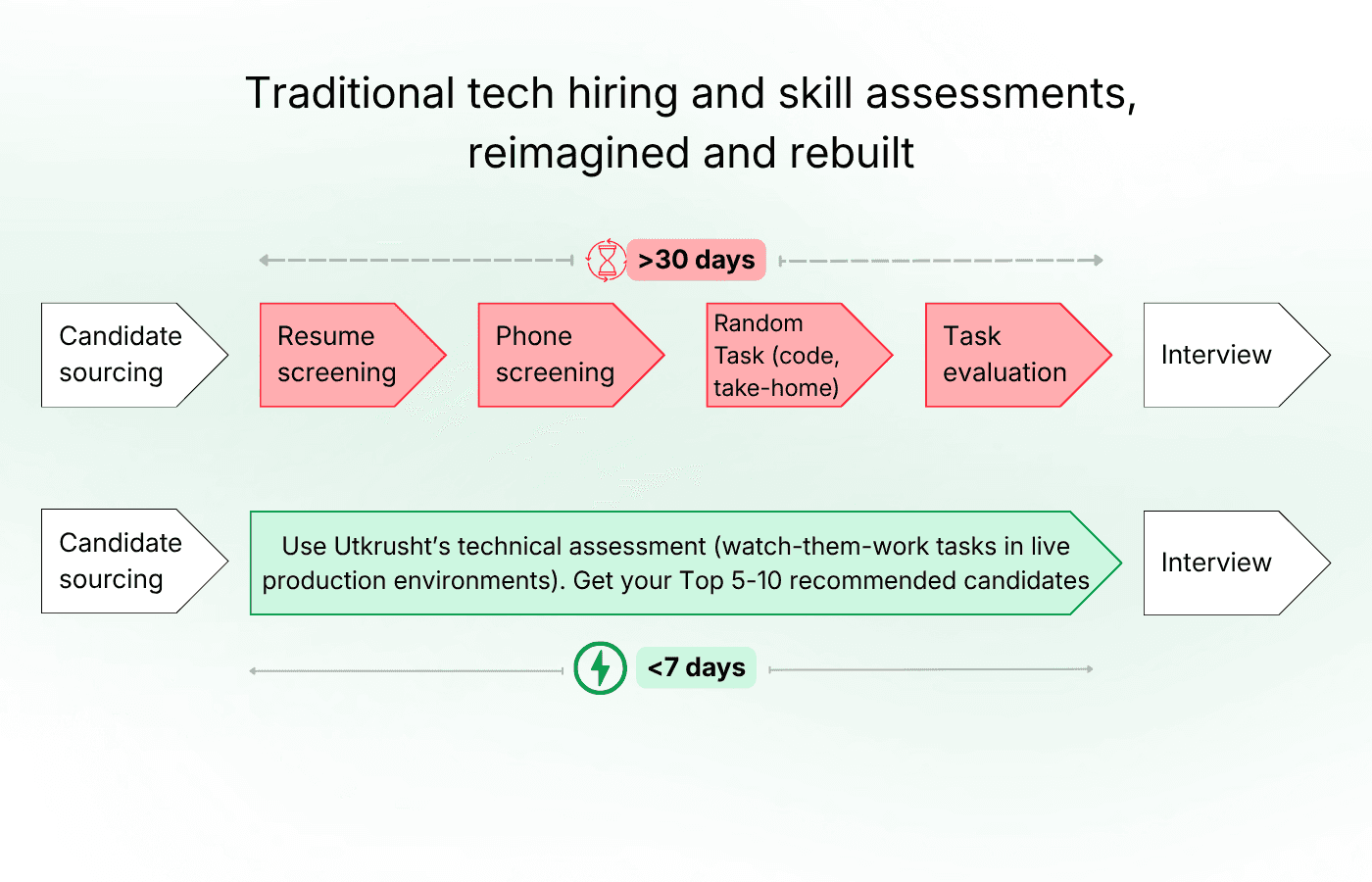
So what should tech interviews ideally look like? Here's a dead-simple process we’ve rigorously researched, thoroughly tested, and proven it works:

Round 1 (optional, if you have HR):

Initial chat with all candidates (spotting curiosity), and strictly no resume screening at this stage


Round 2: Build Something Live

All candidates take an automated Assessment to build something (fundamental skills + judgment, live in action). No complicated 2-hour coding challenges, instead simple 30minute problem-solving on-the-job tasks.

Review the work samples of all, and shortlist top 5-10 candidates based on this


Round 3 (optional): 

Take-home assignment. This is generally not needed if you implement Round 2 correctly.


Round 4: Interview only the best

Deep dive into past experience, culture-fit, role alignment, etc. with those 5-10 (systematic thinking + curiosity, learning speed), and hire your top candidate from this


If you implement this simple framework, you will see how tech hiring at your company improves dramatically -

– your time spent on interviews and hiring is cut down by ~70%

– you start seeing strong candidates in the team

– you aren’t doing guesswork hiring anymore

Each round focuses on one key trait. Together, they show you how someone thinks, works with modern tools, and learns new things.

Btw, several tech companies have all moved towards practical, tool-inclusive interviews. They're seeing better hires and less false negatives (missing good candidates because of artificial test conditions).


Our Approach: Don’t test candidates for what they already know. Instead, simulate scenarios, make them execute on-the-job tasks, and evaluate on that


After talking to engineering leaders across 100+ companies, we realized something simple but extremely powerful: the best way to hire good tech talent, is to simply watch them HOW they work in real-job situations.

Not with asking theory based or MCQ questions. With the exact problems your team solves every day. 

Applying this powerful principle, our platform puts candidates into real scenarios and codebases where, for example they:

  • Debug production issues

  • Refactor messy functions

  • Make architecture decisions

  • Explain their reasoning as they work

  • Handle edge cases under time pressure


Why Other Hiring Tools and Methods (still) get this Wrong


We looked at about 50+ other modern AI tools in this space. Think HackerRank, Leetcode, etc.

Again, credit to them they've done a reasonably good job in standardizing processes and putting things in place, but yet don't accurately evaluate technical skills of candidates.

Here's some specific reasons for it -

They test memorized theory knowledge. We simulate your job. Other platforms focus on data structures and whiteboard problems. We drop candidates into realistic scenarios: "This API is returning 500 errors. Fix it and explain your approach."

They ask static questions. We generate infinite real-world scenarios. Candidates can't memorize answers when every assessment is dynamically generated. No more gaming the system with LeetCode 500+ problems solved and practicing it.

They waste everyone's time. We respect it. 20-minute assessments with 90%+ completion rates. Your candidates don't need to block out their entire evening. Your team doesn't need to screen 200 people to find 5 good ones.

They cover common skills. We go deep and wide. 200+ skills including the rare ones you actually need: GenAI implementation, cybersecurity protocols, embedded systems. Not just "can you reverse a linked list."

They rely on human bias. We let code speak. No resume filtering. Just pure performance on tasks that matter.

They restrict. We give full liberty. We encourage candidates to use AI tools in our assessments. Wasn’t that the point of AI? Then why not allow them to use during interviews?

We believe engineering leaders deserve good quality tech candidates by accurately measuring their technical skills, rather than “guesswork” hiring


We have AI and all modern tools today, but Engineering leaders still spend atleast 30% of their time on hiring – screening, filtering, interviewing, coordinating with candidates who look perfect on paper but can't write clean code. We've lived this pain ourselves.

As engineers who've built teams at scale, we know the frustration of that "great interview, terrible first commit" moment.

We've sat through those 5-8pm interview blocks that eat up 30% of your week. We've stared at stacks of 500 resumes wondering who actually knows their stuff.

That's why we built Utkrusht — to show you exactly who can build, debug, and code before you ever meet them.

Ready to hire your next candidate with proof of skill?

Utkrusht helps you reduce the hiring time significantly by providing candidates' core skill evaluations.