Contents
Key Takeaways
TL;DR
Workplace conflict costs companies dearly - employees spend, on average, two hours per week dealing with conflict, equating to a loss of $3,216 per employee per year (USA) in productivity alone.
For CEOs and founders of custom software development companies, that number hits especially hard when your engineers could be shipping products instead. Much like how Utkrusht AI is built on the belief that the way we evaluate engineers is fundamentally broken, the way most companies handle conflict is equally flawed.
This guide breaks down five proven conflict resolution techniques to keep your dev teams aligned, productive, and building great software.
Key Takeaways:
Build structured communication frameworks - prevent conflict before it starts
Define roles clearly using RACI matrices and team agreements to eliminate ambiguity
Train your team leads in active listening and mediation for when disputes do arise
Run sprint retrospectives consistently to catch friction early and improve team dynamics
Invest in emotional intelligence training and team-building to reduce interpersonal disputes by up to 50%
Why Conflict Is So Common in Software Development Teams
Where different personalities and perspectives work toward shared goals, conflicts are certain to arise - and this can be particularly challenging for software development teams that thrive in collaboration and innovation.
As a founder or CEO of a custom software shop, you know this dynamic well. Your engineers hold strong technical opinions. Your QA leads prioritize quality over speed. Your PMs push for delivery.
Software development teams divided into units like UX, Product, and QA often complain about unclear goals, roles, and interdependencies - developers aim to ship software as fast as possible, QA engineers take time to ensure a product is bug-free, while designers prioritize usability and appealing interfaces over speed.
Left unmanaged, this friction becomes expensive. Unresolved conflicts can lead to decreased productivity, increased employee turnover, damaged team dynamics, and hindered innovation, ultimately costing organizations millions in lost revenue and talent acquisition expenses.
But there's a flip side. Workplace conflict can have positive outcomes when managed effectively. Over 50 percent of survey respondents reported that conflict can lead to improved working relationships, better understanding of others, and even more creative solutions to problems.
The goal, then, is not to eliminate conflict but to manage it well. Here are five conflict resolution techniques in software development teams that work.
Technique 1: Build a Clear Communication Framework
Why does poor communication trigger so many dev team conflicts?
A study by the Project Management Institute revealed that 67% of projects fail due to poor communication. Creating an environment where developers can express concerns without fear of repercussions can potentially reduce tension significantly.
When your engineering team lacks structured channels for feedback, misunderstandings build silently until they explode during a sprint review or code deployment.
The most effective technology leaders establish strong communication frameworks that prevent conflicts before they emerge. This involves creating structured channels for technical discussions, implementing regular check-ins for project alignment, and establishing clear protocols for escalating concerns.
Practical steps to apply this technique:
Hold daily stand-ups that give every engineer a structured voice
Set up async documentation in tools like Confluence or Notion so decisions are recorded and visible
Create a clear escalation path so disagreements about technical choices don't fester
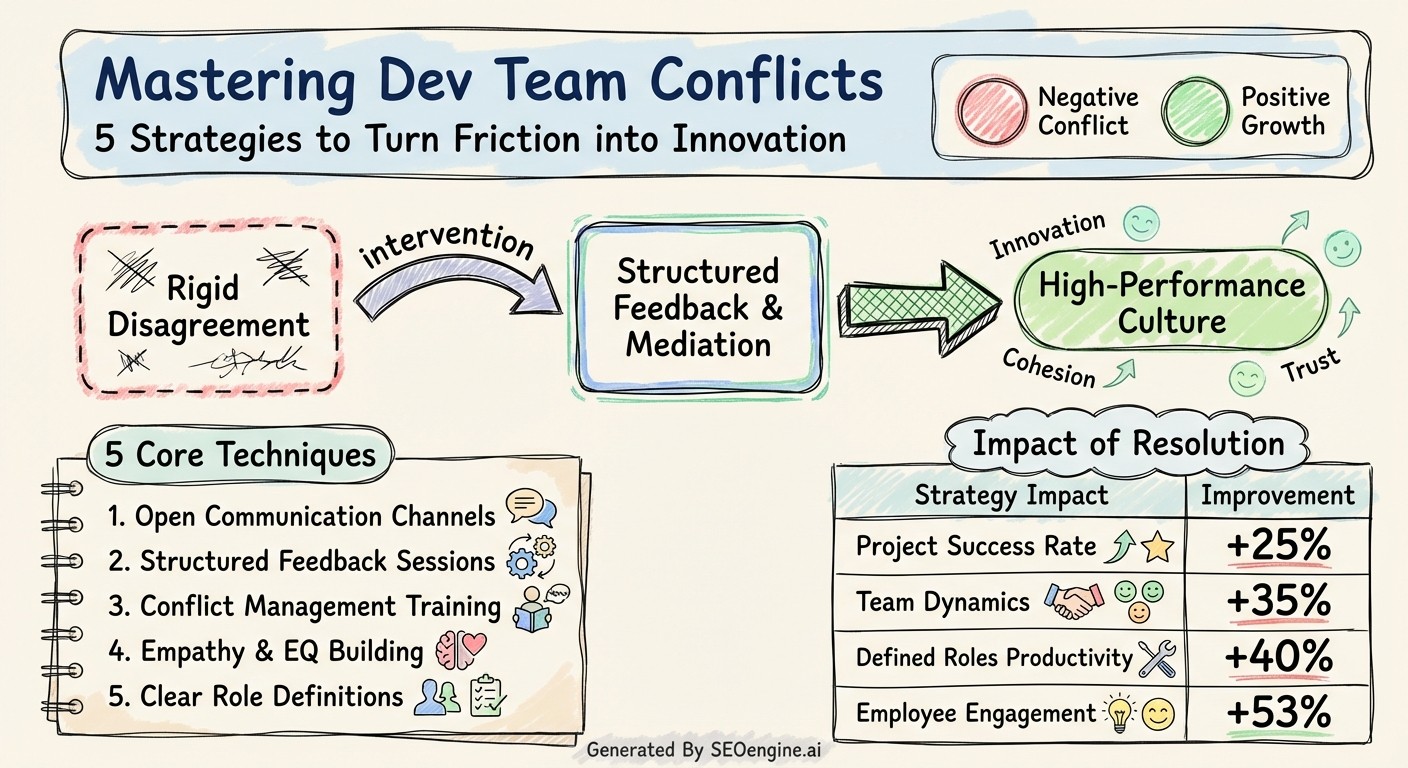
Establishing a culture of open communication within the team matters here. Research indicates that teams with transparent communication channels achieve a 25% increase in project success rates, and regular check-ins can facilitate these discussions, allowing team members to share their thoughts and concerns without hesitation.
How does structured feedback reduce disputes?
Implementing structured feedback sessions makes a measurable difference. A study by Google revealed that teams that engage in structured feedback saw a 35% improvement in team dynamics and collaboration.
Scheduled reviews should focus on both technical progress and interpersonal relationships, ensuring all voices are heard and valued.
Tools like Utkrusht AI, which evaluates how engineers actually work in real job scenarios, reinforce this principle - clarity about expectations reduces friction from the very moment a developer joins your team.
Technique 2: Define Roles and Responsibilities Clearly
Why does role ambiguity cause so many team conflicts?
When roles and responsibilities are not clearly defined at the start of a project, confusion and frustration often follow. Team members may find themselves working on overlapping tasks or feeling that others are not pulling their weight, leading to resentment.
For a custom software development firm, this plays out constantly. A backend engineer assumes the DevOps engineer owns the CI/CD pipeline. The DevOps engineer assumes the backend team handles deployment configs. Nobody does it, and the release breaks.
Defining clear roles and responsibilities is critical. A McKinsey report shows that well-defined roles improve productivity by 40%, and a shared understanding of each person's responsibilities can prevent potential conflicts before they arise.
Three tools that help define roles on dev teams:
RACI Matrix - Clarifies who is Responsible, Accountable, Consulted, and Informed for every deliverable
SMART Task Assignment - The SMART system of assigning tasks helps make them specific to avert ambiguity, measurable to track performance, achievable to meet set deadlines, relevant to attain the ultimate project goal, and timed to plan tasks and subtasks within a fixed budget
Team Agreements - Creating a teamwork agreement that outlines roles, responsibilities, and expectations, implementing written processes for addressing conflicts, and defining clear roles and goals for each team member goes a long way
Role Clarity Level | Conflict Frequency | Productivity Impact | Team Morale |
|---|---|---|---|
No role definition | [X] High | [X] Low | [X] Poor |
Informal role understanding | [CHECK] Moderate | [CHECK] Medium | [CHECK] Average |
Formal RACI + team agreements | [CHECK] Low | [CHECK] High | [CHECK] Strong |
Technique 3: Use Active Listening and Mediation
How does active listening actually resolve dev team disputes?
Active listening and empathy address the root causes of miscommunication and misunderstandings. By truly listening to each other, team members can identify areas of agreement and disagreement, and work towards finding common ground. Empathy helps team members understand each other's perspectives and feelings, reducing tension and conflict.
In practice, active listening is not about waiting for your turn to speak - it's about genuinely trying to understand the other person's technical and emotional concerns before responding.
In conflict resolution, listening attentively to others when they are speaking is of utmost importance. When the team fails to listen to each other, be the impartial facilitator without forming opinions or intervening prematurely.
Avoid being shallow just to appear involved; instead, gain a deeper understanding of the intent behind their concerns to uncover both apparent and hidden perspectives. This will help you respond more thoughtfully.
When self-resolution fails, formal mediation becomes necessary. Mediation involves a neutral third-party facilitating a discussion between the conflicting parties, while negotiation involves the parties directly negotiating a resolution.
Designating trained mediators or facilitators who can guide discussions and help the involved parties find mutually acceptable solutions can be invaluable in resolving complex conflicts within software development teams.
Conflict Approach | Speed | Team Relationship Outcome | Resolution Durability |
|---|---|---|---|
Avoidance | [X] Slow | [X] Damaged | [X] Temporary |
Competing | [CHECK] Fast | [X] Damaged | [X] Temporary |
Mediation | [CHECK] Moderate | [CHECK] Preserved | [CHECK] Lasting |
Technique 4: Run Sprint Retrospectives for Ongoing Resolution
How can Agile retrospectives prevent conflict from recurring?
This is what all retrospectives are actually about. The positive effect of retrospectives doubles thanks to communication and engagement.
Retrospectives are one of the most underused conflict resolution techniques in software development teams. They create a regular, structured forum for surfacing issues before they become disputes.
Implementing a structured approach to conflicts through regular retrospectives makes a real difference.
According to a 2024 survey by Scrum Alliance, teams that held retrospectives after each sprint reported a 22% decrease in misunderstandings and disputes. Use this time to revisit issues, listen to team members, and generate actionable solutions.
Post-conflict retrospectives should focus on process improvement rather than blame assignment, cross-team sharing of effective conflict resolution techniques, integration of conflict management topics into technical leadership development programs, and regular updates to conflict management processes based on new research and industry best practices.
A simple retrospective format for conflict resolution:
What went well? - Reinforce positive team behaviors
What caused friction? - Name issues specifically, not people
What do we change next sprint? - Assign action items with owners and deadlines
In short, Agile conflict resolution is more immediate, more collaborative, and deeply rooted in team self-management. The goal isn't just to fix the problem; it's to improve how the team works together, sprint after sprint.
This mirrors the philosophy behind how Utkrusht AI approaches candidate evaluation - not as a one-time test, but as an ongoing, evidence-based process of understanding how engineers actually think and perform under real working conditions.
Retrospective Cadence | Conflict Detection Speed | Team Improvement Rate | Issue Recurrence |
|---|---|---|---|
No retrospectives | [X] Slow | [X] Low | [X] High |
Monthly retrospectives | [CHECK] Moderate | [CHECK] Medium | [CHECK] Moderate |
Every-sprint retrospectives | [CHECK] Fast | [CHECK] High | [CHECK] Low |
Technique 5: Invest in Team Building and Emotional Intelligence
Why does emotional intelligence matter in software development teams?
Emotional intelligence enhances conflict management by enabling team members to understand, interpret, and manage emotions effectively, leading to more empathetic and constructive interactions.
High emotional intelligence (EQ) in engineering teams is not a soft bonus - it's a performance multiplier. Teams with higher emotional awareness reportedly experience 50% fewer disputes. Training programs focusing on empathy and active listening can enhance members' ability to address disagreements constructively.
Interpersonal conflicts, whether stemming from communication styles, personality clashes, or differing work approaches, can significantly impact team dynamics. Implementing strategies such as conflict resolution workshops, team-building exercises, and mentorship programs can help address and mitigate interpersonal conflicts, promoting a more harmonious and productive team environment.
Ways to build EQ and team cohesion in your dev organization:
Invest in conflict resolution workshops tailored to technical teams
Run quarterly team-building activities - remote or in-person - to build trust outside of code reviews
Invest in team-building activities to strengthen relationships among members. A study from the Institute for Corporate Productivity reveals that teams engaging in regular bonding activities show a 15% improvement in collaboration.
This is also where hiring the right people from the start pays dividends. Platforms like Utkrusht AI assess how candidates actually behave under real job conditions - debugging production code, making tradeoffs, and working through ambiguity - giving you early signals about how someone will collaborate with your team, not just how they perform on a whiteboard.
Effective conflict management can improve team productivity by up to 30% while reducing employee turnover and fostering innovation in tech environments.
Frequently Asked Questions
What are the most common causes of conflict in software development teams?
Whether it's disagreements over technical approaches, mismatches in priorities, unclear requirements, differences in work styles, conflicting points of view, or arguments over standards, unresolved conflicts may have undesirable impacts on the core strength, collaboration, or productivity of a team. Role ambiguity and poor communication are the two most frequently cited root causes in custom dev environments.
How much does unresolved conflict cost a software company?
Employees spend an average of 2.8 hours per week resolving disputes, amounting to $359 billion annually in lost productivity across U.S. businesses. Managers face similar challenges, dedicating 20-40% of their time to managing conflicts. For a 20-person dev team, that adds up to significant wasted engineering hours every single year.
When should a founder or CEO step in to resolve a team conflict?
Developers do require autonomy at a personal level, and they must be encouraged to find solutions to problems, discuss issues, and resolve personal differences on their own. However, there might be instances where self-resolution won't be of good use.
Team members with clashing personalities, varying experience levels, or conflicting work styles can compromise the team's progress and productivity. In such situations, you must step in to take control of the matter.
Can conflict actually benefit a software development team?
Yes - when managed well. 40% of survey respondents reported that well-handled conflict leads to increased trust within teams. When approached with intentionality, compassion, and strategic intervention, conflict can serve as a catalyst for growth, fostering better relationships, improved problem-solving, and stronger teams.
How do you prevent the same conflicts from repeating?
By outlining the causes, parties involved, and resolution steps, project managers create a blueprint for proactively dealing with similar situations. This documentation can also inform adjustments in project requirements or team roles, reducing the likelihood of repeated conflicts. Sprint retrospectives combined with a formal conflict log are the most practical tools for this.
What role does hiring play in reducing team conflicts?
Hiring plays a bigger role than most founders realize. When engineers are assessed on how they actually perform under real working conditions - not just algorithm tests - you gain a clearer picture of their collaboration style, communication patterns, and decision-making under pressure.
Getting the right technical fit from day one is one of the most effective conflict-prevention strategies available to a custom software CEO.
How do remote and hybrid dev teams handle conflict differently?
The return-to-office mandates of 2024 fueled tensions, with 74% of HR leaders noting an increase in disputes. Hybrid work challenges and misaligned expectations are significant contributors. Remote dev teams need more deliberate communication frameworks - async documentation, video check-ins, and written decision records become even more critical when you cannot resolve a misunderstanding with a quick hallway conversation.
Conclusion
Conflict is built into the DNA of software development teams. Engineers disagree on architecture. Timelines clash with quality standards. Remote and hybrid arrangements add layers of complexity.
But here's the thing - engineers, developers, and architects are highly skilled professionals with strong opinions, and sometimes those opinions clash. While conflict is natural, how it is handled makes all the difference between a dysfunctional team and a high-performing one.
As a CEO or founder of a custom software development company, your job is to build an environment where disagreements produce better products - not burned-out engineers.
The 5 conflict resolution techniques in software development teams covered here give you a concrete playbook to do exactly that. As Utkrusht AI exemplifies with its proof-of-skill hiring approach, building a strong engineering culture starts before day one - and the same discipline that goes into identifying the right people must carry through into how those people are managed, supported, and heard.
Start by auditing your current conflict response process this week. Do you have a formal escalation path? A retrospective cadence? A team agreement that everyone has signed off on? Pick one gap and close it.

Zubin leverages his engineering background and decade of B2B SaaS experience to drive GTM as the Co-founder of Utkrusht. He previously founded Zaminu, served 25+ B2B clients across US, Europe and India.
Want to hire
the best talent
with proof
of skill?
Shortlist candidates with
strong proof of skill
in just 48 hours