Contents
Key Takeaways
Merit-based hiring often fails in practice because it relies on subjective interpretations of “merit,” usually tied to pedigree, alma mater, and past employers rather than real ability.
Skills-based hiring replaces assumptions with proof, using job-relevant assessments to measure what candidates can actually do, not what their résumé claims.
This shift expands the talent pool dramatically, opening doors for self-taught engineers, bootcamp grads, and non-traditional candidates who often outperform pedigree hires.
Skills-first processes reduce bias and improve diversity, relying on objective, standardized evaluations instead of gut-driven screening.
Tech teams adopting skills-based hiring see stronger performance, fewer mis-hires, and faster, more predictable hiring pipelines.
Hiring the right engineer feels broken. You sift through countless resumes, searching for the right schools and past employers, only to find that the candidate who looks perfect on paper can’t deliver clean, reliable code.
This gap between a polished resume and actual on-the-job performance is a clear signal that traditional hiring methods are failing modern tech teams. The problem isn’t the desire to hire the best, but how we define “best.”
What is merit based hiring?
Merit based hiring is a system designed to select the best candidate for a role based on their qualifications and abilities, rather than on connections, favoritism, or personal bias.
It’s a principle rooted in fairness and objectivity, aiming to create a level playing field where the most deserving person gets the job. The concept has historical roots, such as the Pendleton Act of 1883 in the U.S., which replaced the spoils system with a merit-based approach for federal jobs.
In theory, this sounds like the ideal way to build a strong team. You set the criteria, evaluate everyone against it, and pick the winner. However, the effectiveness of merit based hiring depends entirely on how “merit” is defined and measured.
What does hiring by merit mean?
In practice, hiring by merit means establishing a structured process to evaluate candidates against a predetermined set of qualifications.
The goal is to make objective, evidence-based decisions. This process is supposed to act as a safeguard against unconscious bias, ensuring that every applicant is judged solely on their professional worth.
However, the entire system hinges on the criteria used to assess merit. If the criteria themselves are flawed or are poor predictors of job performance, the whole process breaks down, leading to subpar hires despite the best intentions.
What does “merit” comprise?
Historically, “merit” in the tech industry has been a proxy for a handful of conventional signals. Hiring managers and recruiters, often overwhelmed by applications, rely on these shortcuts to make quick filtering decisions.
These traditional markers of merit typically include:
Educational Background: A degree in computer science, especially from a prestigious university, is often used as a primary filter.
Work Experience: Time spent at well-known tech companies (like FAANG) is seen as a strong endorsement of a candidate’s abilities.
Certifications: Industry-recognized credentials are used to validate expertise in specific technologies or methodologies.
Resume Keywords: Applicant Tracking Systems (ATS) and human screeners scan for specific terms like “Python,” “AWS,” or “Kubernetes.”
These proxies tell a story about where a candidate has been, but they reveal very little about what they can actually accomplish in your specific environment today.

Merit-based hiring process
The typical merit based hiring process is a filtering funnel, designed to narrow the candidate pool at each stage using the proxies mentioned above.
Resume Screening: An ATS or recruiter scans for keywords, schools, and previous employers. Candidates without these signals are often rejected within seconds.
Phone Screen: A brief call, usually with a non-technical recruiter, to verify resume details and gauge general interest.
Technical Interviews: A series of interviews involving theoretical questions, whiteboarding exercises, and discussions about past projects.
Final Decision: The hiring committee compares the remaining candidates, often weighing their interview performance against the prestige of their resume.
This entire pipeline is built on the assumption that these traditional signals accurately predict on-the-job success—an assumption that is proving to be increasingly unreliable.
Is merit-based hiring always fair?
While the goal of merit based hiring is fairness, its reliance on traditional proxies often introduces significant bias, making the process inherently unfair.
The system rewards pedigree over proficiency. It assumes a candidate’s past environment is a guarantee of their future success, which is a dangerous assumption.
This focus on credentials creates a system that inadvertently filters for a specific socioeconomic background. A polished resume might reflect access to elite education or powerful networks, not necessarily superior talent. This isn’t just an ethical issue; it’s a strategic blunder. You shrink your talent pool and miss out on exceptional developers who solve problems in new and innovative ways.
A 2019 study on hiring practices found that a focus on “merit” can paradoxically lead to more biased outcomes. When managers believe their process is purely objective, they are less likely to scrutinize their own decisions for hidden biases, often resulting in them hiring people who look and think just like them.
Merit based hiring examples
Let’s consider two common scenarios in merit-based hiring:
Example 1: The FAANG Pedigree A hiring manager has two candidates for a senior developer role. Candidate A has a degree from a top-tier university and spent five years at a well-known tech giant. Candidate B is self-taught with experience at several smaller, lesser-known startups. Based on traditional merit, Candidate A is the clear front-runner, even if Candidate B has more relevant, hands-on experience with the company’s specific tech stack.
Example 2: The Keyword Filter A company uses an ATS to screen for a “React Developer” role. The system is programmed to prioritize resumes that mention “React” five or more times. A brilliant JavaScript engineer who has extensive experience with similar frameworks like Vue but only mentions React once on their resume is automatically discarded. The system selects for keyword optimization, not actual engineering skill.
What is skill based hiring?
If merit based hiring is flawed, what’s the alternative? The answer is not to abandon the idea of merit, but to redefine it. This is the shift to skill based hiring, an approach that evaluates candidates based on their actual, demonstrable ability to perform the tasks required for the job.
Instead of relying on proxies like degrees or former employers, skill based hiring asks a direct question: can this engineer solve the problems they will face in this role? It replaces guesswork with verification, turning hiring from a subjective process into an objective, evidence-based one.

What do “skills” comprise?
In a technical context, “skills” represent a combination of competencies that determine an engineer’s true effectiveness.
A complete view of skills includes:
Hard Skills: Teachable, technical abilities, such as fluency in Python, expertise in system design, or mastery of cloud services like AWS.
Problem-Solving Skills: A developer’s approach to debugging, breaking down complex tasks, and writing clean, maintainable code.
Collaboration Skills: The ability to communicate technical decisions, participate in constructive code reviews, and work effectively within a team.
This holistic definition provides a far more accurate predictor of a candidate’s potential impact than a resume ever could.
Skills-based hiring process
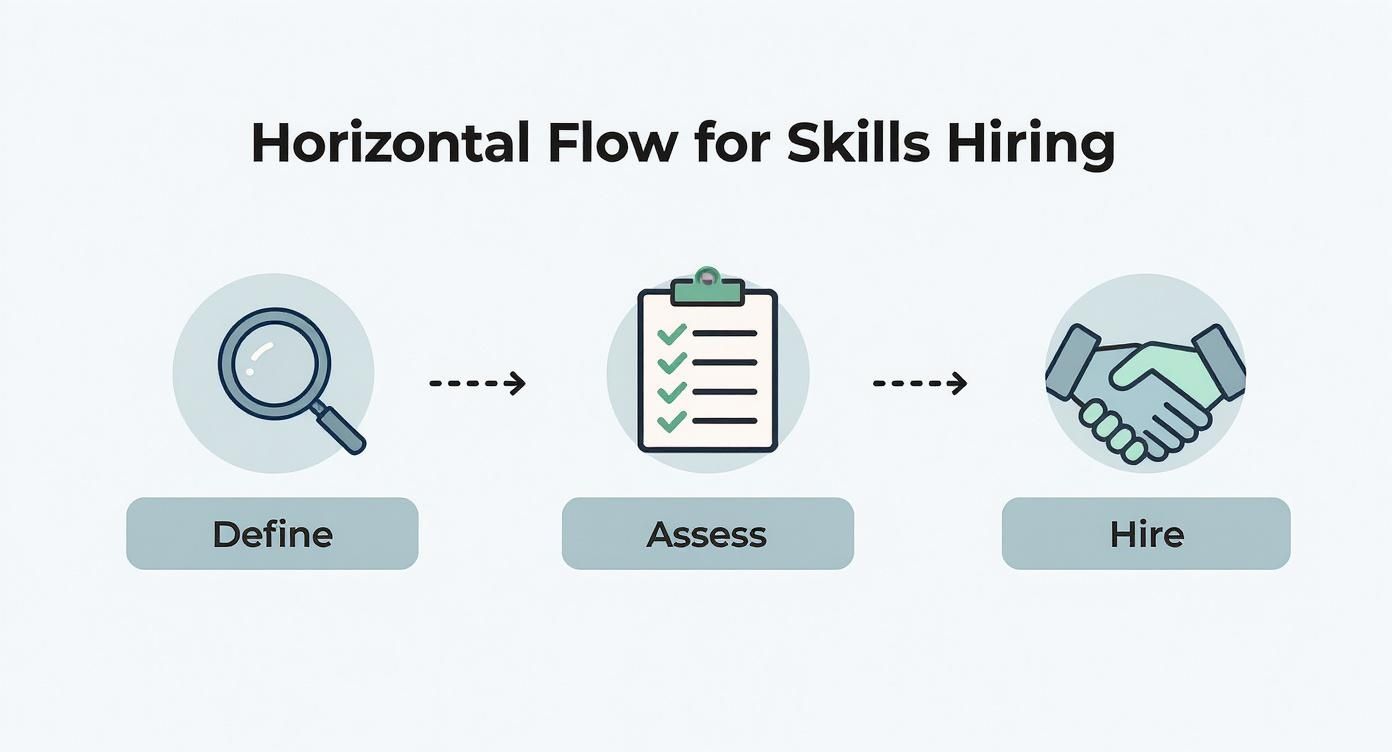
The skill based hiring process inverts the traditional funnel. It prioritizes skill verification at the beginning, ensuring that engineering time is spent only on candidates who have proven they are qualified.
Skills Assessment: Instead of a resume screen, candidates are sent a practical, hands-on challenge that simulates real work (e.g., debug a broken API, add a feature to a small codebase).
Assessment Review: The engineering team reviews the submissions from the top performers, focusing on code quality, problem-solving approach, and efficiency.
Technical Conversation: The interview is now a deep dive into the candidate’s assessment. It’s a collaborative discussion about their code and thought process.
Final Decision: The decision is based on demonstrated ability and alignment with the team’s needs, backed by objective data from the assessment.
Skill based hiring examples
Here’s how the previous examples would look in a skill based model:
Example 1: The FAANG Pedigree Revisited Both Candidate A (from a FAANG company) and Candidate B (from startups) are given a practical coding challenge relevant to the role.
Candidate B submits a clean, efficient, and well-documented solution, while Candidate A’s submission is functional but less robust. The skill based process reveals that Candidate B is the stronger engineer for this specific role, a conclusion that would have been missed by a resume-first approach.
Example 2: The Keyword Filter Revisited Instead of using an ATS, all applicants for the “React Developer” role are sent a short assessment to build a small component.
The brilliant JavaScript engineer who was weak on keywords but strong in fundamentals quickly builds a high-quality component, demonstrating their ability to adapt and learn. They immediately move to the top of the list, proving their skill is more valuable than their resume’s keyword density.
Why you should never hire based on merit (alone)
Relying solely on traditional merit based hiring is one of the biggest strategic errors a tech company can make. It’s a high-risk gamble that optimizes for pedigree over performance, creating a dangerous gap between how an engineer appears on paper and how they actually perform.
The core problem is that resume signals reward the past, not the present. A degree from ten years ago says nothing about a developer’s fluency in modern frameworks. Questioning whether an academic degree is truly necessary for success in IT is long overdue. Focusing on a resume is like judging a chef by reading their recipes instead of tasting their food.
This flawed model forces you to bet on candidates with incomplete data. You’re guessing who can perform, not knowing. The consequences are severe: missed deadlines, the astronomical cost of a bad hire, and an engineering team that can’t innovate fast enough.
Why skills-based hiring is a much better approach
Skills-based hiring directly aligns your evaluation process with the actual demands of the job. It is a far more reliable predictor of success. Research from McKinsey has shown that hiring for skills is five times more predictive of job performance than hiring based on education, and twice as predictive as hiring based on work experience.
This approach offers several powerful advantages:
Reduces Bias: By focusing on objective, standardized assessments, you create a level playing field where every candidate has a fair chance to demonstrate their ability, regardless of their background.
Expands the Talent Pool: You unlock access to a massive, untapped pool of talent—self-taught coders, bootcamp graduates, and engineers from non-traditional backgrounds who are often overlooked.
Improves Retention: Developers hired for what they can do are more engaged and satisfied. It sends a message that you are a true engineering-led organization, which attracts and retains top talent.
Increases Speed and Efficiency: Automating the initial screening with skills assessments saves hundreds of engineering hours, allowing your team to focus only on the most qualified candidates.
The only way to know if a developer can write solid Python code is to have them do it.
Why tech companies are moving away from merit based hiring
The shift away from traditional merit based hiring is a strategic move by the world’s most innovative companies. Leaders at Google, IBM, and Shopify have dropped rigid degree requirements because they recognize that in a rapidly evolving industry, practical skills are the only currency that matters.
They understand that the speed of innovation is directly tied to the capabilities of their engineering teams. By prioritizing what a developer can build over what their resume claims, these companies are creating faster, smarter, and more resilient organizations. The global recruitment trends shaping the industry all point toward a future where skills are the primary measure of a candidate’s worth.
Using a modern candidate vetting engine with technical skill assessments is no longer a luxury; it’s a competitive necessity.
Platforms like Utkrusht.ai offer features designed to test real-world engineering skills, moving you beyond resumes and into a world of data-backed hiring decisions.
Frequently Asked Questions
Is merit based hiring the same as skill based hiring?
How do you measure "merit" without relying on resumes?
Doesn't a skills-first approach ignore a candidate's potential for growth?
Can skill based hiring completely eliminate bias from the hiring process?
How can a small company or startup implement skill based hiring effectively?
Merit isn't found on a résumé—it’s proven through real work.
Utkrusht helps you evaluate true engineering skill with watch-them-work tasks that predict on-the-job performance. Get started now and modernize your hiring.

Founder, Utkrusht AI
Ex. Euler Motors, Oracle, Microsoft. 12+ years as Engineering Leader, 500+ interviews taken across US, Europe, and India
Want to hire
the best talent
with proof
of skill?
Shortlist candidates with
strong proof of skill
in just 48 hours


