Contents
Key Takeaways
Pre-employment tests are now a cornerstone of modern hiring, helping companies objectively evaluate skills, cognitive ability, personality, and job readiness before interviews begin.
These tests reduce reliance on resumes and gut feeling, offering standardized, data-driven insights that improve hiring accuracy and fairness.
Different test types (cognitive, technical, behavioral, situational) give employers a 360° view of a candidate’s potential and fit for the role.
Skill-based and watch-them-work task-based tests offer the highest predictive validity, showing how candidates perform on real tasks instead of theoretical questions.
When implemented correctly, pre-employment tests shorten time-to-hire, lower turnover, improve team quality, and enhance the overall candidate experience.
Drowning in a sea of look-alike resumes? You’re not alone. Finding the right technical talent feels like searching for a needle in a haystack.
An employment test is your data-driven compass, helping you see a candidate’s real-world skills in action before you ever speak to them. It’s about building a hiring culture based on what people can do, not just what they claim on paper.
What are pre-employment tests?
A test for employment is a standardized, objective method to evaluate a candidate’s skills, knowledge, and abilities for a specific role. For a CTO, this means swapping guesswork for tangible data. Instead of being swayed by resume keywords or a smooth interview, you get a clear picture of their technical chops.
This isn’t just a trend; it’s a fundamental shift in how smart companies build elite teams. The World Economic Forum’s Future of Jobs Report highlights this move towards skills-based assessments as technology constantly reshapes roles. It’s about predicting on-the-job performance with data, not gut feelings.
Why to use pre-employment tests?
Implementing the right test for employment delivers serious, measurable advantages that ripple through your entire organization. It’s about more than just finding a decent coder; it’s about transforming your hiring process from a high-stakes gamble into a predictable system for acquiring top talent.
Here’s what you stand to gain:
Slash Hiring Bias: Good tests are the ultimate equalizer. They force you to evaluate every candidate on the same criteria, putting the focus squarely on merit, not where someone went to school. This helps you build truly diverse and high-performing teams.
Drastically Lower Turnover: When you hire people whose skills are a proven match for the job, they’re happier and more engaged. This leads to a massive drop in those costly first-year exits that kill team morale and budgets.
Boost Team Productivity: Imagine new hires who can hit the ground running from day one. That’s what happens when you vet for practical skills. The entire team’s velocity and output get a significant lift.
Get Way Better at Predicting Success: A traditional interview is a notoriously poor predictor of job performance. A well-designed, hands-on test for employment is infinitely better.
This image gives you a sense of the different types of assessments out there, from cognitive tests to watch-them-work tasks. The main takeaway? The most effective strategies often mix and match a few different types to get a complete picture of a candidate.
You can dive deeper into building out a robust process in our other guides, like our main assessment guide. And on a related note, it’s not just about what you test for; candidates also need to be aware of the impact of digital footprint on job opportunities, because what employers find online matters, too.
The 14 types of pre-employment tests (pros and cons)
Feeling lost in the sea of pre-employment tests? It’s a common problem. The trick is knowing which tool to pull out of the toolbox for the job at hand. This breakdown cuts through the noise, covering the 14 essential assessment types that smart tech teams use.
Each test serves a specific purpose. Some gauge raw problem-solving horsepower, while others show you exactly how a candidate would perform in a simulated work environment. We’ll get into what each one measures, the roles they’re a good fit for, and the honest pros and cons.
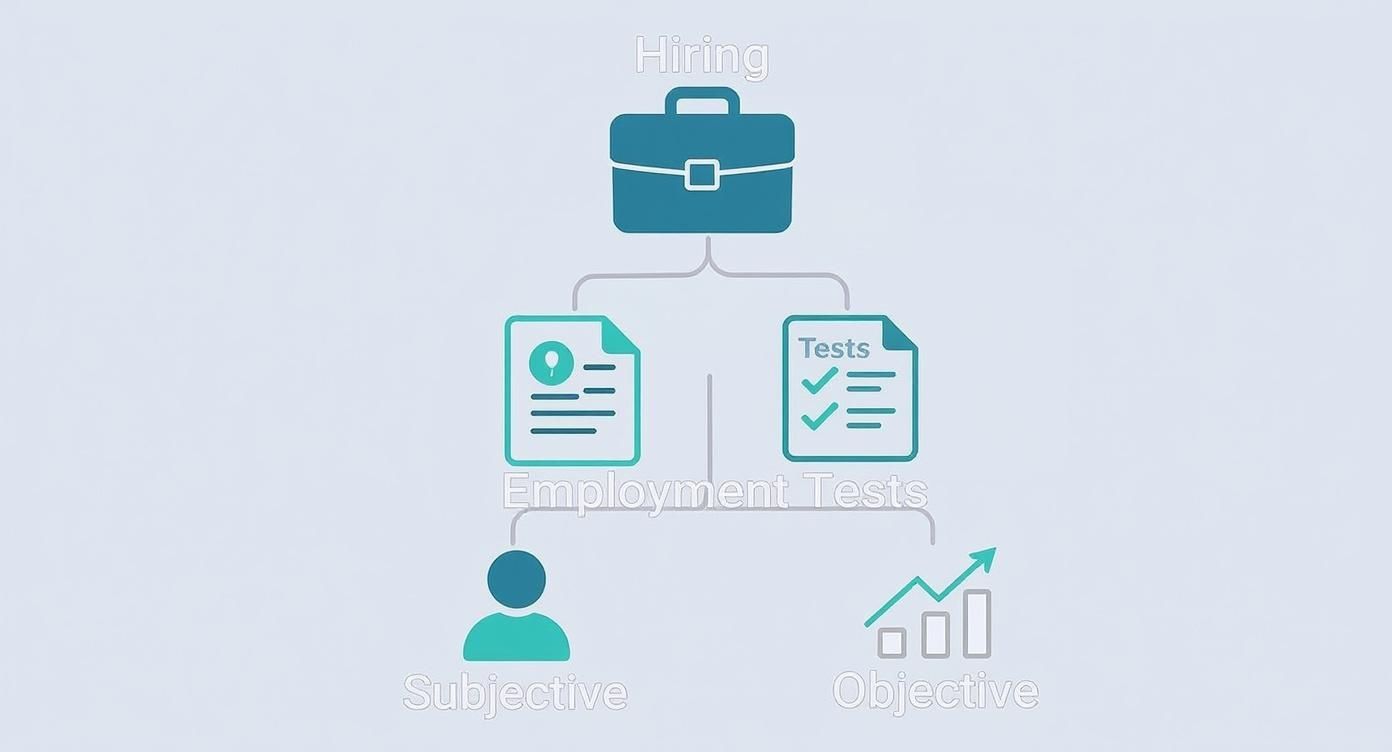
This infographic shows how tests shift hiring from gut-feel resume reviews to objective, data-driven decisions. Relying on resumes alone is a gamble. Bringing in objective tests gives you a far more reliable and fair picture of what a candidate can actually do.
1. Job knowledge tests
These are straightforward “what do you know” tests, usually multiple-choice, to check if a candidate understands the basic concepts and jargon for a role.
Pros: Quickly filters for baseline knowledge.
Cons: Measures theory, not practical application.
2. Cognitive ability tests
These tests assess raw thinking skills—like reasoning, problem-solving, and learning ability. They are strong predictors of job performance because they get at how a candidate thinks.
Pros: Gauges potential to tackle complex, new problems.
Cons: Doesn’t measure specific, learned technical skills.
3. Personality tests
These assessments map out personality traits to see how a candidate might fit with your team and company culture.
Pros: Offers insight into work style and collaboration potential.
Cons: Poor predictor of technical skill; can introduce bias.
4. Emotional intelligence (EQ) tests
EQ tests measure a person’s ability to understand and manage their own emotions and those of others, which is crucial for leadership roles.
Pros: Excellent for senior or leadership roles requiring strong interpersonal skills.
Cons: Less relevant for assessing the raw coding ability of a junior developer.
5. Skills assessment tests
This broad category measures specific, trainable abilities, from typing speed to proficiency with a specific software tool.
Pros: Verifies the hard skills listed on a resume.
Cons: Doesn’t assess deeper skills like complex problem-solving.
6. Work sample tests (job watch-them-work tasks)
This is where the rubber meets the road. These tests give a candidate a task that’s a direct slice of their potential day-to-day job.
Pros: The most accurate predictor of on-the-job performance.
Cons: Requires more time investment from the candidate than a quick screen.
7. Physical ability tests
These test strength, stamina, and coordination. They are critical in fields like manufacturing but rarely relevant for tech roles.
Pros: Essential for jobs with clear physical demands.
Cons: Irrelevant and inappropriate for any office-based technical position.
8. Language proficiency tests
These assessments check a candidate’s fluency in a specific language, covering reading, writing, and speaking skills.
Pros: A must-have for roles requiring flawless communication with a global audience.
Cons: Unnecessary for roles where the team shares the same native language.
9. Situational judgment tests (SJTs)
SJTs present realistic, hypothetical work scenarios and ask, “What would you do?” Their choices reveal soft skills and problem-solving approaches.
Pros: Shows how a candidate thinks on their feet and handles tricky interpersonal situations.
Cons: Does not measure technical ability or hard skills.
10. Integrity tests
These tests gauge a candidate’s honesty, dependability, and work ethic. For a closer look, you can find examples of 6 types of integrity test sample questions.
Pros: Useful for roles with access to sensitive data or high autonomy.
Cons: Can feel invasive if not handled properly; best used with other tools.
11. Coding tests
A classic in tech hiring, these tests present algorithmic problems for candidates to solve in code, measuring fundamental computer science knowledge.
Pros: Assesses core data structures and algorithm knowledge.
Cons: Doesn’t show how a candidate navigates a large, existing codebase or makes real-world trade-offs.
12. Soft skills assessment
These assessments focus on non-technical skills like communication, teamwork, and adaptability, often through behavioral questions or SJTs.
Pros: Ensures your next hire can contribute to a positive team dynamic.
Cons: Cannot replace verification of essential technical skills.
13. Culture fit assessment
These tests aim to see if a candidate’s values align with your company’s culture. A better frame is “culture add,” focusing on what unique perspective a candidate brings.
Pros: Helps understand a candidate’s work preferences and what they can add to the team.
Cons: Can easily lead to a homogenous team, killing innovation.
14. Reference checks
A well-structured reference check is a form of assessment, confirming a candidate’s experience and performance with former managers.
Pros: A final validation check before extending an offer.
Cons: Should be reserved for finalists, not used as an early-stage screen.
Quick decision guide for choosing pre-employment test
Feeling overwhelmed? Use this quick-reference table to match test types to your hiring goals.
Use this if you prefer… | Do not use this if you prefer… | Recommended Test Type(s) |
|---|---|---|
To see skills in a real-world context | To screen hundreds of candidates in minutes | Work Sample Tests (Job Watch-them-work tasks) |
To quickly filter for baseline knowledge | To evaluate practical problem-solving skills | Job Knowledge Tests, Coding Tests |
To predict learning agility and adaptability | To measure specific, learned technical skills | Cognitive Ability Tests |
To evaluate teamwork and interpersonal skills | To make a final decision based on personality | Personality Tests, EQ Tests, SJTs |
To validate claims on a resume | To screen candidates at the top of the funnel | Reference Checks |
What is the best way to determine the right pre-employment screening method?
Picking the right screening test isn’t about luck; it’s a strategic move. The test for a senior backend engineer is worlds apart from one for a junior frontend developer. The key is to align your tests with what the role actually requires.
Start with a quick but honest job analysis. Before looking at platforms, define the top three to five non-negotiable skills for success in the role. Is it debugging a legacy codebase, designing scalable APIs, or collaborating on complex UI components? These core competencies are the foundation of your testing strategy.
Once you have that list, match the skills to the right assessment. For a developer who needs to jump into your Python codebase on day one, a generic algorithm quiz is useless. You need a test that mirrors that reality, like asking them to fix a bug in a small Django app.
To test debugging skills: Use a watch-them-work task with a small codebase and a specific bug to find.
To test system design: A work sample asking them to architect a small-scale system reveals their architectural thinking.
To test coding proficiency: Use a focused test on a specific framework they’ll use daily, like our assessment for basic Python skills.
Why should you use online proctoring when conducting online pre-employment tests?
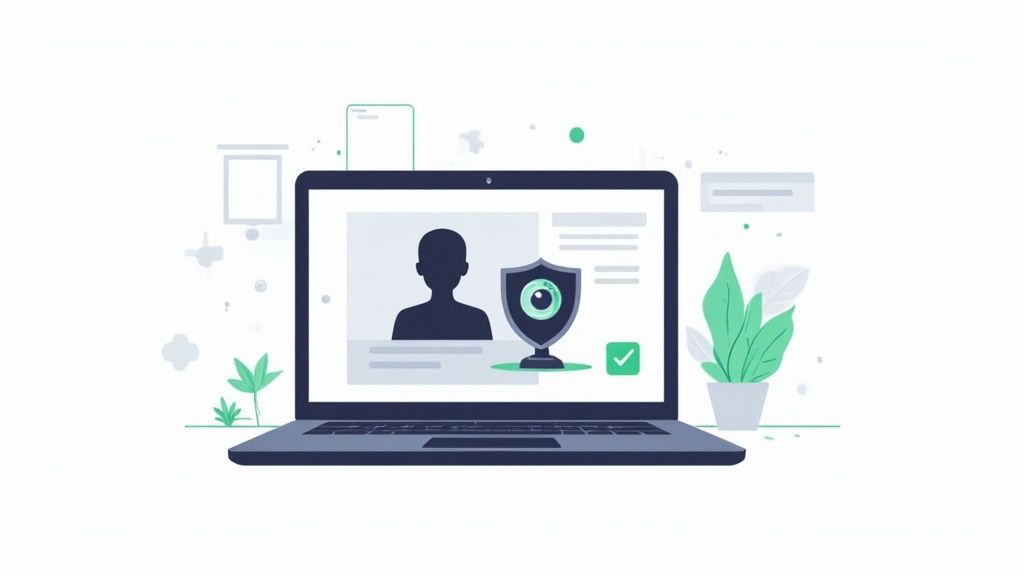
In a remote-first world, your talent pool is global. The bad news? So is the risk of hiring fraud. How can you be sure the candidate who aced your coding challenge is the same person you interview? This is where online proctoring becomes a critical part of your hiring toolkit.
Proctoring isn’t about spying; it’s about protecting the integrity of your hiring process. When you use a test for employment remotely, proctoring validates that the skills you’re seeing are real, giving you confidence in your data. It creates a level playing field, ensuring every candidate takes the assessment under the same conditions.
Modern proctoring systems are smart and non-intrusive. They flag specific behaviors that suggest cheating, like:
Switching tabs or windows to search for answers.
Copying and pasting pre-written code.
Using multiple monitors.
Verifying identity with a photo ID before the test.
By flagging only suspicious activities, modern proctoring maintains integrity without creating a stressful environment. It makes every remote test something you can count on.
How to pick the right pre-employment test platform for your requirement, follow this simple decision making checklist
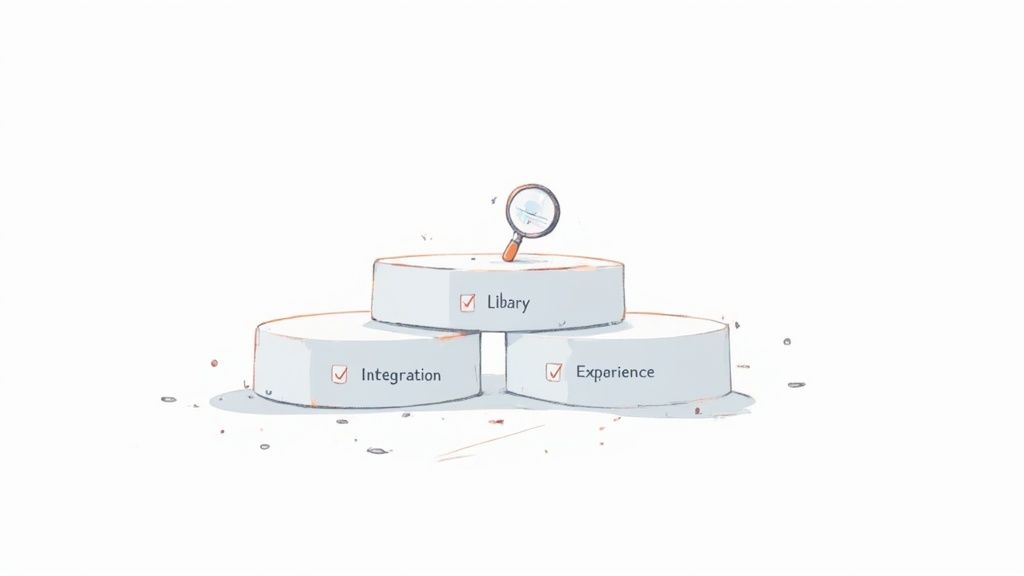
Picking a technology partner can either launch your hiring into orbit or grind it to a halt. As a CTO, this is a critical infrastructure decision. The right platform directly impacts the quality of your team and engineering velocity.
The platform evaluation checklist
Cut through the marketing noise. Here’s what actually matters when evaluating platforms for a technical test for employment.
Quality of the Test Library: Look for realistic watch-them-work tasks that mirror the actual work your team does, not just abstract algorithm puzzles.
Customization: You need the ability to tailor tests to your specific needs. The gold standard is building your own watch-them-work tasks using your own codebase.
Seamless ATS Integration: The tool should plug directly into your Applicant Tracking System (ATS) to streamline your workflow. Look for a robust API and ask for references. You can learn more about integrated platform features.
Candidate Experience: A clunky, frustrating testing experience will send top candidates to your competitors. Ensure the interface is clean, intuitive, and uses a realistic development environment.
Here’s the most important piece of advice: always, always try a product for a month, then evaluate which is right for your needs. A hands-on trial is the only way to know if a platform will be a true asset.
Frequently Asked Questions
Are Pre-Employment Tests Legal and How Can We Avoid Bias?
How Do We Add Tests Without Scaring Away Good Candidates?
What Is the Best Way to Measure the ROI of Our Testing Program?
Should We Use Personality Tests for Hiring Software Developers?
Can Pre-Employment Tests Replace Technical Interviews?
Transform your hiring with assessments that actually predict performance.
With Utkrusht, evaluate skills, cognition, and job readiness—all in one platform. Get started now and elevate your talent strategy.

Founder, Utkrusht AI
Ex. Euler Motors, Oracle, Microsoft. 12+ years as Engineering Leader, 500+ interviews taken across US, Europe, and India
Want to hire
the best talent
with proof
of skill?
Shortlist candidates with
strong proof of skill
in just 48 hours


