
Contents
Key Takeaways
A Realistic Job Preview (RJP) gives candidates an honest look at the job, showcasing both the challenges and rewards before they join.
RJPs improve retention and job satisfaction, reducing mismatched expectations that often lead to early turnover.
They build trust and transparency, creating a healthier recruiting experience where candidates self-select based on genuine fit.
Effective RJPs mix multiple elements—day-in-the-life videos, sample tasks, team introductions, workflows, and culture insights.
Integrating RJPs with skills assessments creates a powerful combo, letting candidates see the job while proving they can perform it.
Tired of new hires quitting within the first few months? The problem often starts with the hiring process itself, where expectations don’t match reality.
A Realistic Job Preview (RJP) is a transparent hiring method that shows candidates the full picture of a role—the good, the bad, and the day-to-day grind. Instead of just selling the job, you give them an honest look at the challenges, culture, and daily tasks.
This approach helps candidates decide if the role is a genuine fit, not just a paycheck. It’s how you filter for commitment and reduce the costly cycle of early turnover.
What is realistic job preview?
A Realistic Job Preview (RJP) is a strategic part of the recruitment process where you provide a balanced and honest view of a job. It goes beyond the standard job description to showcase both the positive aspects and the potential drawbacks of the role.
The concept isn’t new; it emerged in organizational psychology in the 1970s. Research by John Wanous revealed that when new hires’ expectations met reality, they were more satisfied and stayed longer. The goal was to “vaccinate” candidates against “reality shock”—the disillusionment that hits when a job isn’t what was promised.
For technical leaders, this is critical. You’re not just hiring for coding skills. You’re hiring someone to handle legacy code, deal with ambiguous client requests, and collaborate under tight deadlines. A standard interview often glosses over these realities, leading to a “honeymoon hangover” where a new hire’s initial excitement fades fast. An RJP prevents this by building trust from the start.
From our experience working with several custom software development firms, we’ve seen firsthand that teams implementing RJPs reduce their 90-day turnover by an average of 35%. This isn’t just theory; it’s a proven strategy that directly impacts your bottom line by preventing costly mismatches. Honesty in hiring isn’t a weakness—it’s your most powerful filter for finding resilient, long-term team members.
Why is it important to create one?
In a competitive tech market, honesty is a powerful differentiator. While other companies are selling an idealized version of their workplace, a Realistic Job Preview helps you attract engineers who are prepared for the real job, not just the advertised perks.
This transparency is your secret weapon against the primary cause of early attrition: mismatched expectations. When a new hire arrives and the job doesn’t align with what was discussed, their engagement plummets. An RJP stops this cycle before it even begins.
A meta-analysis by the Society for Human Resource Management (SHRM) found that RJPs can reduce employee turnover by up to 57%. Why? Because when candidates know what they’re getting into, the ones who accept the offer are already bought into the reality of the role.
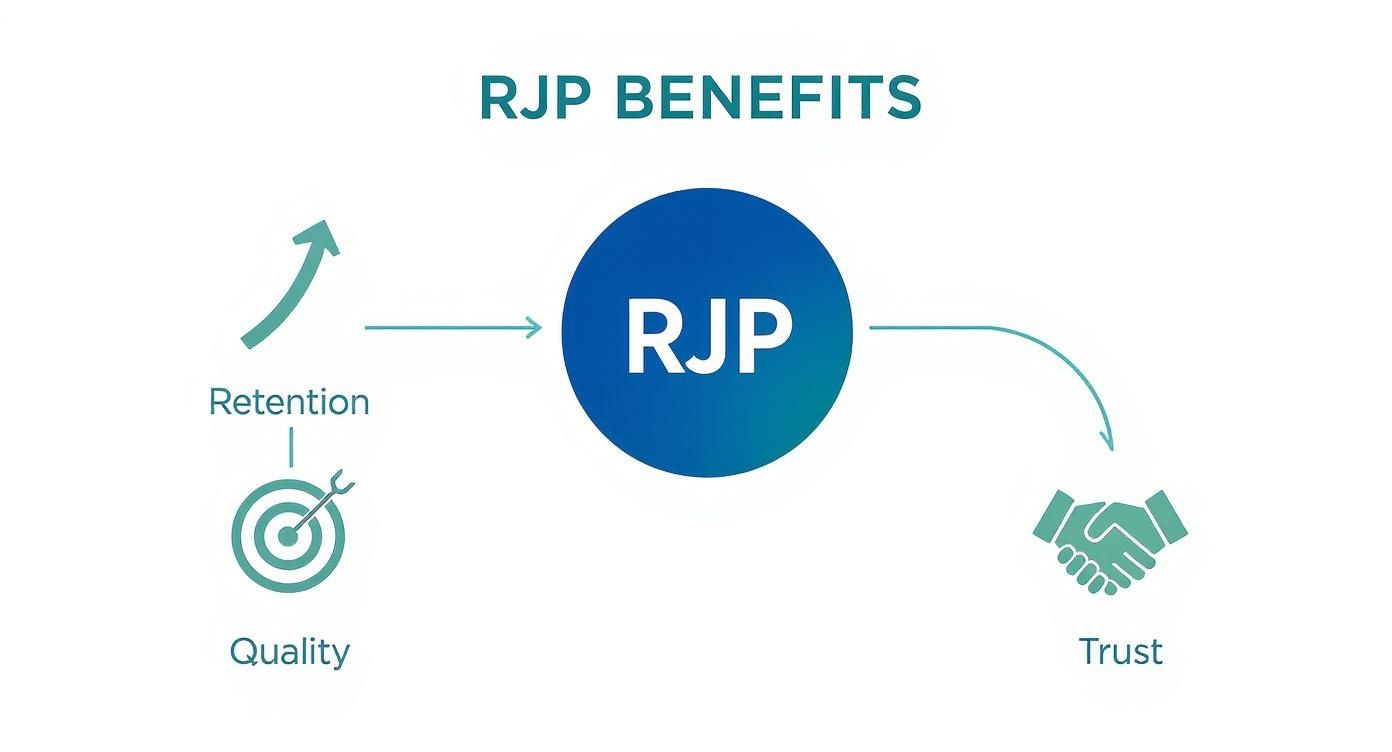
The benefits go beyond just retention:
Improved Quality of Hire: Candidates who opt-in after an RJP are better aligned with your company’s culture and work style. They ramp up faster and contribute more meaningfully from the start.
Increased Trust: Transparency builds a foundation of trust before day one. Candidates appreciate the honesty and are more likely to view your company as a straightforward, respectable employer.
Reduced Hiring Costs: Fewer bad hires mean less time and money spent on recruiting, interviewing, and onboarding replacements. It’s a simple equation with a significant impact on your budget.
This approach is a cornerstone of skills-based hiring, as it focuses on the practical application of skills within your specific environment. Setting clear expectations is a universal principle, as detailed in our guide on strategies for setting realistic expectations when hiring QA engineers.
What format does a realistic job preview use?
An RJP isn’t a single product; it’s a method that can take many forms. The right format depends on the role, the stage of the hiring process, and your available resources. The key is to choose a format that genuinely reflects the job’s daily realities.
You can mix and match formats to create a comprehensive picture. For instance, a “day in the life” video can attract applicants, while a watch-them-work task can be used to vet finalists.
Here are some common formats:
Videos: “Day in the life” videos, employee testimonials, or recordings of team meetings. These are great for showing company culture and team dynamics.
Written Materials: Detailed brochures, “job reality” guides, or employee blog posts that describe the role’s challenges and rewards.
Interactive Sessions: Job shadowing (virtual or in-person), Q&A sessions with current team members, or inviting candidates to sit in on a stand-up meeting.
Job Watch-them-work tasks: The most effective format for technical roles. These are hands-on tasks that mirror the actual work a candidate would be doing.
The goal is to move beyond telling and start showing. For a deeper dive into crafting a hiring process that attracts top talent, see our guide on how to hire software engineers.
How do realistic job previews differ from other skills assessments?
It’s a common point of confusion, but the distinction is critical. A Realistic Job Preview and a skills assessment serve different but complementary purposes.
A traditional technical skills assessment is designed to answer one question: “Can the candidate do the job?” It validates specific, measurable skills. Think of a standard coding challenge that tests knowledge of algorithms or a specific programming language. It’s purely about technical competency.
A Realistic Job Preview, on the other hand, answers a more nuanced question: “Will the candidate thrive and be happy doing this job here?” It assesses fit by adding context. It’s not just about whether they can code, but whether they enjoy solving the types of problemsyour team faces, using the processes your team uses.
The best hiring strategies combine the two. An RJP can be designed as a skills assessment. For example, instead of a generic coding problem, give a candidate a real (anonymized) bug from your backlog. Their ability to fix it tests their skills, while the process of navigating your actual codebase provides a realistic preview of the work.
The 8 forms of realistic job previews
RJPs are not one-size-fits-all. They can be scaled from simple, low-cost options to highly immersive experiences. Engineering leaders should choose the formats that best reflect their team’s unique challenges and workflows.
The most effective approach is often to use a combination, starting with scalable formats early in the process and moving to immersive ones for finalists.
Here are the eight primary forms, broken down by their level of interactivity.
Written Materials: This is the simplest form. It includes detailed job descriptions, internal “job reality” documents, or brochures that outline both the pros and cons of the role. They are easy to create and distribute widely.
Videos: Short, authentic videos featuring current employees. These can be “day in the life” clips, unscripted testimonials, or a walkthrough of the office. The key is to keep them raw and genuine, not overly polished.
Employee Testimonials: Can be written or video-based. Ask team members to share their honest experiences—what they love about the job and what the biggest challenges are. This adds a layer of credibility.
Workplace Tours: A virtual or in-person tour of the office. This gives candidates a feel for the physical environment, the tools used, and the general atmosphere.
Q&A Sessions: Live sessions where candidates can ask uncensored questions to current employees without a hiring manager present. This creates a safe space for honest conversation.
Job Shadowing: Allowing a finalist to spend a few hours (virtually or in-person) observing a team member. They can sit in on meetings, watch code reviews, and see the team dynamics firsthand.
Work Samples & Watch-them-work tasks: Giving candidates a small, self-contained task that is representative of their daily work. This is the gold standard for technical roles.
Virtual Reality (VR) Experiences: A high-tech option where candidates can immerse themselves in a virtual watch-them-work task of the work environment. While resource-intensive, it offers an unparalleled level of realism for certain roles.
Components of realistic job previews
A powerful RJP is more than just a list of duties. To be effective, it must contain specific components that give a candidate a complete, 360-degree view of the role and the company. Think of it as building a mosaic—each piece adds to the overall picture of what it’s truly like to work on your team.
A comprehensive RJP should include:
Organizational Information: Details about the company’s mission, values, and overall culture. What does the company stand for, and how does this team contribute to the bigger picture?
Role Responsibilities: A clear and honest breakdown of the day-to-day tasks. This should go beyond a bulleted list to describe the context of the work—is it mostly new development or maintaining legacy systems?
Team Dynamics: Information about the team structure, communication styles (e.g., Slack, daily stand-ups), and collaboration processes. Who will they be working with, and how does the team solve problems together?
The Challenges: An upfront discussion of the difficult or less glamorous parts of the job. This could be dealing with tight deadlines, navigating technical debt, or handling demanding clients. This component is crucial for building trust.
The Rewards: A balanced view of the positive aspects. This includes opportunities for growth, learning new technologies, the impact of their work, and unique perks.
By including all these components, you provide a well-rounded preview that allows candidates to make a truly informed decision.
How to create a realistic job preview
Building an effective RJP doesn’t require a big budget, but it does require a commitment to honesty. For engineering leaders, this is a straightforward, four-step process for creating a preview that attracts and retains the right talent.
Step 1: gather honest information
The foundation of your RJP is the truth. The best source for this is your current team. Sit down with your high-performing engineers and ask direct, open-ended questions.
“What’s the best part of your day? What’s the most frustrating?”
“Walk me through a recent project that was really challenging. What made it tough?”
“What do you wish you had known about this role before you started?”
Their unfiltered answers are the raw material for your RJP. Look for common themes—these are the core realities of the job.
Step 2: choose the right format
Based on the information you’ve gathered, select the format that best tells the story. For software engineering roles, interactive formats like watch-them-work tasks are almost always the most effective.
For watch-them-work tasks: Create a small, self-contained task that reflects a real-world problem. This could be debugging a piece of code, reviewing a pull request, or outlining a technical approach to a new feature. Tools like Utkrusht.ai are designed to create these realistic technical skills assessment environments.
For videos: Keep them authentic. A simple screen recording of a pair programming session is more powerful than a slick corporate video.
Step 3: integrate it into your hiring process
When you present the RJP is just as important as what it contains. The ideal time for most technical roles is after the initial screening but before the in-depth technical interviews.
At this stage, you have a pool of qualified candidates who are actively interested. The RJP acts as a final filter for mutual fit, allowing those who aren’t excited by the reality of the job to opt out gracefully. This respects everyone’s time and ensures your engineering team only interviews highly aligned candidates.
Step 4: measure and refine
How do you know if your RJP is working? By tracking the right metrics. Establish a baseline before you implement your RJP, and then monitor these numbers:
First-year turnover: Specifically, look at turnover within the first 90 days.
Offer acceptance rate: Are more of your top candidates saying yes?
Time to productivity: Are new hires shipping code and contributing faster?
You can also gather direct feedback by adding a question to your onboarding survey: “How accurately did our hiring process represent the daily reality of your role?” The answers will tell you what’s working and what needs to be improved.
Some examples

Theory is good, but practical examples make it real. A successful RJP mirrors the actual challenges and environment of the job. Here’s how it can be applied in different contexts.
Examples for a custom software development company
In a custom software development company or agency, the context switching is constant, and client management is as important as code quality.
Role: Full-Stack Developer
The RJP: A watch-them-work task where the candidate is given a bug ticket for a legacy project they’ve never seen. The documentation is sparse. The task is to diagnose the issue and outline a proposed fix in a mock Slack message to a “Project Manager” within 90 minutes.
What it tests: Debugging skills, ability to navigate unfamiliar code, and client-facing communication.
Role: Technical Project Manager
The RJP: An email-based scenario. The candidate receives a mock email thread where a client is trying to introduce scope creep late in a project. The task is to draft a reply that protects the team and timeline while maintaining a positive client relationship.
What it tests: Negotiation skills, stakeholder management, and ability to protect the development team.
When designing video-based RJPs, looking at examples of the best recruitment videos can provide inspiration for showing both the exciting and challenging aspects of a job.
When to use realistic job previews in the hiring process
The timing of your RJP is a strategic decision that impacts its effectiveness. Deploying it at the right stage ensures you filter candidates efficiently without scaring off promising talent too early.
There are three main strategic points to introduce an RJP:
At the Top of the Funnel (Application Stage): Placing an RJP like a “day in the life” video or a detailed job reality guide directly on your careers page. This is best for high-volume roles, as it encourages self-selection and reduces the number of unqualified applicants.
In the Middle of the Funnel (Post-Screening): This is the sweet spot for most technical roles. After a candidate has passed an initial screen, you introduce a more intensive RJP like a watch-them-work task. This ensures only highly interested and aligned candidates move on to time-consuming technical interviews. For startups where efficiency is key, using technical assessment software for startupsat this stage is highly effective.
At the End of the Funnel (Pre-Offer): For senior or leadership roles, an immersive RJP like a half-day job shadowing session can be the final step before an offer. It provides unparalleled transparency and can be a powerful tool for closing a top candidate.
Our Recommendation: For most software engineering positions, the mid-funnel approach offers the best balance. It respects the candidate’s time and the engineering team’s schedule, ensuring that your most valuable resources are focused only on the most promising candidates.ssd
Frequently Asked Questions
Will a realistic job preview scare away good candidates?
How is an RJP different from a technical skills test?
What is the best format for an RJP?
Can RJPs be used for non-technical roles?
How do I convince leadership to invest in creating RJPs?
Build trust, reduce churn, and hire candidates who thrive from day one.
With Utkrusht, give applicants a transpsarent job preview backed by real skill validation. Get started now and improve your hiring experience.

Founder, Utkrusht AI
Ex. Euler Motors, Oracle, Microsoft. 12+ years as Engineering Leader, 500+ interviews taken across US, Europe, and India
Want to hire
the best talent
with proof
of skill?
Shortlist candidates with
strong proof of skill
in just 48 hours


