Contents
Key Takeaways
Programming aptitude tests measure foundational problem-solving ability, not just language-specific knowledge, making them useful for identifying raw potential.
Strong aptitude assessments evaluate logic, pattern recognition, debugging ability, and computational thinking, all of which translate across tech stacks.
These tests are most effective when paired with real-world coding watch-them-work tasks, giving a full picture of both potential and practical skill.
Aptitude tests help widen the hiring funnel, giving self-taught developers and career-switchers a fair chance by emphasizing capability over pedigree.
Leaders should avoid relying solely on aptitude, ensuring assessments remain relevant to the actual role and required competencies.
Hiring developers often feels like a high-stakes gamble. You sift through resumes, guessing if the skills listed translate to real-world ability. A wrong bet costs you tens of thousands in wasted salary, lost productivity, and a demoralized team. It’s a massive headache for engineering leaders who just want to build a reliable team that ships quality products.
Programming aptitude tests cut through the noise. Instead of relying on subjective resumes and polished interview answers, you get objective, measurable data on a candidate’s core problem-solving and logical reasoning skills. It’s about identifying true talent, not just people who are good at interviewing.
The hidden costs of a flawed hiring process
Let’s be direct: traditional hiring is slow, expensive, and unpredictable. The cycle of screening resumes, initial phone calls, and multiple interview rounds consumes your engineering managers’ time—time they should be spending on building your product.
A study from the Society for Human Resource Management (SHRM) pegs the average cost per hire at nearly $4,700. For specialized tech roles, that number is just the beginning.
But the real gut punch isn’t the recruitment fee; it’s the cost of a mishire. A developer who can’t problem-solve will inevitably ship bugs, derail timelines, and drag down the team’s morale. According to the U.S. Department of Labor, a bad hire can cost up to 30% of their first-year salary. For a senior developer, that’s a $30,000 mistake.
Beyond resumes and pedigree
The fundamental flaw with the old way of hiring is its reliance on proxies for skill. A resume packed with keywords or a degree from a fancy university doesn’t prove a candidate can debug a legacy system or design a scalable feature. Too often, these credentials reflect privilege, not raw engineering talent.
This broken system filters out brilliant developers from non-traditional backgrounds while rewarding candidates who have mastered the “interview game”—only for them to underperform on the job.
Programming aptitude tests sidestep this mess by measuring what actually matters:
Logical Reasoning: Can they break down a complex problem and map out a coherent solution?
Problem-Solving Ability: How do they handle challenges they’ve never seen before?
Learning Potential: How quickly can they spot new patterns and apply them?
By shifting your focus from pedigree to proven ability, you build a merit-based hiring process. You stop guessing and start making decisions based on evidence of skill. This doesn’t just lower your risk of a bad hire; it opens your talent pool to incredible engineers you would have otherwise missed.
What kinds of programming aptitude tests are out there?
Let’s be honest, not all “programming tests” are created equal. The format you choose changes what you measure. Picking the right one means understanding what skill each assessment is designed to reveal, so you can filter for the competencies your team actually needs.
The goal isn’t just to throw a quiz at someone. It’s to align the test with the real-world demands of the job. A test for a junior developer should stick to foundational logic, while an assessment for a senior engineer needs to dig into architectural thinking and how they tackle complex problems. Knowing the difference helps you get a clear signal, not just more noise.
Multiple-choice questions (MCQs) and quizzes
When you need to screen a high volume of candidates, multiple-choice questions are often the first line of defense. They’re great for quickly gauging foundational knowledge, logical reasoning, and pattern recognition without asking a candidate to write a single line of code. Think of them as a quick check to see if someone has the basic cognitive toolkit for programming.
This isn’t a new idea. Back in the day, the IBM Programmer Aptitude Test (PAT) was the industry standard. By 1966, hundreds of companies were using it to assess logical reasoning, establishing a precedent for measuring aptitude over existing knowledge.
But MCQs have a ceiling. They can’t tell you if a candidate writes clean, maintainable code or how they’d debug a tricky system. They’re best used as a simple, low-effort filter at the top of the funnel before moving to more practical tests.
Algorithmic and live coding challenges
Live coding is a staple in tech interviews for a reason—it’s designed to see how a candidate thinks on their feet. Usually done on a whiteboard or over a shared screen, these challenges test a developer’s handle on data structures, algorithms, and problem-solving under pressure. You get a direct window into their thought process as they talk through a solution.
This simple flowchart can help you decide when to use aptitude tests versus relying on resumes alone.
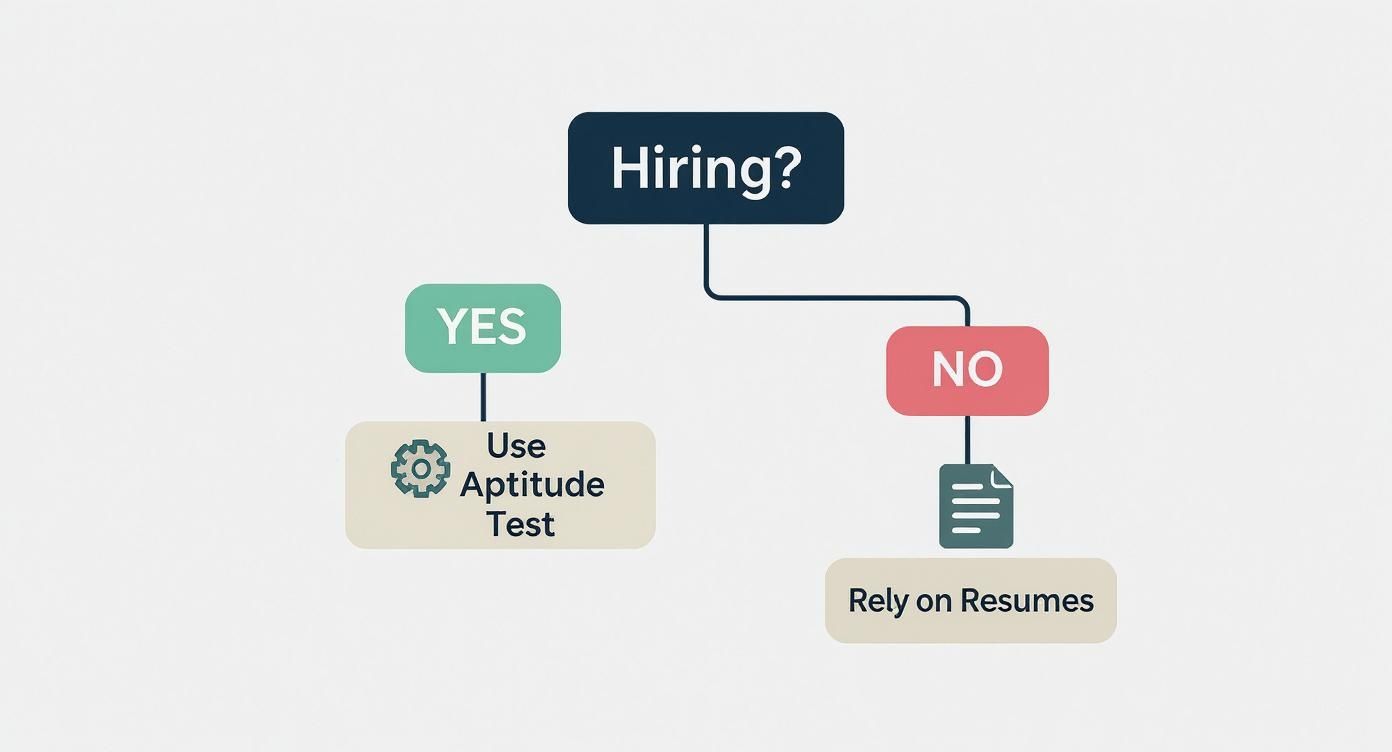
The flowchart makes a simple point: objective data from assessments is almost always more reliable than the subjective claims on a resume. However, the big knock against live coding is the high-pressure environment it creates. It doesn’t reflect a normal workday, and you risk filtering out perfectly capable developers who just don’t perform well under that kind of spotlight. For a deeper look, this resource on understanding the importance of programming assessments is a great starting point for building a better hiring process.
To help you navigate these options, here’s a quick comparison of the most common test formats.
Programming aptitude test formats compared
Test Format | Primary Skills Assessed | Best For | Potential Drawback | |||||||||||||||||||
|---|---|---|---|---|---|---|---|---|---|---|---|---|---|---|---|---|---|---|---|---|---|---|
MCQs & Quizzes | Foundational knowledge, logic, pattern recognition | High-volume, top-of-funnel screening | Doesn’t measure actual coding ability | |||||||||||||||||||
Live Coding | Algorithms, data structures, real-time problem-solving | Mid-to-late stage interviews for senior roles | High-pressure, can cause anxiety, poor predictor of daily work | |||||||||||||||||||
Take-Home Projects | Coding style, project structure, ability to follow specs | Mid-stage evaluation for specific roles (e.g., frontend) | Time-consuming for candidates, hard to prevent plagiarism | |||||||||||||||||||
Each format has its place, but the trend is clearly moving toward assessments that more closely mirror the actual job. Take-Home Projects and Watch-them-work tasksIf you want a more realistic peek at what a candidate can do, take-home projects are a solid option. By giving them a small, well-defined project, you can evaluate their coding style, how they structure their work, and their ability to follow instructions in a low-pressure setting. It’s an excellent way to see skills that are nearly impossible to measure in a short quiz or a live coding session.
Watch-them-work tasks take this a step further. Instead of an isolated project, candidates are dropped into a replica of your actual work environment. You can explore different types of watch-them-work task assessments Utkrusht offers to see this in action. They might be asked to debug a piece of existing code, add a feature to a small application, or review a pull request—all tasks that directly mirror their day-to-day responsibilities. This approach gives you the most accurate and complete picture of a candidate’s true abilities. Why Objective Assessments are a Business Decision, Not Just an HR ChecklistHiring engineers is expensive and risky. When you rely on resume screening and subjective interviews, you’re gambling with your company’s most critical asset: its technical talent. Switching to objective assessments isn’t about adding another step to your process; it’s a strategic move that plugs leaks in your budget and builds a stronger engineering team. For CEOs and engineering leaders, the pain of a bad hire is real. It’s not just the salary—it’s the wasted engineering hours on fruitless interviews, the onboarding costs, and the massive productivity drag of someone who can’t perform. Objective assessments stop this by ensuring every candidate who reaches the final stages has already proven they have the core skills for the job. You front-load the qualification, saving your senior engineers from countless hours of interviews. From Guesswork to Measurable OutcomesThis isn’t just theory. The data shows a clear line between skills-first hiring and a healthier bottom line. A 2023 industry report found companies that adopted coding aptitude tests saw a 48% jump in the accuracy of their technical hires. Why? Because these tests measure what an engineer can actually do, not just what they claim they can do on a resume. The efficiency gains are just as impressive. Those same organizations reported screening candidates 3x faster. This isn’t just a “nice-to-have”—in a market where top engineers are gone in days, speed is your competitive advantage. It also creates a better experience for candidates. Engagement rates climbed from a lukewarm 35% to a solid 60%. Developers appreciate a process that respects their time and gives them a real chance to show off their skills. You can dig into the full research on these hiring metrics here. The Long-Term PayoffThe real value of getting hiring right goes beyond the first few months. When you hire for proven ability, you lay the foundation for a more stable, productive, and innovative engineering culture. The same report highlighted two critical long-term wins:
At the end of the day, using programming aptitude tests is a direct investment in the quality of your product and the health of your business. The data is clear: moving from subjective guesswork to objective, skills-based hiring delivers better results every time. How to Design Fair and Effective AssessmentsA poorly designed programming aptitude test is worse than useless. It can trick you into hiring the wrong person and, even worse, filter out incredible candidates who could have been your next top performers. Building an assessment that actually predicts on-the-job success isn’t about asking trick questions. It’s about a thoughtful approach that ensures the test is valid, reliable, and fair for everyone. The goal is to get a clear signal of a candidate’s potential, not just collect noise.  Core Principles for Fair Assessment DesignFairness is the cornerstone of any modern hiring process. An unfair test doesn’t just hurt candidates; it shrinks your talent pool and prevents you from building a stronger, more representative engineering team. Here are three non-negotiable principles to guide your design:
Sticking to these principles gets you closer to a true skills-based hiring model, where raw ability is the only thing that counts. You can dive deeper into this approach in our guide on what is skills-based hiring. Mitigating Bias in Technical TestingUnconscious bias is a huge risk in hiring, and technical tests are no exception. History is littered with notoriously biased aptitude tests. For example, some early programmer assessments were built on the flawed idea that good programmers are antisocial, which systematically screened out countless qualified people, especially women. To avoid falling into the same traps, you have to be proactive. Here’s how:
Balancing Difficulty and TimeFinally, the practical details matter. If a test is too easy, it tells you nothing. If it’s impossibly hard, you’ll just frustrate and lose your best candidates. You’re looking for that sweet spot—a challenge that lets strong engineers shine without being punishing. Keep these guidelines in mind:
A well-designed programming test is a powerful tool. It gives you objective data, cuts down on bias, and ultimately helps you build a team of high-performing engineers who are ready to hit the ground running. Moving Beyond Aptitude with Watch-them-work tasksA good programming aptitude test gives you solid signals. You learn if a candidate has the core logic and problem-solving chops. But it’s a test in a vacuum. It tells you if a developer can think logically, but not how they’d apply that thinking inside a messy, real-world codebase. That’s where the next evolution in tech hiring comes in: watch-them-work tasks. These aren’t just harder coding challenges. Watch-them-work tasks drop candidates into a realistic work environment that mirrors the day-to-day of your engineering team. Instead of an abstract algorithm puzzle, they might be asked to fix a bug in a legacy system, review a pull request, or implement a small feature in an existing app. 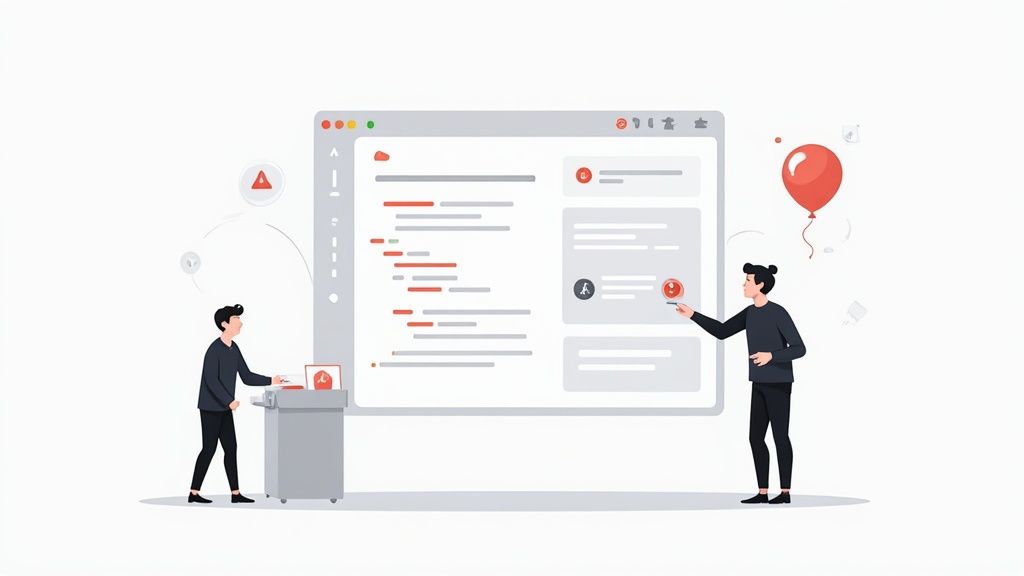 This approach shifts the focus from theoretical potential to demonstrated capability. You’re not just predicting performance anymore; you’re observing it firsthand. From Abstract Puzzles to Real-World TasksTraditional aptitude tests often feel disconnected from the actual job. A candidate can be a master of algorithms but completely freeze up when trying to navigate a complex codebase or collaborate with a team. Watch-them-work tasks bridge that gap by assessing the practical, everyday skills that define an effective engineer. This “proof-of-work” method gives you a much richer dataset for making hiring decisions. You can learn more about this approach in our article on what is proof-of-work based hiring. The insights you get are far more predictive of how a candidate will perform on your team. Think about the difference in what you’re measuring:
These are the skills that separate a good coder from a great teammate, and they’re almost impossible to gauge with a standard quiz or a live coding challenge.
Aptitude Tests vs Watch-them-work tasksBoth assessment styles have a role, but they serve different purposes. Aptitude tests are great for high-volume, top-of-funnel screening. Watch-them-work tasks, on the other hand, provide the deep, qualitative insights needed to shortlist your final candidates. Here’s a quick breakdown of how they stack up.
By moving toward watch-them-work tasks, you build a hiring process that is not only more accurate but also gives candidates a far better experience. Developers appreciate the chance to show off their real skills in a practical setting, which makes your company stand out. This shift leads to better hires, less turnover, and a stronger, more capable engineering team. Building Your Modern Technical Hiring StrategyRethinking your entire hiring process can feel overwhelming. But you can make it happen with a step-by-step approach. Bringing in programming aptitude tests or watch-them-work tasks isn’t just about plugging in a new tool. It’s about building a scalable, data-driven machine that consistently finds and attracts the best engineers. The whole point is to move away from hiring based on guesswork and gut feelings and toward a system that runs on evidence. That means putting objective assessments right at the start and using that data to make smarter, faster decisions. It’s a system built on respect for everyone’s time—yours, your team’s, and the candidate’s. Integrating Assessments into Your WorkflowFirst, decide where to slot assessments into your hiring funnel. For the biggest impact, they should come immediately after the initial application, before a human looks at a resume. This one change filters your talent pool based on what people can actually do, not just the keywords they’ve listed. A solid, modern workflow usually looks like this:
|
Data-Driven Shortlist: You get back a ranked list of candidates who have already proven they have the skills for the job. No more guessing.
Targeted Interviews: Your engineering team invests their valuable interview time only with candidates who have demonstrated they can deliver.
This structure can save your engineering team countless hours and guarantees that every interview is a high-value conversation.
Setting up clear evaluation rubrics
An assessment is only as good as the rubric you use to score it. Before you send out a single test, your team has to agree on what “good” looks like. A clear, well-defined rubric strips away subjectivity and makes sure every candidate is measured against the exact same yardstick.
Your rubric should lay out clear criteria and a scoring system for things like:
Correctness: Does the solution actually work and hit all the requirements?
Code Quality: Is the code clean, readable, and maintainable?
Problem-Solving Approach: How did the candidate think through the problem and break it down?
A detailed rubric is non-negotiable. It’s your single best defense against unconscious bias and ensures your hiring decisions are based on merit, not just a gut feeling. This objective foundation is critical to building a diverse, high-performing team.
Training and communicating for success
Once your tools and rubrics are ready, the final pieces are training your team and communicating the new process to candidates. Your hiring managers and interviewers need to understand how to interpret assessment results fairly. The data is a strong signal, but it’s just one signal among others—not the sole reason to hire or reject someone.
Just as important is how you frame this for candidates. Be transparent. Tell them why you use assessments—to give everyone a fair shot to show off their skills, not just what’s on their resume. A skills-first process that’s communicated well improves the candidate experience and positions your company as a modern, merit-based place to work.
Of course, assessments are just one part of the picture. For a complete guide on securing top talent, explore different strategies for hiring software engineers effectively in today’s market. The impact of this strategic shift is real—just look at these case studies from companies that transformed their hiring by putting skills first.
Frequently Asked Questions
How Do You Prevent Candidates from Cheating?
Can These Tests Fairly Assess Senior Developers?
What’s the Best Way to Ensure a Good Candidate Experience?
What if a great candidate performs poorly on the test?
Should we let candidates use AI tools like GitHub Copilot?
Build teams with both potential and proven skill.
With Utkrusht, evaluate logical reasoning and practical coding side-by-side for better hiring decisions. Get started now.

Zubin leverages his engineering background and decade of B2B SaaS experience to drive GTM as the Co-founder of Utkrusht. He previously founded Zaminu, served 25+ B2B clients across US, Europe and India.
Want to hire
the best talent
with proof
of skill?
Shortlist candidates with
strong proof of skill
in just 48 hours