Contents
Key Takeaways
Coding assessment tools are now core infrastructure for CTOs, enabling fast, accurate, and scalable technical screening without draining engineering time.
Not all tools are created equal—platforms range from simple MCQs to deep, real-world watch-them-work tasks that mirror an engineer’s actual workflow.
Watch-them-work task platforms deliver the strongest hiring signal, helping teams predict on-the-job performance far better than whiteboarding or take-home tests.
CTOs should choose tools based on realism, automation, integrations, and role-specific depth, not just brand recognition.
The right assessment tool dramatically reduces time-to-hire, improves quality-of-hire, and expands access to diverse, skilled candidates.
Sorting through hundreds of resumes for a single engineering role is a fundamentally broken process. It forces your team to waste valuable engineering hours on interviews that go nowhere, all while the best candidates are getting snapped up by competitors.
The core problem isn't a lack of talent; it's the inability to accurately identify true skill from a resume or a simple quiz.
This guide cuts through the noise. We analyze the best coding assessment tools to see how a candidate performs on real-world tasks, not just what they claim on their profile.
You'll get an honest look at top solutions like HackerRank and CodeSignal, alongside innovative platforms like Utkrusht.Ai that focus on real-watch-them-work tasks over abstract challenges.
Why Use a Coding Assessment Tool?
A coding assessment tool standardizes the technical screening process, providing objective data on a candidate's practical skills. Instead of relying on resume keywords or gut feelings from a phone screen, these platforms measure a candidate's ability to solve real problems. This saves countless engineering hours by filtering out unqualified applicants early.
The right tool provides a strong, predictive signal of on-the-job performance. It allows you to see how a candidate debugs code, navigates a codebase, or implements a feature. This data-driven approach leads to higher-quality hires, reduces bias, and shortens the overall time-to-hire.
Ultimately, these tools help you build a stronger engineering team by focusing your interview time on a pre-vetted shortlist of the most qualified candidates.
1. Utkrusht.Ai
Utkrusht.Ai shifts technical screening from theoretical knowledge to practical, on-the-job performance. It’s built for engineering leaders who need to validate a candidate's real-world problem-solving abilities, not just their resume claims. Only platform that offers pay-per-usage, no monthly/annual pricing.
The platform moves beyond multiple-choice questions (MCQs) and algorithm puzzles, immersing candidates in hands-on, simulated work environments.
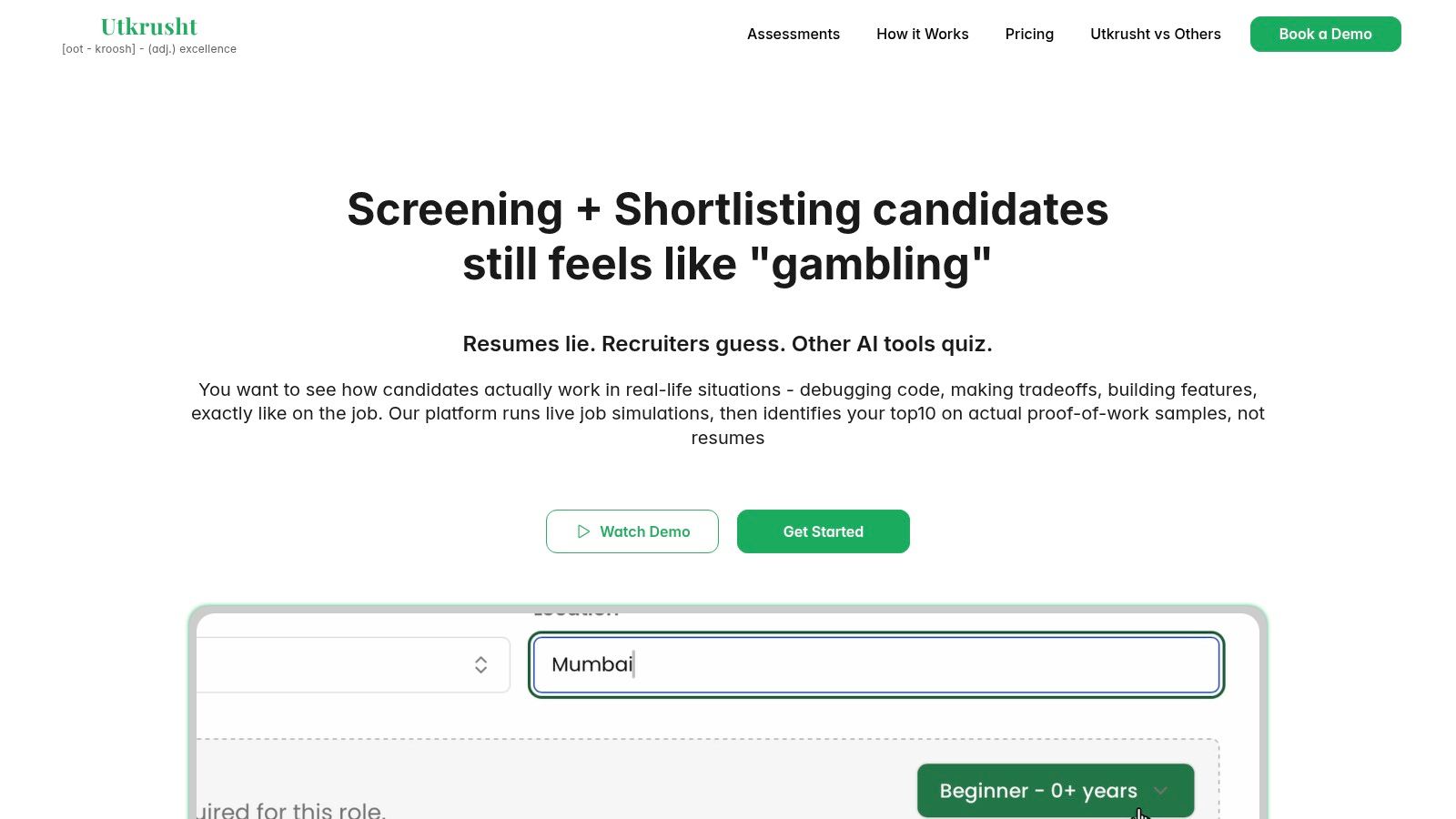
This approach makes it one of the best coding assessment tools for teams that prioritize true engineering skill. Candidates are tasked with debugging code, refactoring complex modules, or fixing a broken Docker container on a live EC2 instance.
Utkrusht then delivers a ranked shortlist of the top 10 candidates within 48 hours, saving managers over 60 hours per hire.
To understand how this work-watch-them-work task model stacks up against traditional assessment methods, you can explore a direct comparison of Utkrusht.Ai versus other tools.
Main USP: Utkrusht evaluates candidates on how they work in real-life situations. Instead of asking candidates to explain why a SQL query is slow, the platform makes them connect to a database, add indexes, and confirm latency improvements. Candidates fix Docker containers on an EC2 server, implement dependency injection with Guice, and refactor code to demonstrate practical skills, not just theoretical knowledge.
Main 3 Features: (1) Real-world watch-them-work tasks in a complete development environment. (2) A "proof-of-work" video recording of the candidate's entire problem-solving process. (3) A fully managed service that delivers a pre-vetted, ranked shortlist of the top 10 candidates.
One Standout Feature: The fully managed screening process. Utkrusht handles sourcing, screening, and shortlisting, freeing up engineering managers entirely from top-of-funnel evaluation.
Use this tool if you prefer: Verifiable, on-the-job performance over theoretical knowledge and want a managed service that delivers a ranked shortlist of candidates.
Who should not buy: Teams that prefer to manage the entire screening process internally or need to assess candidates on abstract algorithmic puzzles.
Pricing: pay-per-usage, one-time only, no monthly lock-in
Website: https://utkrusht.ai
2. HackerRank
HackerRank is a comprehensive technical hiring platform for companies that need a scalable, end-to-end solution for screening and interviewing. It combines a massive question library with robust proctoring and a dedicated live interview environment. The platform excels at standardizing the initial screening process through role-based tests and algorithmic challenges.
Its core strength lies in its deep feature set, including ATS integrations with major players like Greenhouse and Workday. However, it is less focused on real-world, multi-file project watch-them-work tasks. For teams looking to evaluate how candidates handle complex, on-the-job tasks, you can learn more about HackerRank for Work's alternative approaches.
Main USP: An all-in-one, enterprise-grade platform that combines a massive question library with advanced proctoring and seamless ATS integrations for standardized, large-scale hiring.
Main 3 Features: (1) Extensive question library with over 2,000 questions. (2) Integrated platform for both asynchronous screening and live interviews. (3) Advanced integrity controls like AI-driven proctoring and a secure desktop app.
One Standout Feature: The "Roles" framework, which provides pre-built, customizable assessments for over 35 common technical roles, speeding up test creation.
Use this tool if you prefer: A standardized, scalable platform with a vast question library and strong proctoring for high-volume, enterprise-level hiring.
Who should not buy: Teams that prioritize realistic, job-watch-them-work task assessments over algorithmic challenges and want a more candidate-friendly experience.
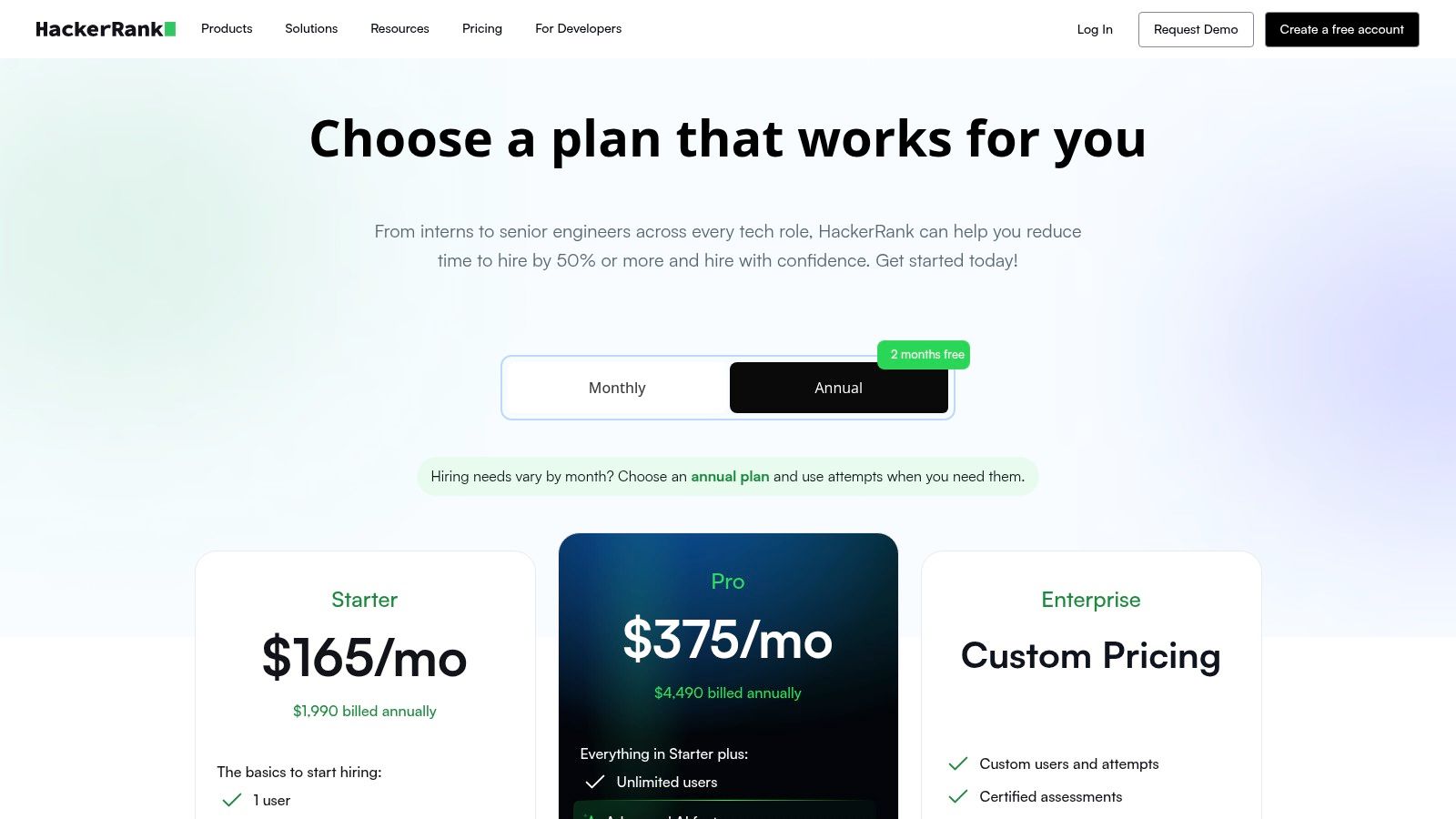
Pricing: Offers transparent pricing for its lower tiers (Starter and Pro), billed per attempt. Enterprise plans are custom.
Limitations: Costs can escalate as you scale, and extra attempts beyond your plan’s allocation come at an additional cost.
3. CodeSignal
CodeSignal is a cloud IDE-based assessment platform designed for mid-market and enterprise teams seeking realistic, job-like evaluation environments. It provides a comprehensive suite for skills assessments, live technical interviews, and even an AI Interviewer for certain roles. The platform excels at simulating a developer's day-to-day work environment with a full filesystem and build tools.
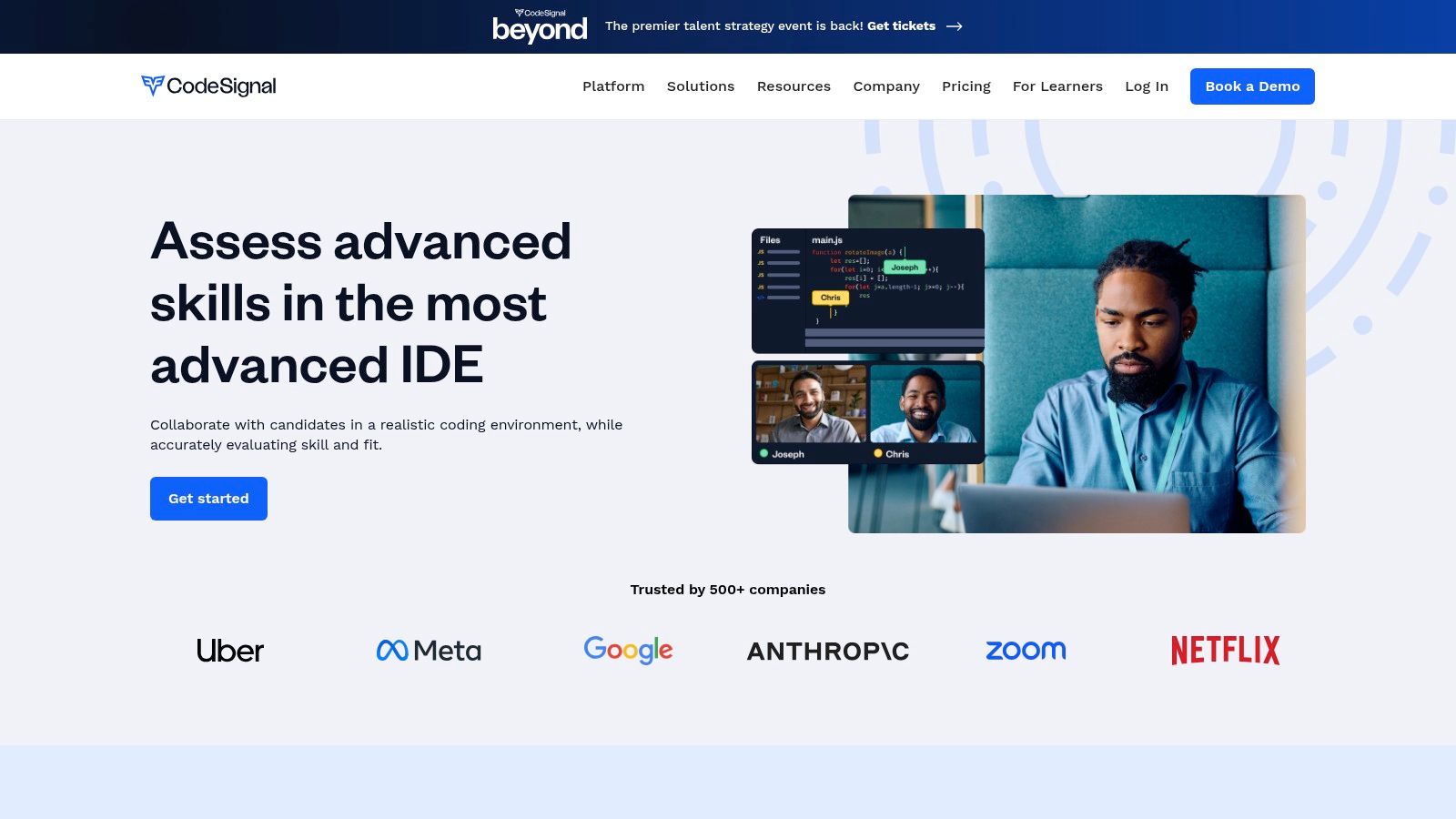
Its primary strength is its rich, interactive integrated development environment (IDE), which gives candidates a familiar workspace. For companies looking for assessments that replicate their exact production codebase, you can learn more about CodeSignal's advanced alternatives.
Main USP: An advanced cloud IDE that closely simulates a local development environment, providing a realistic and powerful workspace for candidates to tackle multi-file projects.
Main 3 Features: (1) A feature-rich IDE with a terminal, filesystem, and multi-language support. (2) An integrated workflow for video interviews and collaborative whiteboarding. (3) Specialized AI-led interview watch-them-work tasks for data science and other roles.
One Standout Feature: The "Replit-like" IDE experience, which supports complex projects and build tools, offering a high-fidelity signal on a candidate's practical development skills.
Use this tool if you prefer: A realistic IDE-based experience for both assessments and live interviews that goes beyond single-file challenges.
Who should not buy: Small teams or those with fluctuating hiring needs, as the custom pricing model is geared toward mid-market and enterprise customers.
Pricing: Available by quote and is not publicly listed.
Limitations: The enterprise-focused pricing model may be inaccessible for smaller teams. Advanced features may require higher-tier plans.
4. Codility
Codility provides a robust suite of screening and interviewing tools built around a science-backed task library. It is well-regarded among global tech hiring teams for its straightforward invite-based pricing model and integrated proctoring controls. The platform effectively balances a rich feature set with a user-friendly interface.
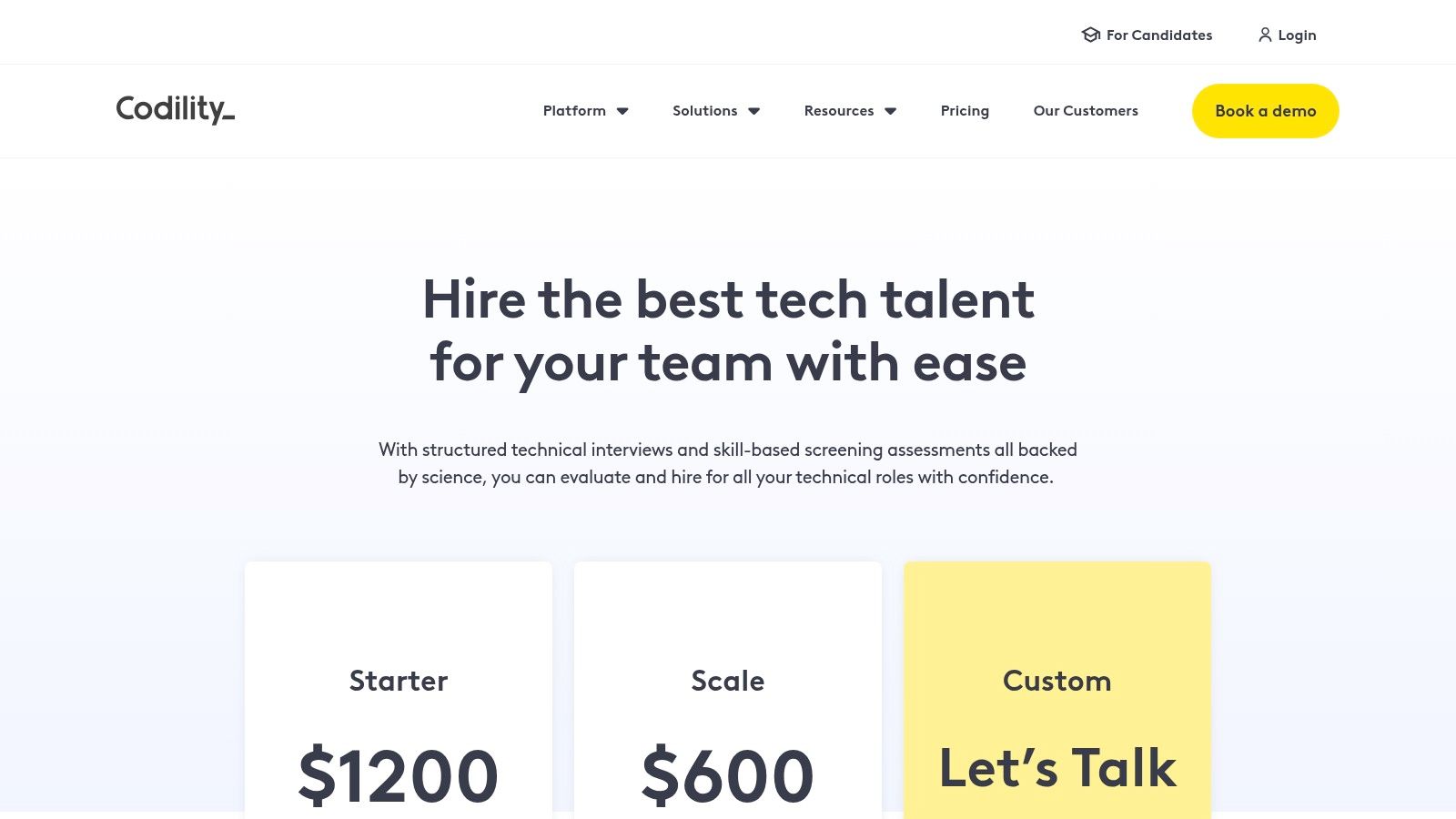
Its primary appeal lies in its simplicity and transparent usage model, where a shared pool of "invites" can be used for either screening tests or live interviews. For those seeking to evaluate candidates on complex, real-world engineering tasks rather than isolated challenges, you can explore alternatives to Codility.
Main USP: A flexible, invite-based pricing model that allows teams to use a single pool of credits for either asynchronous tests or live interviews, simplifying resource management.
Main 3 Features: (1) A science-backed task library with over 1,200 tasks. (2) A unified platform for both "Screen" (tests) and "Interview" (live coding). (3) Built-in plagiarism detection and fundamental proctoring tools.
One Standout Feature: The unified "invite" currency. This allows hiring managers to decide on the fly whether to use their quota for a screening test or a live interview, offering great flexibility.
Use this tool if you prefer: A straightforward, predictable pricing model and a balanced platform for both screening and interviewing based on algorithmic tasks.
Who should not buy: Teams that require advanced proctoring or assessments that simulate complex, multi-file projects rather than single-function challenges.
Pricing: Offers clear, published pricing tiers based on a set number of invites.
Limitations: The starter plan is limited to a single user, and its proctoring is considered basic compared to enterprise-focused alternatives.
5. HackerEarth Assessments + FaceCode
HackerEarth provides a robust suite of developer assessment tools that cater well to teams seeking both technical screening and comprehensive skill evaluation. Combining asynchronous coding assessments with a live pair-programming environment called FaceCode, it stands out for its versatility. Its inclusion of psychometric and soft-skills testing helps build a holistic candidate profile.
The platform is particularly attractive for small to mid-sized teams due to its competitive entry-level pricing and a vast question library. It supports a wide array of technical roles, including niche specializations like DevOps and GenAI. Its credit-based metering system offers flexibility, allowing teams to pay for what they use.
Main USP: A holistic assessment platform that combines technical skill tests with psychometric and soft-skills evaluations, providing a 360-degree view of the candidate.
Main 3 Features: (1) A massive question library with over 25,000 questions. (2) "FaceCode" for integrated live pair-programming interviews. (3) Support for non-technical assessments like psychometric tests.
One Standout Feature: The breadth of its question library, which covers not only standard programming but also specialized domains like Machine Learning, DevOps, and Quality Assurance.
Use this tool if you prefer: A flexible, credit-based platform that allows for holistic candidate evaluation beyond just coding skills.
Who should not buy: Teams that prefer a simple, all-inclusive subscription model, as the credit-based system can lead to unexpected overage costs.
Pricing: Begins with an attractively priced entry tier, but its credit-based metering can introduce management overhead.
Limitations: The credit system and annual auto-billing for overages can be a drawback for teams with fluctuating hiring needs.
6. DevSkiller TalentScore
DevSkiller TalentScore is a technical screening and interview platform built around a "RealLifeTesting" methodology. It focuses on evaluating developers using realistic work-sample tasks and project-based challenges. This approach is ideal for hiring managers who want to see how a candidate would perform on tasks that mirror their actual day-to-day job.
Its main strength is the authenticity of its assessments, allowing candidates to use a familiar in-browser VS Code editor or even their local IDE with Git. For teams that prioritize simulating a complete on-the-job environment, you can learn more about DevSkiller's alternative approaches.
Main USP: The "RealLifeTesting" methodology, which allows candidates to complete project-based tasks in their local IDE and submit their work via Git, closely mimicking a real work scenario.
Main 3 Features: (1) A library of over 5,000 work-sample tasks. (2) Support for both a VS Code-powered in-browser IDE and local Git-based workflows. (3) An integrated platform for assessments and live code-pairing interviews.
One Standout Feature: The ability for candidates to use their own local development environment. This provides a high-fidelity signal on their practical skills and tooling proficiency.
Use this tool if you prefer: Assessments that closely mirror real-world development workflows, including the use of local IDEs and Git.
Who should not buy: Smaller teams or those looking for transparent, self-service pricing, as it is enterprise-focused with a custom quote model.
Pricing: Not publicly listed and typically requires a demo or custom quote.
Limitations: Business plans often require annual commitments, and the lack of transparent pricing can be a barrier for smaller companies.
7. TestDome
TestDome positions itself as a practical, pay-as-you-go skills testing platform, making it a great choice for small to mid-sized companies with fluctuating hiring needs. It eliminates the need for a subscription by offering credits that never expire. The platform focuses on high-quality, pre-made tests designed to evaluate practical problem-solving.
Its core advantage is simplicity and transparent pricing, where all features are included regardless of purchase volume. While its library is less extensive than enterprise giants, its focus on AI-resistant questions provides a reliable screening solution. For teams that need more complex project watch-them-work tasks, you can explore alternatives to TestDome.
Main USP: A flexible, pay-as-you-go pricing model with credits that never expire, making it ideal for companies with infrequent or unpredictable hiring needs.
Main 3 Features: (1) A library of over 2,000 AI-resistant questions. (2) An all-inclusive feature set with proctoring and a collaborative IDE. (3) Transparent, per-candidate pricing with no subscriptions.
One Standout Feature: The "credits never expire" policy. This removes the pressure of "use it or lose it" subscriptions, offering maximum flexibility.
Use this tool if you prefer: A simple, cost-effective, and transparent pay-as-you-go model for practical skills testing.
Who should not buy: Large enterprises that require deep ATS integrations, advanced analytics, and enterprise-grade security features.
Pricing: Starts at $20 per candidate and decreases with volume.
Limitations: Lacks the deep integrations and advanced features found in enterprise-focused platforms like HackerRank or Codility.
8. Coderbyte for Employers
Coderbyte for Employers is a highly flexible assessment platform targeting small to mid-sized businesses (SMBs) and talent agencies. Its main differentiator is the unlimited usage model on subscription plans, which removes per-candidate costs. This makes it a great choice for organizations prioritizing cost-effectiveness and administrative simplicity.

The platform is designed for ease of use with both self-service options and enterprise-grade features, striking a balance between accessibility and power. While it excels at straightforward algorithmic challenges, it is less focused on complex, job-replica watch-them-work tasks. For teams needing to see how a candidate debugs a multi-file project, you can explore Coderbyte's alternative approaches.
Main USP: An unlimited usage subscription model that allows for a fixed annual cost regardless of how many candidates are assessed, providing high predictability for scaling teams.
Main 3 Features: (1) Unlimited candidates, assessments, and admins on subscription plans. (2) Both self-service and enterprise tiers are available. (3) Integrations with popular ATS platforms and API access.
One Standout Feature: The predictable, flat-rate subscription. This is ideal for high-growth companies that need to screen a large volume of candidates without worrying about per-assessment fees.
Use this tool if you prefer: A cost-effective, unlimited subscription model for screening a high volume of candidates with standard algorithmic challenges.
Who should not buy: Teams that need to assess candidates on complex, real-world projects and require a more sophisticated IDE experience.
Pricing: Subscription model is its greatest strength, with transparently priced self-service plans.
Limitations: Some concurrency limits may apply to live interviews on lower tiers. The most advanced features are reserved for enterprise customers.
9. CoderPad Screen / Codingame for Work
CoderPad Screen, formerly known as CodinGame for Work, is a candidate-friendly platform that leverages gamification to make technical assessments more engaging. It is particularly well-suited for university recruiting and roles where creating a positive first impression is a top priority. The platform blends asynchronous challenges, live interviews, and take-home projects.

Its primary advantage is the high level of candidate satisfaction driven by its unique, puzzle-like challenges. For teams needing to assess how candidates build and debug code in a production-like environment, an alternative like Utkrusht.ai offers job-replica watch-them-work tasks that mirror on-the-job responsibilities more closely.
Main USP: A gamified assessment experience that improves candidate engagement and completion rates, making it ideal for university recruiting and top-of-funnel screening.
Main 3 Features: (1) A library of over 3,500 gamified challenges. (2) A unified platform for screening, live interviews ("Pads"), and take-home projects. (3) Robust integrity features like Code Playback and plagiarism detection.
One Standout Feature: The "Clash of Code" and other game-like challenges that make the assessment feel less like a test and more like a fun, interactive puzzle.
Use this tool if you prefer: An engaging, gamified experience to attract junior talent and improve assessment completion rates.
Who should not buy: Teams hiring for senior roles that need to evaluate complex system design skills or performance on realistic, non-gamified tasks.
Pricing: Public pricing varies; be mindful of potential overage charges for tests or interviews that exceed your plan's limits.
Limitations: Its gamified approach may not fully replicate the complexity of enterprise-level software development tasks.
10. iMocha
iMocha is a skills assessment platform that offers a broad library of coding, cloud, and data tests designed for rapid, top-of-funnel screening. Its primary advantage is its extensive range of ready-made, job-role-specific tests. This allows hiring teams to quickly deploy assessments for various tech stacks without significant setup.
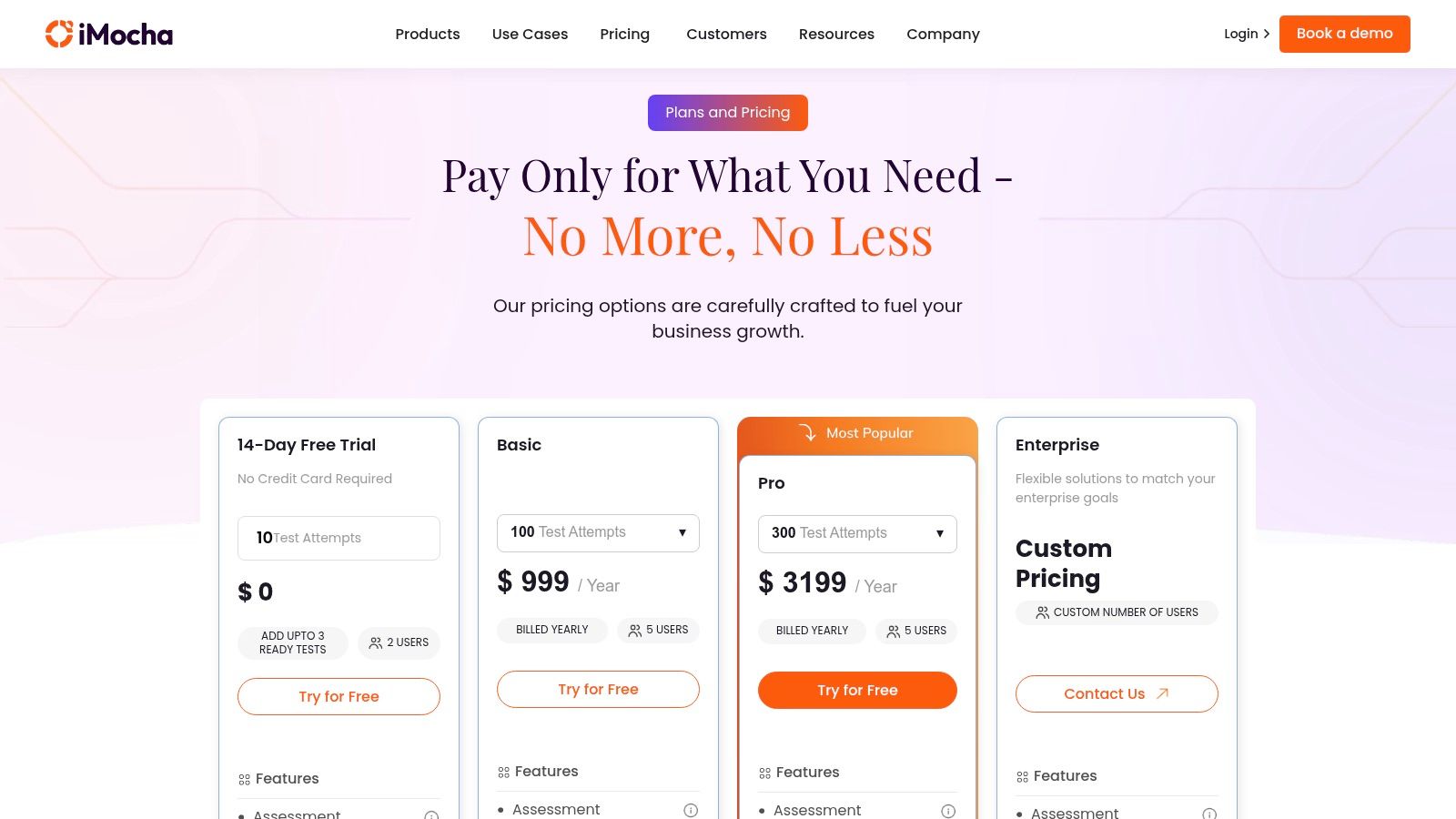
The platform’s core value is its speed and accessibility, particularly with its generous 14-day free trial that requires no credit card. While it offers a comprehensive suite for initial screening, its focus remains on standardized tests rather than complex, real-world project watch-them-work tasks.
Main USP: A vast library of ready-to-use, job-role-specific tests that allows for quick and easy deployment of assessments across a wide range of technical skills.
Main 3 Features: (1) A large library of pre-built assessments for roles like Full Stack Developer and DevOps Engineer. (2) Broad skills coverage, including coding, cloud, and data science. (3) A generous 14-day free trial.
One Standout Feature: The "Live Coding Interview" feature, which allows interviewers to ask candidates to write code for a problem statement in real-time, providing immediate insight into their coding abilities.
Use this tool if you prefer: A quick and easy way to screen candidates for a diverse set of technical roles using a library of pre-built tests.
Who should not buy: Companies that need to assess candidates on complex, multi-file projects that simulate day-to-day engineering work.
Pricing: A free trial is available, but paid plans require a sales consultation.
Limitations: Lack of transparent pricing can be a hurdle. Assessments are less focused on simulating a real development environment.
11. Mercer | Mettl
Mercer | Mettl is an enterprise-grade assessment platform designed for organizations that require robust security, scalability, and deep customization. It stands out with its massive question library and advanced remote proctoring capabilities. This makes it a go-to choice for companies conducting high-stakes, large-scale hiring initiatives.
Its core advantage lies in its comprehensive and secure assessment delivery system, which includes a suite of simulators and auto-grading features. For teams prioritizing how candidates solve multi-file bugs over isolated challenges, you can explore alternatives to Mettl that offer job-replica watch-them-work tasks.
Main USP: Enterprise-grade security and advanced remote proctoring, making it a trusted platform for high-stakes assessments in regulated industries.
Main 3 Features: (1) An extensive test library with over 100,000 technical questions. (2) Coding simulators with auto-grading for various technologies. (3) Robust AI-powered and human-assisted proctoring.
One Standout Feature: The advanced proctoring suite, which offers a level of security and integrity that is critical for large-scale, remote hiring programs.
Use this tool if you prefer: A highly secure, scalable, and customizable platform for conducting large-scale technical assessments with a strong emphasis on proctoring.
Who should not buy: Smaller businesses or teams needing immediate, off-the-shelf solutions, as the platform is complex and requires a custom quote.
Pricing: Not publicly listed and is available only through custom quotes.
Limitations: The enterprise focus and lack of transparent pricing make it inaccessible for smaller teams. It has a steeper learning curve.
12. Adaface
Adaface positions itself as a candidate-friendly platform that prioritizes realistic, non-puzzle coding questions to improve assessment completion rates. It is designed for small to mid-sized businesses that need an effective, straightforward screening solution. The platform focuses on practical, on-the-job style problems.
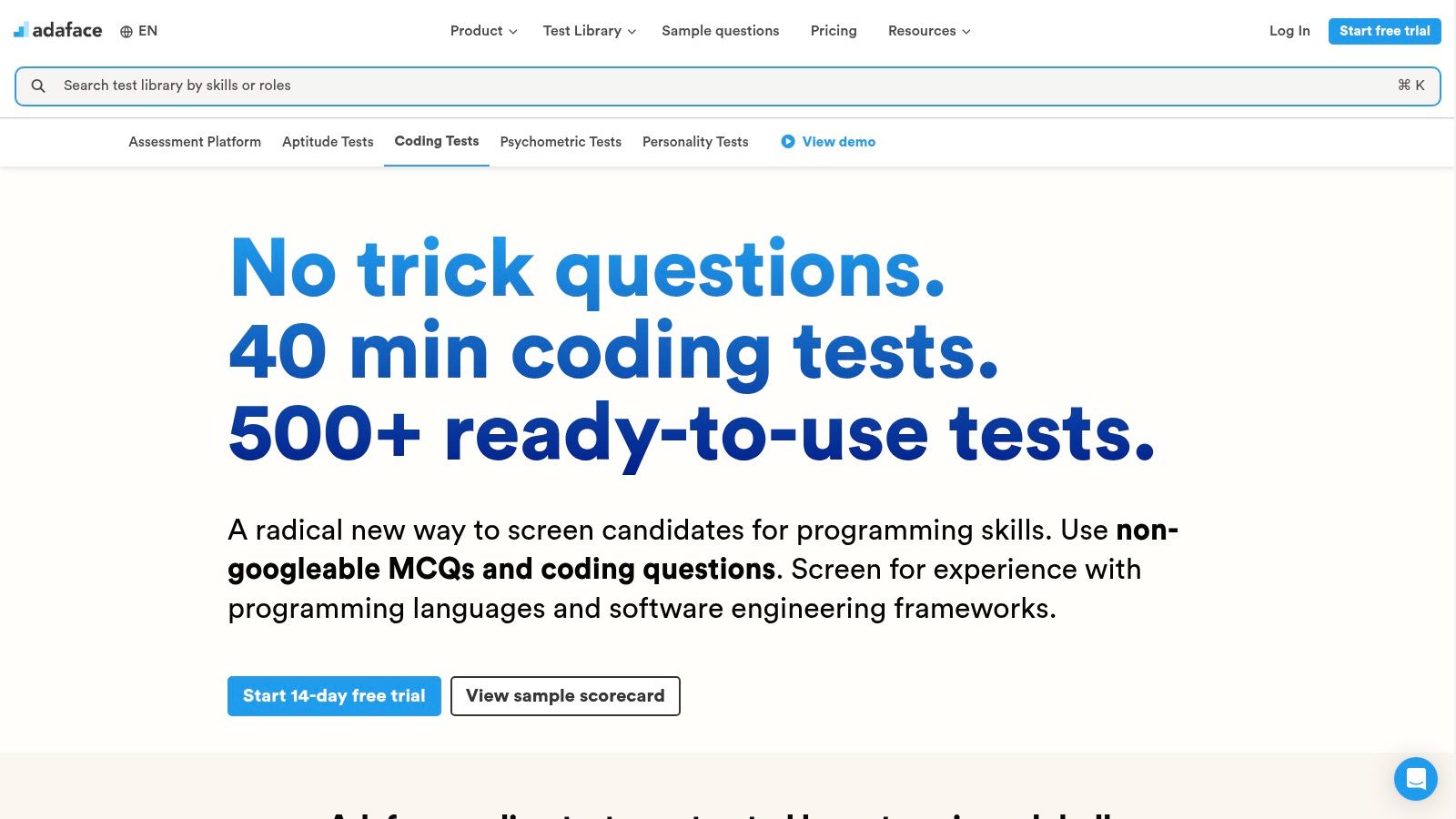
Its core differentiator is a transparent, credits-based pricing model that is highly predictable for teams with fluctuating hiring needs. While it covers core programming skills effectively, it is less suited for companies that require deep, multi-file project watch-them-work tasks. For teams looking to evaluate candidates in a complete, job-replica environment, you can explore alternatives to Adaface.
Main USP: A candidate-friendly approach using short, practical, non-Googleable questions to create a better experience and achieve higher completion rates.
Main 3 Features: (1) A library of over 500 tests focused on practical skills. (2) Short, 45-60 minute assessments designed to respect candidate time. (3) A transparent, credits-based pricing model with refunds for unused credits.
One Standout Feature: The conversational chatbot interface for assessments, which creates a more engaging and less intimidating experience for candidates.
Use this tool if you prefer: A simple, candidate-friendly platform with transparent pricing that focuses on practical, short-form coding challenges.
Who should not buy: Teams that need to assess deep, complex system design skills or require advanced proctoring and enterprise-level integrations.
Pricing: Offers clear annual credit bundles.
Limitations: May lack the extensive enterprise features and deep ATS integrations found in more comprehensive suites.
How to Choose the Right Coding Assessment Tool
Choosing the right tool depends on what your organization values. Do you prioritize theoretical knowledge, or do you seek practical, hands-on problem-solvers who can navigate a real codebase from day one? To make an informed decision, your evaluation should boil down to five critical criteria.
1. Assessment Realism
Does the platform test abstract problems, or does it simulate the actual work your engineers will perform? A high-fidelity assessment that mirrors your tech stack provides the strongest signal. Look for platforms like Utkrusht.Ai that focus on real-world watch-them-work tasks like debugging code or refactoring systems.
2. Candidate Experience
A clunky or frustrating experience will deter top talent. The best candidates want a challenge that feels relevant and respects their time. Ask yourself: "Would my best senior engineer enjoy taking this test?" If the answer is no, it will likely alienate the candidates you want to attract.
3. Integrity and Proctoring
Cheating is a valid concern. Robust proctoring features from tools like HackerRank or Mercer | Mettl might be necessary for high-stakes roles. Alternatively, platforms that use real-world, multi-file projects are inherently more difficult to cheat on than single-function algorithmic problems.
4. Workflow Integration
A new tool should reduce friction, not create it. Check for native integrations with your Applicant Tracking System (ATS), like Greenhouse or Lever. A smooth workflow that automates invitations, reminders, and score reporting saves your teams countless administrative hours.
5. Pricing Model and Scalability
Ensure the pricing model aligns with your hiring velocity. A pay-as-you-go model (TestDome) is ideal for sporadic hiring. An unlimited subscription (Coderbyte) offers better value for high-growth companies. The goal is to find a tool that improves your quality of hire and reduces time spent on interviews.
Frequently Asked Questions
What is the key difference between algorithmic tests and real-world watch-them-work tasks?
How do coding assessment tools prevent cheating?
Can these tools integrate with my existing Applicant Tracking System (ATS)?
How do I ensure a good candidate experience with these tools?
Are coding assessment tools biased against certain types of candidates?
Don’t let weak screening tools slow down your roadmap.
Utkrusht gives you realistic coding watch-them-work tasks, automated scoring, and role-specific depth—everything you need to hire elite engineers. Get started now and transform your hiring pipeline.

Zubin leverages his engineering background and decade of B2B SaaS experience to drive GTM as the Co-founder of Utkrusht. He previously founded Zaminu, served 25+ B2B clients across US, Europe and India.
Want to hire
the best talent
with proof
of skill?
Shortlist candidates with
strong proof of skill
in just 48 hours