Contents
Key Takeaways
Hiring project-based developers requires choosing channels that balance speed, reliability, and skill depth, since short-term projects leave no room for mis-hires.
Different channels serve different needs—freelance marketplaces offer speed, talent networks ensure vetting, developer communities provide niche specialists, and agencies deliver managed teams.
The strongest channels pre-vet developers for real skills, reducing the risk of delays, rework, or quality issues during time-sensitive projects.
Clear scoping and skill-matching are essential, ensuring developers align with project expectations, tech stack, and delivery timelines.
A skills-first approach helps filter out unreliable talent, leading to smoother execution, predictable costs, and faster time-to-value.
With an engineering background and having conducted over 500 tech interviews globally, we know finding candidates is easy; finding the right ones is hard. The real challenge is accurately identifying developers with proven skills without wasting weeks on pointless interviews. This guide cuts through the noise of endless platforms to give you a clear roadmap.
Here’s a quick overview of the 15 best channels we researched:
daily.dev Recruiter: A hiring platform built on a massive, active developer community.
Toptal: An elite network known for its rigorous screening of the top 3% of talent.
Index.dev: Focuses on matching companies with vetted LATAM software engineers.
Upwork: A giant marketplace for a wide range of freelance skills and budgets.
Arc.dev: A platform specializing in vetted, remote developers for long-term projects.
Flexiple: Connects businesses with top-tier freelance developers and designers.
Wellfound (AngelList Talent): Strong focus on the startup ecosystem for full-time and contract roles.
Hired: A marketplace where companies apply to interview pre-vetted candidates.
We Work Remotely: One of the largest and most respected job boards for remote positions.
GitHub Jobs: Leverages the world’s largest developer platform (Note: now retired, but the community is a key talent pool).
Fiverr: Known for project-based services, with a “Pro” tier for vetted talent.
PeoplePerHour: A UK-based platform focused on freelance projects with a strong European talent pool.
CodePen: A community and job board specifically for front-end developers.
SimplyHired: A broad job aggregator with an enormous reach across industries.
WeAreDevelopers: A European-focused tech job board and event organizer.
More companies are shifting to flexible talent. A recent Gallup report found that 36% of the U.S. workforce—roughly 58 million people—are independent workers, a trend accelerating in the tech sector. This guide will help you tap into that massive talent pool effectively, detailing each platform so you can find the best channels to hire project-based developers for your specific needs. For specific project types like building a Minimum Viable Product, looking into dedicated startup MVP development services can be a strategic approach.
1. Daily.dev recruiter
daily.dev Recruiter is not a traditional freelance platform; it’s a hiring channel built on a community of over one million active developers. It taps into a highly engaged audience that is constantly learning and staying updated with the latest tech trends. This makes it a powerful source for finding developers who are passionate and proactive.
Main USP
Access to a massive, highly engaged, and actively learning developer community. You are not just posting a job; you are reaching developers where they already spend their time learning and growing their skills.
3 Key features
Targeted Job Postings: Your job ads are displayed to developers based on their specific tech interests and reading habits.
Employer Branding: Build visibility and credibility within a dedicated developer community.
Access to Passive Talent: Reach skilled developers who may not be actively searching on job boards but are open to the right opportunity.
Pricing
Pricing is based on job posting packages, offering various levels of visibility and targeting options.
Prefer this platform if:
You want to hire developers who are genuinely passionate about their craft and are continuously learning. It’s ideal for building a long-term talent pipeline and employer brand.
Main downside
It’s more of a sourcing channel than a full-service freelance platform. You’ll need your own process for contracting, payments, and, most importantly, skill validation.
2. Toptal
For teams that prioritize pre-vetted, senior-level talent, Toptal is a premium network. It accepts only the top 3% of applicants through a rigorous screening process. This makes it one of the best channels to hire project-based developers for complex, mission-critical projects where expertise is non-negotiable.
Toptal operates more like a high-touch talent consultancy. After you submit your requirements, their team hand-selects candidates for you, typically within 48 hours. This curated approach saves significant time by eliminating the need to sift through hundreds of applications.
Main USP
Exclusive, rigorously vetted network of elite talent. Toptal provides a fast, reliable way to engage senior developers who have already passed extensive technical and soft-skill assessments.
3 Key features
Strict Multi-Stage Vetting: A comprehensive screening process including language skills, timed algorithms, and test projects.
Hands-On Matching Support: Dedicated experts connect you with the most suitable candidates.
Two-Week “No-Risk” Trial: Work with a developer for up to two weeks and only proceed if you are fully satisfied.
Pricing
Toptal requires an initial deposit of $500, which is applied as a credit. Hourly rates for developers typically range from $80 to $200+.
Prefer this platform if:
You have a business-critical project with a healthy budget and need a senior, specialized developer quickly without a lengthy vetting process.
Main downside
The cost is significantly higher than on open marketplaces. This makes Toptal less suitable for startups on a tight budget or for smaller projects. While their vetting is strong, supplementing it with your own project-specific evaluation using technical assessment software for startups is still a best practice.
Website: https://www.toptal.com
3. Index.dev
Index.dev specializes in connecting companies with vetted software engineers from Latin America (LATAM). This focus on a specific region allows them to build deep talent pools and offer time-zone alignment for U.S.-based companies. It’s a strong choice for building remote teams that can collaborate in real-time.
Main USP
Access to a pre-vetted, high-quality talent pool of LATAM developers, offering both technical skill and time-zone compatibility at competitive rates.
3 Key features
Regional Specialization: Deep expertise in the LATAM tech talent market.
Rigorous Vetting: Multi-stage screening process that tests for technical skills, English proficiency, and remote work readiness.
Fast Matching: Connects clients with suitable candidates in under 48 hours.
Pricing
Pricing is based on the developer’s hourly rate, which is competitive due to the regional focus. The platform fee is included in the rate.
Prefer this platform if:
You are a U.S. or European company looking to hire skilled, remote developers who can work during your business hours without the high costs of local talent.
Main downside
The talent pool is geographically limited to Latin America. If you require developers with experience specific to other regions or markets, this may not be the best fit.
4. Upwork
As the world’s largest open freelance marketplace, Upwork offers an unparalleled talent pool for nearly any technology stack. Its sheer scale means you can post a job and receive proposals within hours. The platform provides flexibility and security for both clients and freelancers.
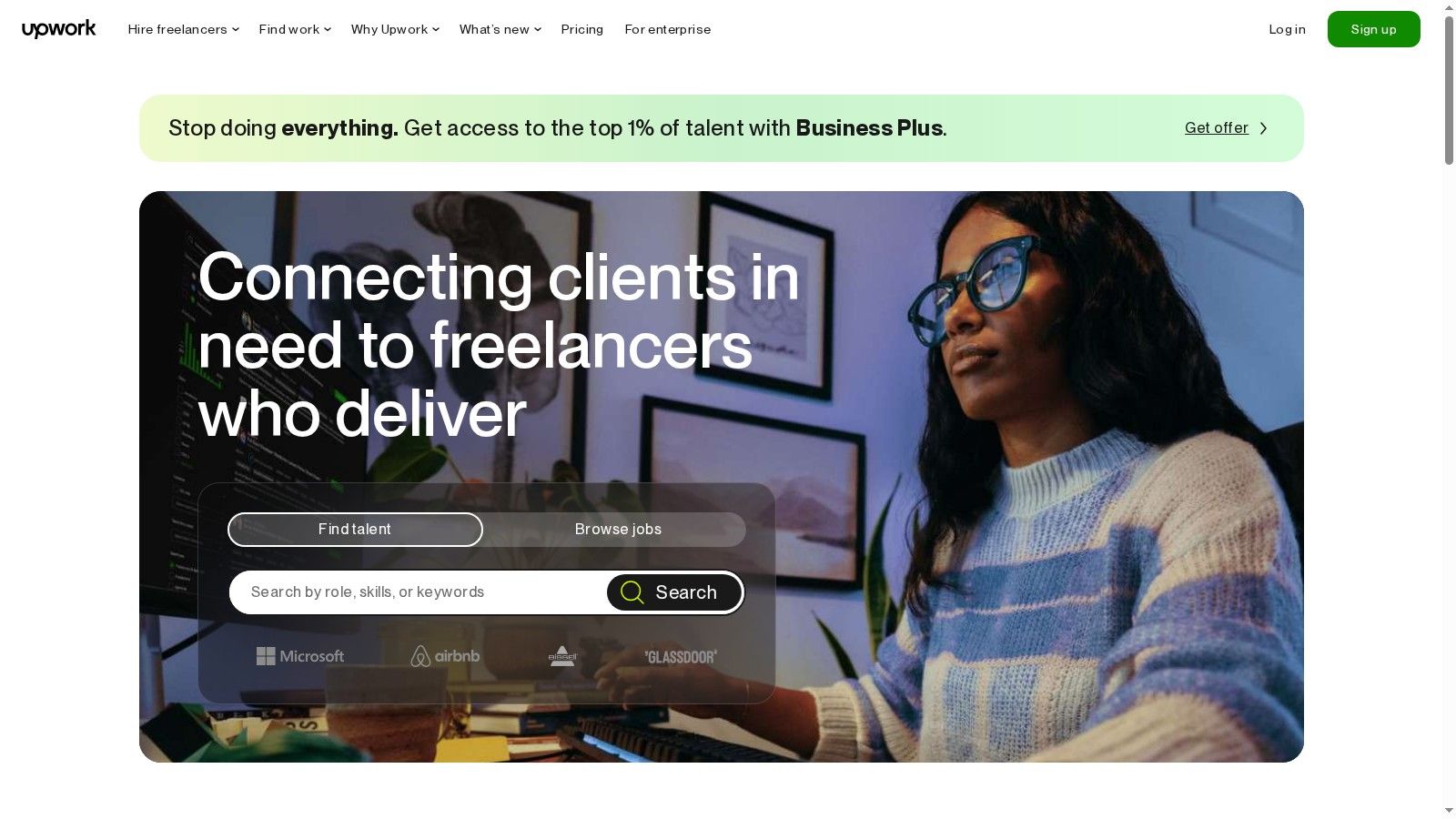
Upwork supports both fixed-price and hourly contracts, with built-in escrow services and a “Work Diary” feature. This provides a strong layer of payment protection and transparency. For engineering managers needing to move quickly, the platform’s AI-assisted search streamlines the discovery process.
Main USP
A massive, diverse talent pool combined with robust, built-in project management and payment protection tools. It’s an all-in-one solution for finding, managing, and paying project-based developers.
3 Key features
Vast Talent Pool: Access millions of developers skilled in everything from React and Django to niche technologies.
Flexible Contract Types: Choose between hourly or fixed-price projects with escrow protection.
Transparent Work History: Freelancer profiles include detailed work history, client ratings, and portfolios.
Pricing
Upwork’s pricing includes a 5% “Marketplace Fee” on all payments. They also offer “Client Plus” plans starting at $49.99/month for additional features.
Prefer this platform if:
You need to hire quickly for a well-defined, short-term project and value the security of integrated payment and time-tracking systems.
Main downside
The quality of talent varies widely. You must invest time in carefully screening proposals and candidates, as the volume of applicants can be overwhelming. Ensuring you have a robust technical screening process is crucial, a topic we explore further in our guide on how to hire software engineers.
Website: https://www.upwork.com
5. Arc.dev
Arc.dev is a premium marketplace for hiring rigorously vetted remote developers, blending the quality assurance of a high-end network with the flexibility needed for project-based work. It provides access to a global talent pool that has been pre-screened for technical skills, English proficiency, and communication.
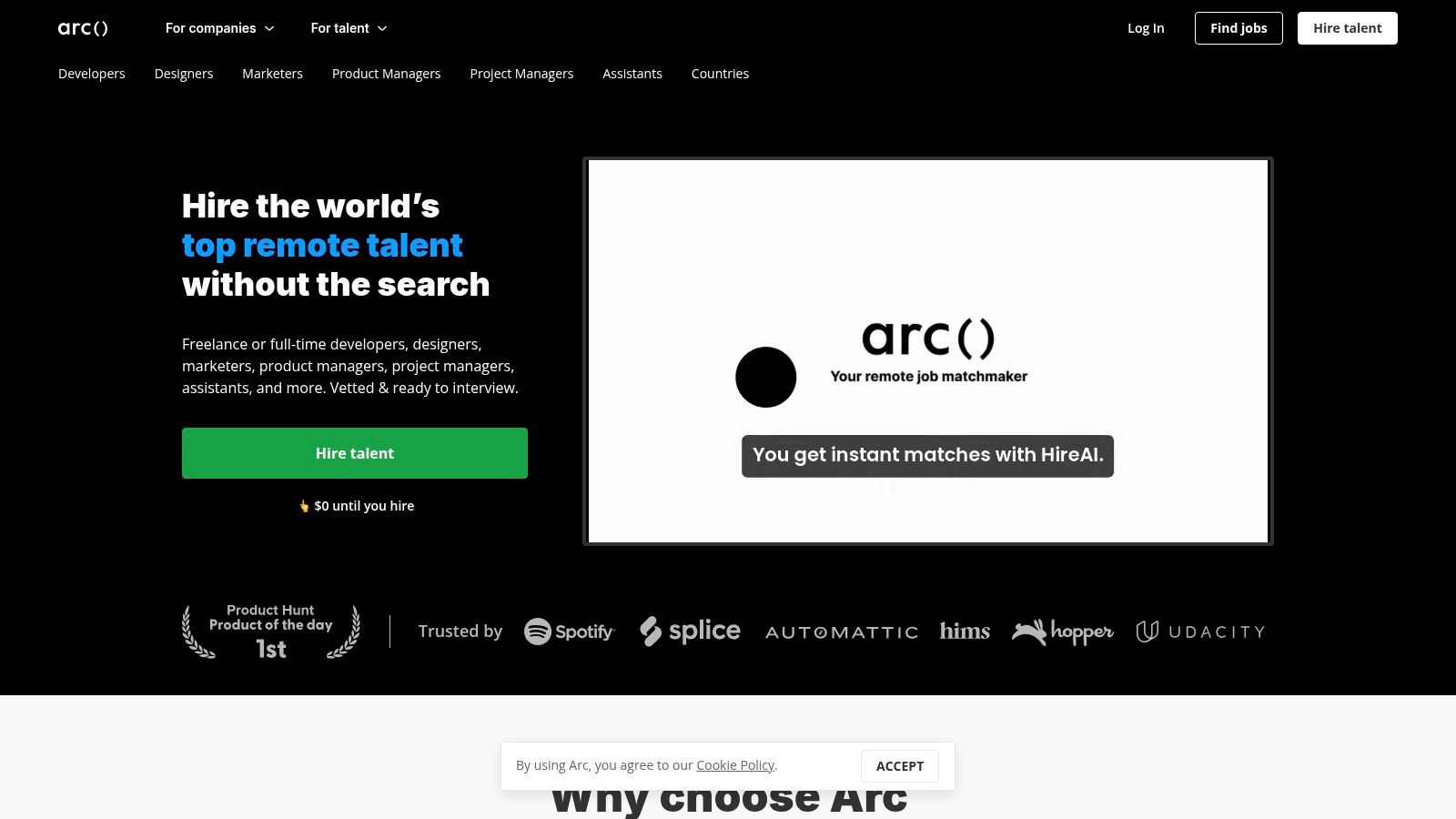
The platform focuses on fast, accurate matching, connecting managers with qualified candidates in as little as 72 hours. It supports both freelance and full-time hiring models and provides resources to navigate the complexities of global compliance and payroll.
Main USP
Arc.dev’s robust, multi-stage vetting process filters for the top 2.3% of applicants. This pre-screening for both technical and soft skills significantly reduces hiring risk and time investment.
3 Key features
Intensive Vetting Process: Candidates undergo profile reviews, behavioral interviews, technical assessments, and pair programming sessions.
Fast Matching: The platform’s algorithm and talent team present a shortlist of ideal developers within days.
Global Compliance Support: Arc.dev offers services to handle contracts, payments, and compliance for international hires.
Pricing
Arc.dev does not publicly list its platform fees. Rates are premium compared to open marketplaces, reflecting the pre-vetting investment.
Prefer this platform if:
You prioritize talent quality and speed over minimizing cost. It’s ideal for U.S.-based teams looking to hire skilled nearshore or offshore developers without the uncertainty of an open marketplace.
Main downside
The primary drawback is the cost. Additionally, the exact markup or platform fee is not transparently published, making it difficult to compare total costs.
Website: https://arc.dev
6. Flexiple
Flexiple focuses on connecting businesses with the top 1% of freelance developers and designers. Their screening process is comprehensive, ensuring that only high-caliber talent makes it into their network. This makes it a reliable choice for companies that need quality and don’t have time to vet candidates themselves.
Main USP
A highly curated network of the top 1% of freelance talent, combined with a personalized matching process and a one-week risk-free trial.
3 Key features
Top 1% Talent: A rigorous, multi-step screening process ensures access to elite developers and designers.
Personalized Recommendations: Their team provides handpicked recommendations based on your project needs.
Risk-Free Trial: Work with a freelancer for a week to ensure they are the right fit before making a financial commitment.
Pricing
Pricing is transparent and based on the freelancer’s hourly rate, with no hidden fees for the client.
Prefer this platform if:
You need top-tier talent for a critical project and value a curated, high-touch experience with the safety net of a trial period.
Main downside
The talent pool, while high-quality, is smaller than on larger platforms. This may result in fewer options for highly niche or specialized skill sets.
7. Wellfound (formerly AngelList talent)
Wellfound is the go-to platform for the startup ecosystem. It connects millions of job seekers with startups, from seed-stage to unicorns. While it’s known for full-time roles, it has a strong and growing section for project-based and contract work, making it ideal for startups needing flexible talent.
Main USP
Unparalleled access to talent that is specifically interested in working for startups. The platform’s focus on transparency, with salary and equity details often listed upfront, attracts a unique candidate pool.
3 Key features
Startup-Focused Talent Pool: Access millions of candidates who are actively looking to work in a startup environment.
Rich Candidate Profiles: Profiles often include detailed work history, personal projects, and GitHub links.
Free to Use: Basic job posting and candidate search features are free for companies.
Pricing
Wellfound offers a free tier for basic job postings and has premium “Curated” and “Recruit Pro” plans for advanced sourcing and filtering tools.
Prefer this platform if:
You are a startup looking for developers who are passionate about building products from the ground up and are comfortable with a fast-paced environment.
Main downside
The platform is heavily geared towards full-time hiring. While contract roles are available, the search and filtering tools are less optimized for short-term project-based work compared to dedicated freelance platforms.
8. Hired
Hired flips the traditional job search model on its head. Instead of companies posting jobs and waiting for applicants, pre-vetted candidates are put into a marketplace where companies “apply” to interview them. This intent-driven model ensures that you are only talking to developers who are actively looking for new opportunities.
Main USP
An intent-driven marketplace where companies bid on pre-vetted, active candidates. This speeds up the hiring process by focusing only on developers who are ready to make a move.
3 Key features
Curated Candidate Pools: Candidates are pre-screened for skills and experience before entering the marketplace.
Upfront Salary Transparency: Candidates state their salary expectations, and companies see this before reaching out.
Efficient Sourcing: The reversed model reduces the time spent on sourcing and initial outreach.
Pricing
Hired operates on a subscription model or a success fee, which is a percentage of the developer’s first-year salary (or a pro-rated amount for contract roles).
Prefer this platform if:
You need to hire for well-defined roles quickly and want to engage with candidates who are actively on the market.
Main downside
The model is primarily optimized for full-time hires, although it supports contract-to-hire and freelance roles. The cost structure can be expensive for short-term projects.
9. We work remotely
We Work Remotely (WWR) is one of the largest and most respected job boards dedicated exclusively to remote work. It’s not a freelance marketplace but a high-traffic job board that attracts a global audience of experienced professionals who are committed to remote work.
Main USP
Access to a massive, global community of remote-first professionals. Its strong reputation means it attracts high-quality candidates who trust the platform.
3 Key features
Highly Targeted Audience: Every visitor to the site is specifically looking for remote opportunities.
Simple Job Posting: A straightforward process for posting jobs with a flat fee.
Strong Brand Recognition: WWR is a well-known and trusted name in the remote work community.
Pricing
A standard job post costs a flat fee of $299 for 30 days.
Prefer this platform if:
You are hiring for a remote-only position and want to cast a wide net to a global pool of experienced remote workers.
Main downside
It’s a job board, not a platform. There are no tools for vetting, payments, or project management. You are responsible for the entire hiring and management process.
10. GitHub jobs (community)
While the official GitHub Jobs board has been retired, the GitHub platform itself remains one of the most powerful places to find developers. Engineering managers can find talent by looking at who is contributing to relevant open-source projects, who is creating popular repositories, or who has a profile that showcases strong coding skills.
Main USP
The ability to see a developer’s actual work. You can review their code quality, collaboration style (through pull requests), and passion for specific technologies before ever reaching out.
3 Key features
Proof of Skill: A developer’s GitHub profile is a living portfolio of their work.
Access to Passionate Developers: Find developers who contribute to projects in their spare time, indicating a high level of engagement.
Targeted Sourcing: You can search for developers based on the specific languages, frameworks, or projects they contribute to.
Pricing
Sourcing on GitHub is free.
Prefer this platform if:
You have the technical expertise to evaluate a developer’s code and want to find talent based on proven skill rather than a resume.
Main downside
This is a pure sourcing method and is very time-consuming. It requires a significant investment in searching, outreach, and building your own hiring pipeline from scratch.
11. Fiverr
Initially known for small “gigs,” Fiverr has evolved with its Fiverr Pro tier, which offers access to hand-vetted, top-tier developers. This makes it a good channel for hiring project-based developers when you need a reliable, fixed-scope outcome without the uncertainty of an open marketplace.
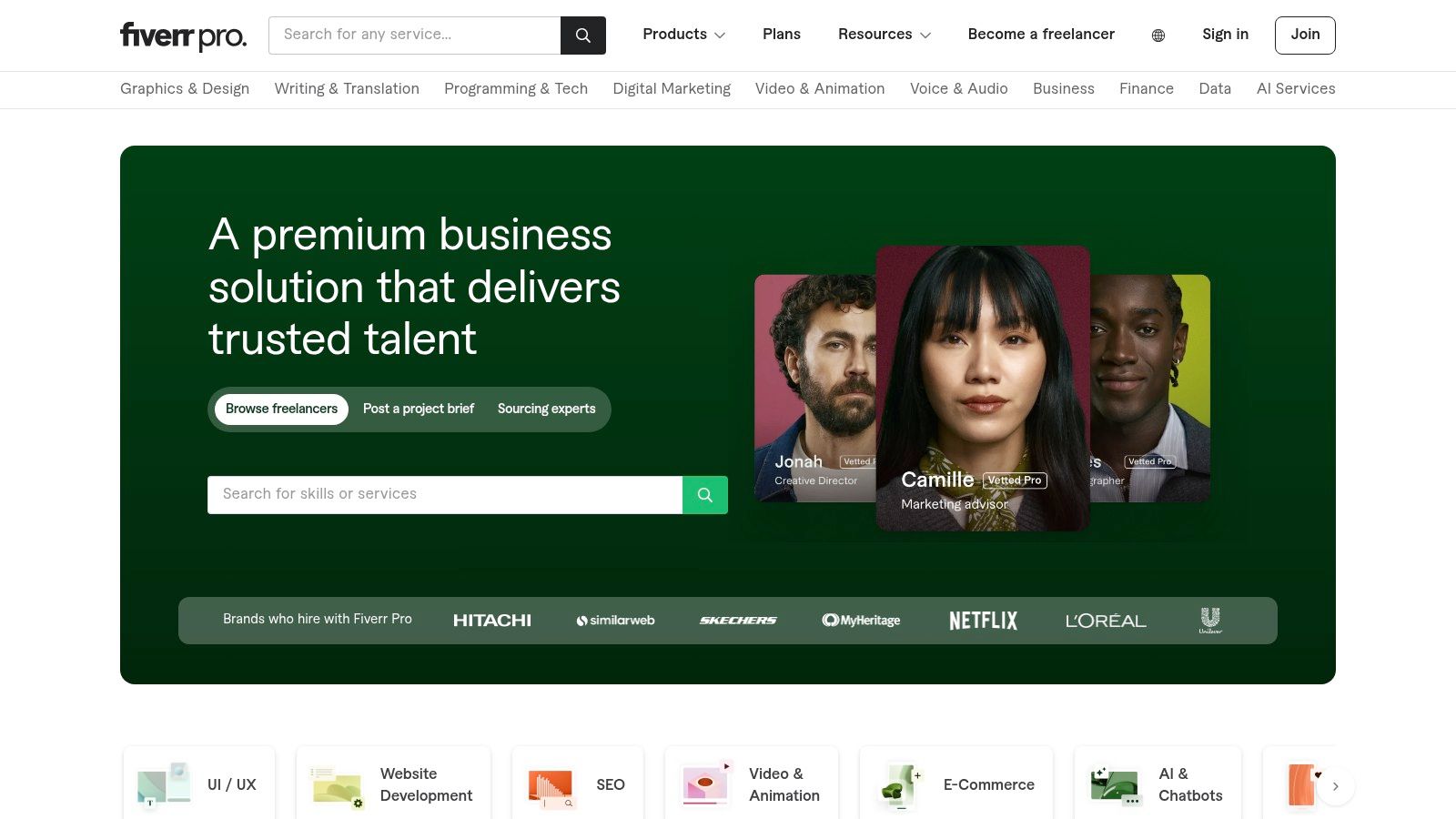
Fiverr Pro operates on a catalog-style model where developers offer pre-packaged services with clear deliverables, timelines, and pricing. This “productized” approach simplifies the hiring process, allowing you to purchase a development task like you would a product online.
Main USP
A “gig-based” model applied to high-caliber, vetted talent. It provides speed and clarity for fixed-scope projects, removing lengthy proposal and negotiation phases.
3 Key features
Vetted “Pro” Talent: Access a select pool of developers verified for professional experience and quality.
Catalog-Style “Gigs”: Hire developers for clearly defined, fixed-price deliverables.
Escrow and Milestone Support: Secure payments are held and released upon completion of milestones.
Pricing
Pricing is set by the freelancer for each “gig.” Fiverr charges a buyer service fee on every transaction.
Prefer this platform if:
You have a highly specific, well-defined task (e.g., “develop a custom WordPress plugin”) and prioritize speed and cost certainty.
Main downside
The platform is less suited for complex or long-term projects that require agile development. Quality outside the “Pro” tier can be highly variable, so it’s crucial to complement the platform’s vetting with your own proof-of-work assessments, a concept we explore in our guide on what is proof-of-work-based hiring.
Website: https://pro.fiverr.com
12. PeoplePerHour
PeoplePerHour is a UK-based freelance platform with a strong presence in Europe. It combines elements of both project-based listings and pre-packaged “Hourlies” (similar to Fiverr’s gigs). This hybrid model provides flexibility for different types of project needs.
Main USP
A strong European talent pool and a flexible platform that supports both custom project bidding and fixed-price “Hourlies.”
3 Key features
Hybrid Model: Post a project for bids or purchase a pre-defined, fixed-price service.
AI-Powered Matching: An AI system helps to match the best freelancers to your project posting.
Escrow Protection: Funds are held securely in an escrow account until the work is approved.
Pricing
Clients pay a service fee on each transaction, which varies based on the total spending.
Prefer this platform if:
You are looking for freelance talent from the UK or Europe and want the flexibility of choosing between bidding on a project or buying a fixed-price service.
Main downside
The user interface can feel dated compared to newer platforms. The talent pool is also smaller and less globally diverse than on giants like Upwork.
13. CodePen
CodePen is not primarily a hiring platform, but a social development environment for front-end designers and developers. It’s a place where they build and share “Pens” (snippets of code), test out new ideas, and build portfolios. The platform also has a dedicated job board.
Main USP
Access to a community of creative and skilled front-end developers who showcase their work publicly. It’s an excellent place to find talent with a strong eye for design and user experience.
3 Key features
Live Portfolios: Developers’ profiles are filled with interactive code snippets you can see and test.
Niche Community: The entire platform is focused on front-end technologies like HTML, CSS, and JavaScript.
Job Board: A dedicated section for posting front-end development jobs to a highly relevant audience.
Pricing
Posting a job on the CodePen job board has a flat fee.
Prefer this platform if:
You are specifically looking to hire a front-end developer and value the ability to see their creative and technical skills in action.
Main downside
It is highly specialized for front-end roles. You will not find back-end, DevOps, or mobile developers here.
14. SimplyHired
SimplyHired is a massive job aggregator that pulls listings from thousands of sites across the web. It functions like a search engine for jobs, providing enormous reach for any role you post. It’s a volume play, designed to get your job description in front of as many eyes as possible.
Main USP
Unmatched reach. SimplyHired distributes your job posting across its network and other partner job boards, maximizing visibility.
3 Key features
Vast Distribution Network: Your job is posted to SimplyHired and 100+ partner job boards.
Free Job Posting: It offers a free job posting option, making it a low-risk choice.
Integrated Hiring Tools: Provides basic tools for screening and managing applicants.
Pricing
It’s free to post a job. You only pay when you want to contact applicants whose resumes you find in their database.
Prefer this platform if:
You want to maximize the visibility of your job posting across a wide range of platforms and are prepared to screen a high volume of applicants.
Main downside
The signal-to-noise ratio is very low. Because it’s an aggregator, you will receive a large number of applications, many of which will be unqualified.
15. WeAreDevelopers
WeAreDevelopers is a leading tech job platform and community in Europe. It’s known for its large-scale developer conferences and events, and its job board is a primary destination for developers in the region looking for new opportunities.
Main USP
Deep access to the European developer community. It’s the go-to platform for companies looking to hire tech talent within Europe.
3 Key features
European Focus: A highly targeted audience of developers from across Europe.
Community Engagement: The platform engages developers through events, content, and conferences, building a strong community.
Employer Branding: Offers opportunities for companies to build their brand within the European tech scene.
Pricing
Pricing is based on job posting packages, with options for increased visibility and employer branding.
Prefer this platform if:
Your primary hiring target is developers located in Europe.
Main downside
Its focus is almost exclusively on the European market. If you are looking for talent in other regions like the Americas or Asia, other platforms would be more effective.
3 Platforms for hiring niche tech talent
Sometimes you need a specialist. While general platforms are great, niche channels offer direct access to experts in fields like cybersecurity, DevOps, and AI.
Cybersecurity - Cybrary: More than just a job board, Cybrary is a massive online learning platform for cybersecurity professionals. Hiring managers can source talent here that is actively upskilling and certified in the latest security protocols.
DevOps - DOJobs.net: A highly specialized job board purely for DevOps, SRE, and Cloud Engineering roles. Posting here ensures you reach an audience that lives and breathes infrastructure as code, CI/CD, and cloud platforms.
AI/ML - Kaggle: Kaggle is the world’s largest data science community. While known for its competitions, its Jobs board is a goldmine for finding data scientists, machine learning engineers, and AI researchers who have proven their skills on real-world datasets.
Key challenges in retaining the best project-based developers
Finding great project-based developers is only half the battle. Retaining them for future projects is what builds a powerful, flexible workforce. Here are the key challenges:
Lack of Integration: Project-based developers often feel like outsiders. They are not included in team meetings, social events, or long-term planning, which makes them feel disconnected and less invested.
Inconsistent Workflow: A “feast or famine” cycle of work is a major issue. If you cannot provide a somewhat predictable stream of projects, your best developers will find clients who can.
Poor Onboarding and Offboarding: Throwing a developer into a project with no context, poor documentation, and unclear goals is a recipe for failure. A smooth process that respects their time is critical for a positive experience.
Delayed Payments: Nothing sours a relationship faster than late payments. Freelancers are running a business, and prompt payment is a fundamental sign of respect and professionalism.
The solution is to treat your project-based developers like valued team members. Integrate them, communicate clearly, pay them on time, and provide the tools they need to succeed.
Quick 10-question checklist: when to hire for project-based requirements
Not every need requires a project-based hire. Use this checklist to decide if it’s the right move for you.
Is the scope of work clearly defined with a specific start and end? (Yes = Project-based)
Do you need a highly specialized skill that your current team lacks for one specific project? (Yes = Project-based)
Is the project short-term (e.g., less than 6 months)? (Yes = Project-based)
Do you need to scale your team up quickly to meet a deadline, then scale back down? (Yes = Project-based)
Is the work non-core to your main business operations? (Yes = Project-based)
Does the project require ongoing maintenance and daily integration with the core team? (No = Full-time)
Are you trying to fill a leadership or management role? (No = Full-time)
Is the scope of work vague and expected to evolve significantly over a long period? (No = Full-time)
Do you need someone to own a core system or product long-term? (No = Full-time)
Is building institutional knowledge and deep domain expertise a primary goal for this role? (No = Full-time)
If you answered “Yes” to most of the first five questions and “No” to the last five, a project-based developer is likely your best option.
Frequently Asked Questions
What is the most effective way to vet developers found on these platforms?
How much should I budget for a project-based developer?
How do I handle contracts and payments for international developers?
What's the biggest mistake companies make when hiring project-based developers?
Beyond technical skills, what is the most important soft skill to look for?
Stop guessing which developers can deliver under pressure.
With Utkrusht, assess real ability before hiring and build a dependable project team. Get started now and avoid costly misfires.

Founder, Utkrusht AI
Ex. Euler Motors, Oracle, Microsoft. 12+ years as Engineering Leader, 500+ interviews taken across US, Europe, and India
Want to hire
the best talent
with proof
of skill?
Shortlist candidates with
strong proof of skill
in just 48 hours


