Contents
Key Takeaways
Work readiness is defined by a blend of soft, technical, and behavioral skills that determine whether someone can be effective from day one.
Twelve core skills consistently matter across industries—including communication, problem-solving, accountability, adaptability, teamwork, and digital literacy.
Employers often overlook work-readiness skills, leading to mis-hires who struggle despite strong technical knowledge.
Assessing these skills requires structured interviews, real-world scenarios, and behavioral observation, not assumptions or résumé-driven judgment.
Candidates with strong work-readiness skills ramp faster, collaborate better, and contribute more sustainably, making them especially valuable in fast-moving teams.
You hired a developer with a flawless resume, but weeks later, they are struggling to ship code. The problem isn’t their knowledge of algorithms; it’s a gap in the practical, day-to-day work readiness skills that traditional interviews almost never touch.
This disconnect between a resume and what an engineer can actually do creates serious friction. Onboarding drags on, projects get delayed, and your senior engineers turn into full-time mentors instead of shipping features.
This guide breaks down the 12 essential skills that separate a good engineer on paper from a great one in production. More importantly, we’ll give you a clear framework to assess them, so your next hire makes an impact from week one.

Why work readiness is your hiring blind spot
Technical chops alone don’t make an effective engineer. Real work readiness is a mix of hard and soft skills that let a developer applytheir knowledge and thrive inside a real team.
Thinking about these skills one by one is a mistake; they all feed into each other to create a developer who makes a real impact. It’s a critical blind spot that costs you time, money, and momentum.
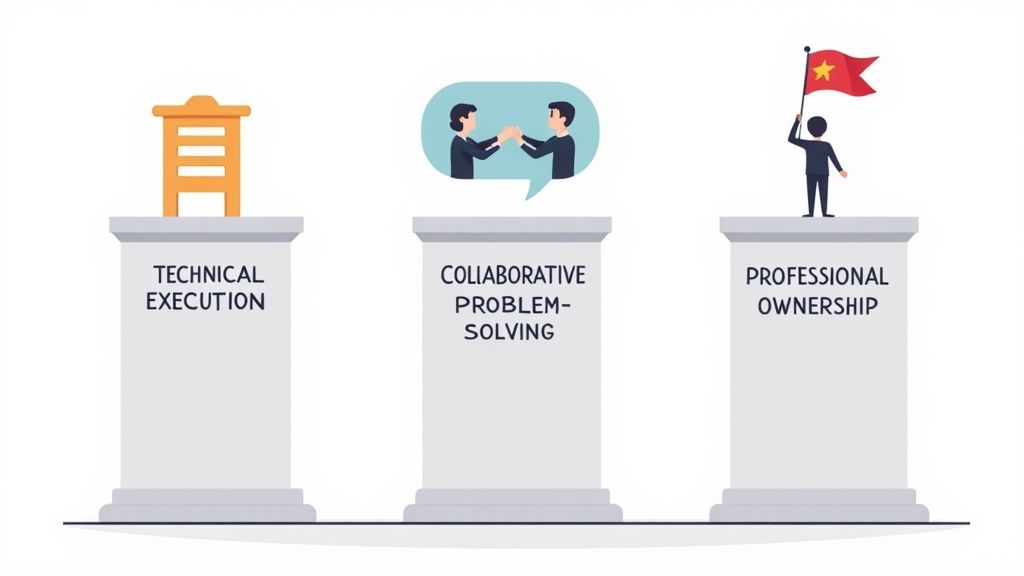
We’ve broken down the 12 essential work readiness skills into three core pillars. Together, they give you a complete picture of what a truly job-ready candidate looks like.
The 12 essential work readiness skills
Here are the 12 skills grouped into three pillars that define a truly prepared engineer.
Pillar 1: Technical Execution
This is about the practical, hands-on ability to write, fix, and ship code in a real-world environment.
Technical Proficiency: Can they write clean, efficient, and readable code that follows established best practices? This is ground zero.
Debugging and Maintenance: How good are they at diving into a complex, unfamiliar codebase to diagnose and crush bugs? This is where the rubber meets the road.
Tooling Fluency: Are they comfortable and effective with essential tools like Git, their IDE, and build automation?
Deployment and Ops Practices: Do they understand the basics of getting code into production and following good operational habits?
Pillar 2: Collaborative Problem-Solving
Software development is a team sport. This pillar is about the communication and teamwork that turn individuals into a high-performing team.
5. Problem-Solving: Can they break down a big, messy problem, figure out the requirements, and come up with a practical solution?
6. Communication: How well do they explain complex technical ideas to both engineers and non-technical folks?
7. Collaboration: Do they work well with others, giving and receiving code reviews constructively and putting team goals first?
8. Adaptability: When project requirements shift, can they roll with the punches without losing steam?
Pillar 3: Professional Ownership
This last pillar is all about mindset. It’s the accountability and drive that separates a mature professional from someone who needs constant hand-holding.
9. Ownership and Accountability: Do they take full responsibility for their work, from the first line of code to long-term maintenance?
10. Learning Agility: Are they genuinely curious and proactive about learning new tools and technologies to stay sharp?
11. Time Management: Can they prioritize tasks, manage their own workload, and hit deadlines without drama?
12. Resilience: How do they handle tough feedback or setbacks? A great engineer learns from mistakes and stays positive.
Without these, even the smartest engineer will struggle to contribute. This is why you must understand what skills-based hiring truly entails to build an assessment process that works.
The impact of poor work readiness
Hiring based on an impressive resume or an abstract algorithm test is a high-stakes gamble. When you overlook practical work readiness skills, you kick off a domino effect that drains your entire organization.
The first people to feel the pain are your senior developers. Instead of building features, their time gets hijacked by a never-ending onboarding cycle. They become full-time mentors, stuck explaining basic Git workflows and fixing code that isn’t up to professional standards.
This isn’t mentorship; it’s hand-holding. And it pulls your most valuable engineers away from their most critical work.
The financial drain of a skills gap
Let’s talk numbers. Every hour a senior engineer spends teaching a new hire how to actually work is an hour they’re not spending on the product.
If two senior developers spend just five hours a week each hand-holding a new hire for three months, you’ve lost 120 hours of high-value engineering time. That’s three full workweeks that could have shipped a new feature.
This isn’t a new problem. A landmark study from 2006 found a huge chunk of graduates were lacking basic workplace skills like teamwork and professionalism. You can read more about those foundational skill gaps here.
The costs keep piling up:
Delayed Timelines: A single underperforming engineer becomes a bottleneck, slowing the whole team’s velocity.
Reduced Code Quality: Work that lacks professional polish is just technical debt in disguise, demanding more time in code reviews.
Increased Management Overhead: Instead of focusing on strategy, managers are stuck dealing with performance issues.
The damage to team morale
Beyond the balance sheet, the indirect costs are just as destructive. When high-performing engineers have to constantly carry the weight of a colleague who lacks ownership, morale plummets.
Resentment starts to build. They get tired of cleaning up sloppy code and picking up the slack just to hit a deadline.
This erosion of trust is toxic. It leads to burnout among your best people, drives up turnover, and makes it incredibly difficult to attract A-players.
You can see how a skills-first screening process helped one of our clients dramatically improve hiring outcomes and protect their team’s focus. Investing in a better assessment process is a critical strategy to safeguard your team.
How to accurately assess work readiness
Whiteboard interviews and abstract brain teasers are terrible predictors of on-the-job performance. They test for rote memorization, not the practical work readiness skills that matter.
The key is to stop asking theoretical questions and start observing how candidates perform real-world tasks. This means embracing practical, watch-them-work task-based assessments.
You want to see how candidates handle the messy reality of a production-like environment. You’re evaluating their entire process, not just looking for a “correct” answer.
From theory to practice: the watch-them-work task method
The goal is simple: create a controlled environment where you can see a candidate’s skills in action. Instead of asking them to architect a system on a whiteboard, give them access to a pre-configured codebase and a small, well-defined task.
Here are a few powerful watch-them-work task ideas:
The Bug Hunt: Give the candidate a small application with a known bug. Their mission is to diagnose it, document their findings, and submit a pull request with a fix.
The Code Review: Hand them a sample pull request and ask for feedback. Are their comments constructive and specific?
The Refactoring Task: Present them with messy but functional code. Ask them to refactor it for clarity and maintainability, explaining their changes.
These aren’t just tests; they’re a preview of how a candidate will perform on your team.
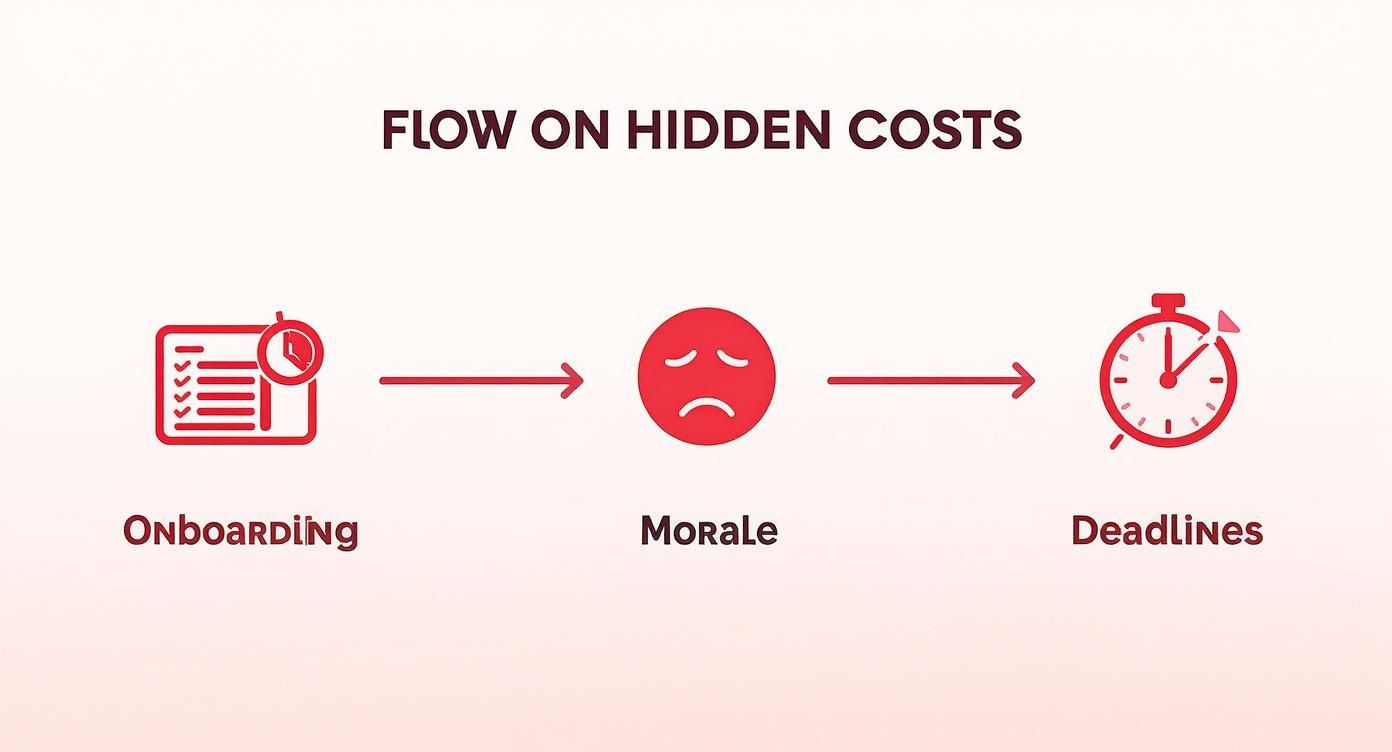
When you overlook these hands-on skills, you invite a cascade of hidden costs into your organization. It starts with painful onboarding and quickly spirals into low team morale and missed deadlines.
Evaluating what truly matters
During watch-them-work tasks, focus on the process, not just the outcome. A candidate who communicates their thought process clearly but doesn’t find the perfect solution is often more valuable.
The most insightful signal is observing how a candidate reacts when they get stuck. Do they ask clarifying questions? Do they methodically use debugging tools?
That moment of friction reveals their true resilience and problem-solving grit. To evaluate this effectively, you might integrate principles from resources like these 10 actionable self-discipline techniques into your assessment framework.
To make this practical, you need a clear rubric scoring candidates on a 1-5 scale across key competencies like:
Problem Diagnosis
Code Quality
Testing and Verification
Communication
Using pre-built, realistic coding environments found in modern job watch-them-work task assessments is a scalable way to implement this strategy without burning out your senior engineers.
Mistakes to avoid when assessing work readiness
Most hiring processes are broken. They’re great at identifying candidates who look good on paper but terrible at finding people who can actually do the job.
Many teams rely on outdated signals that hide the truth about a candidate’s real-world skills. This filters out the doers in favor of the theorists.
The Cengage Group’s 2025 Graduate Employability Report shows a massive gap: 89% of educators believe their students are ready for work, but nearly half of recent graduates feel unprepared. Traditional credentials are not a reliable signal.
Overvaluing pedigree and credentials
One of the biggest traps is giving too much weight to a resume from a big-name tech company. It tells you almost nothing about a candidate’s ability to navigate your specific codebase.
An engineer from a massive company might be an expert in one tiny part of a huge system. Put them in a startup where they need to wear multiple hats, and they might flounder.
Relying on abstract algorithm challenges
Another classic misstep is using abstract algorithm puzzles. These tests don’t measure engineering skill; they measure a candidate’s ability to recall computer science trivia under pressure.
A developer who can balance a binary tree on a whiteboard might be lost when asked to debug a slow API endpoint. These challenges miss the mark on critical work readiness skills like debugging or tooling fluency. Learn about better evaluation methods in our guide on improving your technical skills assessment process.
Conducting unstructured interviews
When every interviewer asks different, unplanned questions, you’re not conducting an assessment—you’re just having a chat. These interviews are unreliable and favor charismatic candidates over competent ones.
Without a consistent framework, interview feedback becomes a collection of subjective opinions. “I got a good feeling from them” is not a reliable indicator of future performance.
You end up with inconsistent feedback and hiring decisions driven by gut feelings and bias, not evidence. A structured scorecard based on the 12 core skills is a simple, powerful solution.
5-Question checklist to evaluate your hiring process
Is your hiring process actually finding engineers who can do the job, or just people who are good at interviews?
This 5-question checklist is a quick audit for your current methods. If you’re answering “no” to most of these, you’re leaving your hiring outcomes to chance.
1. Does our assessment look like a real day on the job?
Think about your main technical screen. A great assessment simulates real work, like debugging a bug or reviewing a pull request. Anything else is just testing academic knowledge, not the practical work readiness skills you actually need.
2. Are we evaluating how candidates think, not just what they know?
The final answer is less important than how a candidate gets there. Does your process let you see their thought process in real-time? You need to see their problem-solving grit in action when they hit a wall.
3. Do we even test for collaboration?
Software engineering is a team sport, but most interviews are a solo performance. You need to see collaboration live. A paired programming session or a simulated code review gives you direct evidence of how they’ll operate on your team.
4. How do we test for learning on the fly?
Tech changes fast. A great engineer doesn’t know everything; they know how to figure out everything. Watching a candidate learn something new under a bit of pressure is a powerful predictor of long-term success.
5. Is our process scalable and fair?
Is your assessment consistent, objective, and respectful of every candidate’s time? Unstructured, marathon interviews and weekend-long take-home projects create bias and push great candidates out of your funnel. A standardized, time-boxed watch-them-work task like those offered by Utkrusht levels the playing field.
Frequently Asked Questions
How can we assess soft skills like communication in a remote hiring process?
Are take-home assignments a good way to test for these skills?
How can a small company implement better assessments without a large budget?
hould we prioritize specific tech stack experience or overall work readiness?
What is the single biggest red flag for a lack of work readiness?
Stop guessing which candidates will thrive in real work environments.
With Utkrusht, measure the skills that drive productivity, teamwork, and long-term success. Get started now.

Zubin leverages his engineering background and decade of B2B SaaS experience to drive GTM as the Co-founder of Utkrusht. He previously founded Zaminu, served 25+ B2B clients across US, Europe and India.
Want to hire
the best talent
with proof
of skill?
Shortlist candidates with
strong proof of skill
in just 48 hours


