Contents
Key Takeaways
Coding assessment tools are now mission-critical for engineering hiring, helping companies evaluate real coding ability at scale without overloading senior developers.
Tools differ drastically in realism, ranging from simple quizzes to full-stack watch-them-work tasks that mirror real development environments.
The highest-rated platforms emphasize real-world problem solving, giving candidates tasks like debugging, feature building, and performance optimization.
Automation, AI scoring, playback reviews, and ATS integrations make modern tools far more efficient and accurate than traditional interviews.
Selecting the right tool depends on your stack, role difficulty, assessment depth, and scalability needs, not just brand popularity.
Finding great developers is a constant challenge. Engineering leaders spend countless hours sifting through resumes and conducting interviews, only to find the process doesn’t reliably predict on-the-job performance.
Traditional screening methods often fail to identify candidates with the practical skills needed to thrive in a real-world development environment. This disconnect leads to costly hiring mistakes and drains valuable engineering time.
This guide cuts through the noise. We will review the 16 best code assessment tools, moving beyond generic feature lists to offer a deep-dive comparison.
You will get a clear understanding of how each platform performs, from simple quizzes to advanced job-watch-them-work task environments that reveal how a candidate truly works.
Our goal is to equip you with the insights needed to stop guessing and start building a more effective, data-driven technical screening process.
Quick glance: here are the top 16 code assessment tools which are top-rated across the globe
Here’s a quick overview of the 16 tools we’ll be comparing in this guide.
iMocha: A comprehensive skills assessment platform with a vast library for both technical and non-technical roles.
LeetCode: A popular platform among developers for practicing algorithmic challenges, also used by companies for screening.
Utkrusht: The first watch-them-work Task platform that assesses candidates in live production environments, by having them perform real-world tasks like debugging and refactoring, and showing you HOW candidates work in real-job situations.
HireHunch: An interview-as-a-service platform that provides expert interviewers to conduct technical screens on your behalf.
TestGorilla: A pre-employment testing tool with a wide range of tests, including coding, cognitive ability, and personality assessments.
CodeSignal: A technical assessment platform known for its validated, standardized tests and detailed candidate performance reports.
HackerRank: An end-to-end platform for technical hiring, offering screening tests, interviews, and a large question library.
WeCP (WeCreateProblems): A platform that offers technical skill assessments, hackathons, and a developer community.
HireVue: A comprehensive hiring platform that combines video interviewing with technical assessments and game-based challenges.
Codility: A technical assessment platform for screening and interviews, focused on role-based tasks and strong integrity controls.
HackerEarth: A developer assessment tool that helps companies hire through coding challenges, hackathons, and interviews.
Vervoe: An AI-powered skills assessment platform that uses immersive watch-them-work tasks to test how candidates perform job-related tasks.
Coderbyte: A flexible platform for coding assessments and interviews, known for its straightforward, scalable pricing models.
CoderPad: A popular tool for live technical interviews, offering a collaborative IDE and a simple, intuitive interface.
TestDome: A skills assessment tool with a flexible, pay-as-you-go pricing model for both programming and non-technical roles.
Mercer Mettl: A large assessment platform offering a wide array of tools for measuring talent, from coding skills to psychometric traits.
What is code assessment?
Code assessment is the process of evaluating a developer’s programming skills and technical abilities. It goes beyond just looking at a resume or asking theoretical questions.
The goal is to get tangible proof of a candidate’s proficiency in specific languages, frameworks, and problem-solving techniques.
This evaluation can take many forms. It might be a short online quiz, a complex algorithmic challenge, or a take-home project that mimics a real-world task. The ultimate aim is to predict how well a candidate will perform on the job before you make a hiring decision.
Effective code assessment helps hiring managers filter candidates objectively. It provides data-driven insights into their capabilities, reducing bias and saving valuable engineering time that would otherwise be spent on unqualified interviews.
What is a code assessment tool?
A code assessment tool is a software platform designed to automate and standardize the process of evaluating developers’ skills. These tools provide a structured environment where candidates can write, run, and debug code to solve specific problems.
They handle the logistics of sending out tests, collecting submissions, and often, automatically scoring the results.
These platforms typically come with a library of pre-built questions and challenges. They also offer features like plagiarism detection, session recording, and integration with Applicant Tracking Systems (ATS) to streamline the hiring workflow.
By using a code assessment tool, engineering leaders can screen a large number of applicants efficiently. This ensures that only the most qualified candidates move forward to the more time-consuming interview stages.
Types of code assessment
Code assessments come in several flavors, each designed to measure different aspects of a developer’s skill set.
Algorithmic Challenges: These are short, puzzle-like problems that test a candidate’s knowledge of data structures and algorithms. They are good for assessing fundamental computer science knowledge.
Multiple-Choice Questions (MCQs): These are quick quizzes used to test theoretical knowledge of a specific language, framework, or concept. They are easy to scale but don’t measure practical application.
Take-Home Projects: Candidates are given a small project to complete on their own time, often over a few days. This format assesses their ability to build something from scratch and follow instructions.
Live Coding Interviews: An interviewer and candidate work together in a shared code editor to solve a problem in real-time. This evaluates communication and collaborative problem-solving skills.
Job Watch-them-work tasks: These are the most realistic type of assessment. Candidates are placed in a pre-configured development environment and asked to perform tasks they would actually do on the job, like fixing a bug or refactoring a piece of code.
How do you assess coding skills?
Assessing coding skills effectively means looking beyond just whether the code works. A holistic evaluation considers multiple dimensions of a candidate’s ability.
First, you assess correctness: does the code produce the right output for all test cases? Next, you evaluate performance and efficiency: is the code optimized to run quickly and use memory responsibly? This is where understanding algorithms and data structures is crucial.
Then, you look at code quality. Is the code clean, readable, and maintainable? Does the candidate follow best practices for style and structure?
Finally, for more senior roles, you assess their problem-solving process: how do they break down a complex problem, consider trade-offs, and explain their decisions? The best assessments provide insight into this entire process, not just the final result.
Comparing the top 16 code assessment tools
1. iMocha
iMocha offers a vast library of over 2,500 skill tests, making it one of the most comprehensive platforms available. It covers not only technical skills like coding and data science but also soft skills, cognitive abilities, and domain-specific knowledge.
This makes it a versatile tool for organizations looking to assess candidates for a wide variety of roles.
Feature | Details |
|---|---|
Main 3 features | 1. Extensive skill library covering tech and non-tech roles. |
2. AI-LogicBox for assessing logical and problem-solving skills without code. | |
3. Strong proctoring features, including video, audio, and image proctoring. | |
Unique differentiation aka core USP | Its sheer breadth of assessment types. iMocha can be a one-stop-shop for an entire organization’s assessment needs, from IT to sales to finance. |
Use this if you prefer | A single platform to assess a wide range of skills across different departments, not just engineering. |
Do not use this if you prefer | High-fidelity, real-world watch-them-work tasks that mimic your specific development environment. |
1 standout feature | AI-LogicBox, which allows you to assess a candidate’s logical thinking on pseudo-code, separating problem-solving ability from language syntax knowledge. |
Pricing | Quote-based pricing, tailored to the number of users and tests. |
Does it evaluate candidates by watching how they work? | No, it primarily relies on automated scoring of challenges and questions rather than observing the problem-solving process via video. |
Best for | Large enterprises that need a scalable, all-in-one assessment solution for diverse hiring needs across the entire company. |
Main downside | The platform can feel less specialized for pure engineering roles compared to more developer-focused tools. The sheer number of options can be overwhelming. |
Does it show proof-of-work samples? | No, assessments are primarily challenge-based. |
Does it have advanced proctoring? | Yes, it offers one of the most robust proctoring suites on the market. |
Does it offer a free trial? | Yes, a free trial is available. |
2. LeetCode
LeetCode is a household name in the developer community, famous for its massive collection of algorithmic coding challenges.
While primarily a platform for developers to practice and prepare for interviews, its “LeetCode for Business” offering allows companies to use the same challenges for screening candidates. It’s the go-to platform for assessing fundamental data structures and algorithm skills.
Feature | Details |
|---|---|
Main 3 features | 1. A vast library of over 2,000 algorithmic problems. |
2. Strong brand recognition and familiarity among developers. | |
3. Sponsored assessments and contests for employer branding. | |
Unique differentiation aka core USP | Its community-driven focus on competitive programming and interview preparation. Companies use it to tap into a culture that many top developers are already a part of. |
Use this if you prefer | To test candidates on classic, algorithm-heavy computer science problems that are common in interviews at FAANG and other large tech companies. |
Do not use this if you prefer | To assess practical, on-the-job skills like debugging a real application, working with a large codebase, or using specific frameworks. |
1 standout feature | The “Discuss” section for each problem, where a massive community shares and debates solutions, making it an unparalleled learning resource. |
Pricing | Quote-based for business plans. |
Does it evaluate candidates by watching how they work? | No, it focuses entirely on the correctness and efficiency of the final submitted code. |
Best for | Companies that prioritize strong fundamentals in algorithms and data structures, especially for new grad and junior roles. |
Main downside | The challenges are often abstract and don’t reflect day-to-day software development, leading to criticism that it tests for “interviewing skills” rather than “engineering skills.” |
Does it show proof-of-work samples? | No, it’s purely about solving algorithmic puzzles. |
Does it have advanced proctoring? | Basic anti-cheating measures are in place, but it’s not as robust as dedicated assessment platforms. |
Does it offer a free trial? | No, a demo must be requested for business plans. |
3. Utkrusht
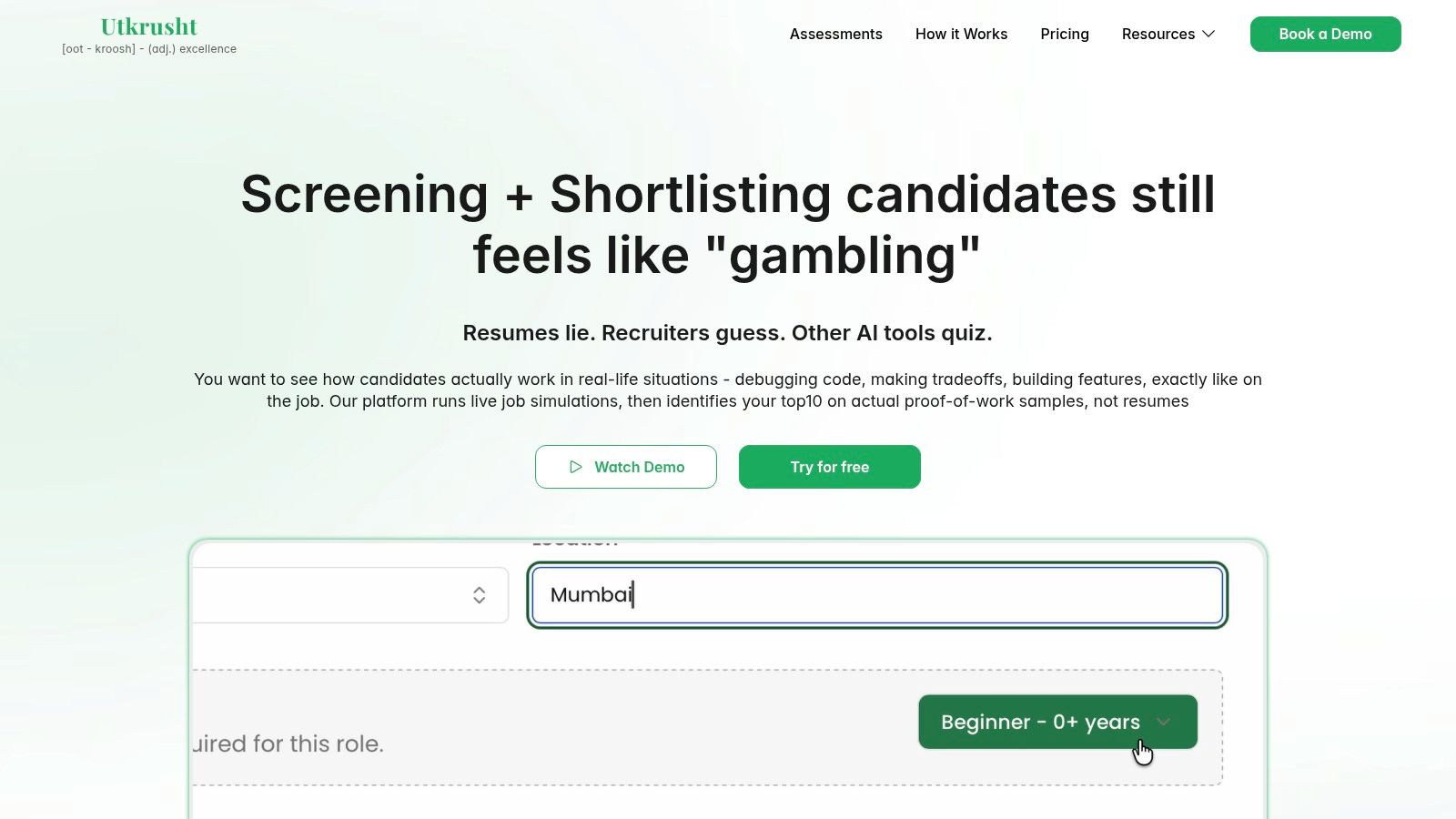
Utkrusht is designed for mid-sized engineering teams who believe the best way to assess a developer is to actually watch them do the job. It moves away from quizzes and puzzles, instead immersing candidates in high-fidelity watch-them-work Tasks.
Candidates are asked to fix bugs, refactor code, or optimize performance in a real development environment, with the entire session recorded for review.
Feature | Details |
|---|---|
Main 3 features | 1. Real-world watch-them-work tasks (e.g., fix a slow SQL query, debug a Docker container). |
2. Full video session recordings of the candidate’s screen and thought process. | |
3. Automated stack-ranked shortlist of top candidates with performance reports. | |
Unique differentiation aka core USP | It assesses candidates by allowing hiring managers to actually watch how they work in real-life job situations. Instead of asking candidates to explain concepts, Utkrusht makes them implement solutions in a live environment, providing undeniable proof of their practical skills. It shows you video sessions and gives you a ranked shortlist, with no generic quizzes or MCQs. |
Use this if you prefer | To see how a candidate actually solves problems, makes trade-offs, and uses tools in a realistic work environment. It’s ideal for small engineering teams (typically under 1000 employees) that prioritize practical, on-the-job skills over theoretical knowledge. |
Do not use this if you prefer | High-volume, automated screening based on simple pass/fail scores from algorithmic quizzes. |
1 standout feature | The video session replays. They provide invaluable, qualitative insight into a candidate’s problem-solving approach that a simple score cannot capture. |
Pricing | Custom-based. It is positioned as the most budget-friendly option compared to all other tools in this list, especially for its high-fidelity assessment model. |
Does it evaluate candidates by watching how they work? | Yes, this is its core function. It records the entire session for hiring managers to review. |
Best for | Mid-sized companies and engineering teams (typically 500-5000 employees) |
Main downside | The in-depth review process may require more initial investment of a hiring manager’s time compared to fully automated MCQ tests, though it saves significant time later by eliminating unqualified interviews. |
Does it show proof-of-work samples? | Yes, the entire recorded session and the final code serve as a powerful proof-of-work sample. |
Does it have advanced proctoring? | Yes, it has built-in mechanisms to flag suspicious behavior to ensure assessment integrity. |
Does it offer a free trial? | Yes, a free trial is available. |
4. HireHunch
HireHunch takes a different approach by offering “interview-as-a-service.” Instead of just providing a software platform, they provide a network of vetted, experienced interviewers from top tech companies.
These experts conduct the first round of technical interviews on your behalf, providing detailed feedback and a calibrated recommendation on whether to move the candidate forward.
Feature | Details |
|---|---|
Main 3 features | 1. A global network of expert interviewers. |
2. Pre-built, role-specific interview templates. | |
3. Detailed interview reports and recordings. | |
Unique differentiation aka core USP | It’s a human-powered service, not just a software tool. HireHunch outsources the time-consuming task of first-round technical screening to trusted, external experts. |
Use this if you prefer | To save your senior engineers’ valuable time by offloading the top-of-funnel technical interviews to a professional service. |
Do not use this if you prefer | An asynchronous, automated screening tool that you can send to hundreds of candidates at once. HireHunch is for synchronous, one-on-one interviews. |
1 standout feature | The quality and calibration of their interviewer pool. It ensures a consistent and high-quality interview experience for every candidate. |
Pricing | Pay-per-interview model. |
Does it evaluate candidates by watching how they work? | Yes, the expert interviewer observes and interacts with the candidate in a live coding session. |
Best for | Companies looking to scale their hiring process without overloading their current engineering team with screening interviews. |
Main downside | The cost per interview can add up quickly for very high-volume hiring. It may also feel like a loss of direct control over the initial screening process for some hiring managers. |
Does it show proof-of-work samples? | Yes, the interview report includes the candidate’s code and a recording of the session. |
Does it have advanced proctoring? | Not applicable in the traditional sense, as it’s a live interview with a human proctor (the interviewer). |
Does it offer a free trial? | Yes, they typically offer a few free interviews to new clients. |
Aspect | Free Coding Platforms | Paid Coding Platforms |
|---|---|---|
Question Library | Limited, often generic questions | Extensive, role-specific, and customizable question libraries |
Cheating Prevention | Basic or non-existent | Advanced proctoring, plagiarism detection, and IP tracking |
Candidate Experience | Often clunky UI, lacks branding | Branded, seamless experience with modern IDEs and clear instructions |
Integrations | Minimal or no ATS/HRIS integrations | Deep integrations with popular systems like Greenhouse, Lever, etc. |
Support | Community forums or limited email support | Dedicated customer support, account managers, and SLAs |
Analytics | Basic pass/fail scores | Detailed performance reports, benchmarking, and candidate comparison |
5. TestGorilla
TestGorilla is a pre-employment screening platform that aims to provide a holistic view of candidates. It stands out by offering a massive test library that goes far beyond coding.
You can combine technical tests with assessments for cognitive ability, personality, culture fit, and specific software skills (like proficiency in Excel or Salesforce), all in a single assessment.
Feature | Details |
|---|---|
Main 3 features | 1. A library of over 400 tests covering a wide range of skills. |
2. Ability to create assessments by mixing and matching different test types. | |
3. Anti-cheating measures and user-friendly candidate experience. | |
Unique differentiation aka core USP | Its multi-measure approach. TestGorilla is built on the belief that job success depends on more than just technical skill, so it makes it easy to assess the “whole candidate.” |
Use this if you prefer X | To get a well-rounded profile of a candidate by testing for personality, culture fit, and cognitive skills alongside their technical abilities. |
Do not use this if you prefer Y | A deep, specialized platform for assessing senior engineering talent with complex, real-world coding challenges. |
1 standout feature | The ability to easily build a custom assessment by combining, for example, a Python coding test, a critical thinking test, and a communication skills test. |
Pricing | Subscription-based, with a limited free plan and paid tiers that offer more features and assessments. |
Does it evaluate candidates by watching how they work? | No, it uses automated scoring for its tests. |
Best for | SMBs and companies that want a simple, affordable way to screen candidates for a variety of roles, not just highly technical ones. |
Main downside | The coding assessments are generally more basic than those on specialized platforms like Codility or HackerRank. It may not be robust enough for very senior or specialized technical roles. |
Does it show proof-of-work samples? | No, it’s based on test results. |
Does it have advanced proctoring? | Yes, it includes webcam snapshots and full-screen mode enforcement. |
Does it offer a free trial? | Yes, it has a “Free forever” plan with limited access to tests. |
6. CodeSignal
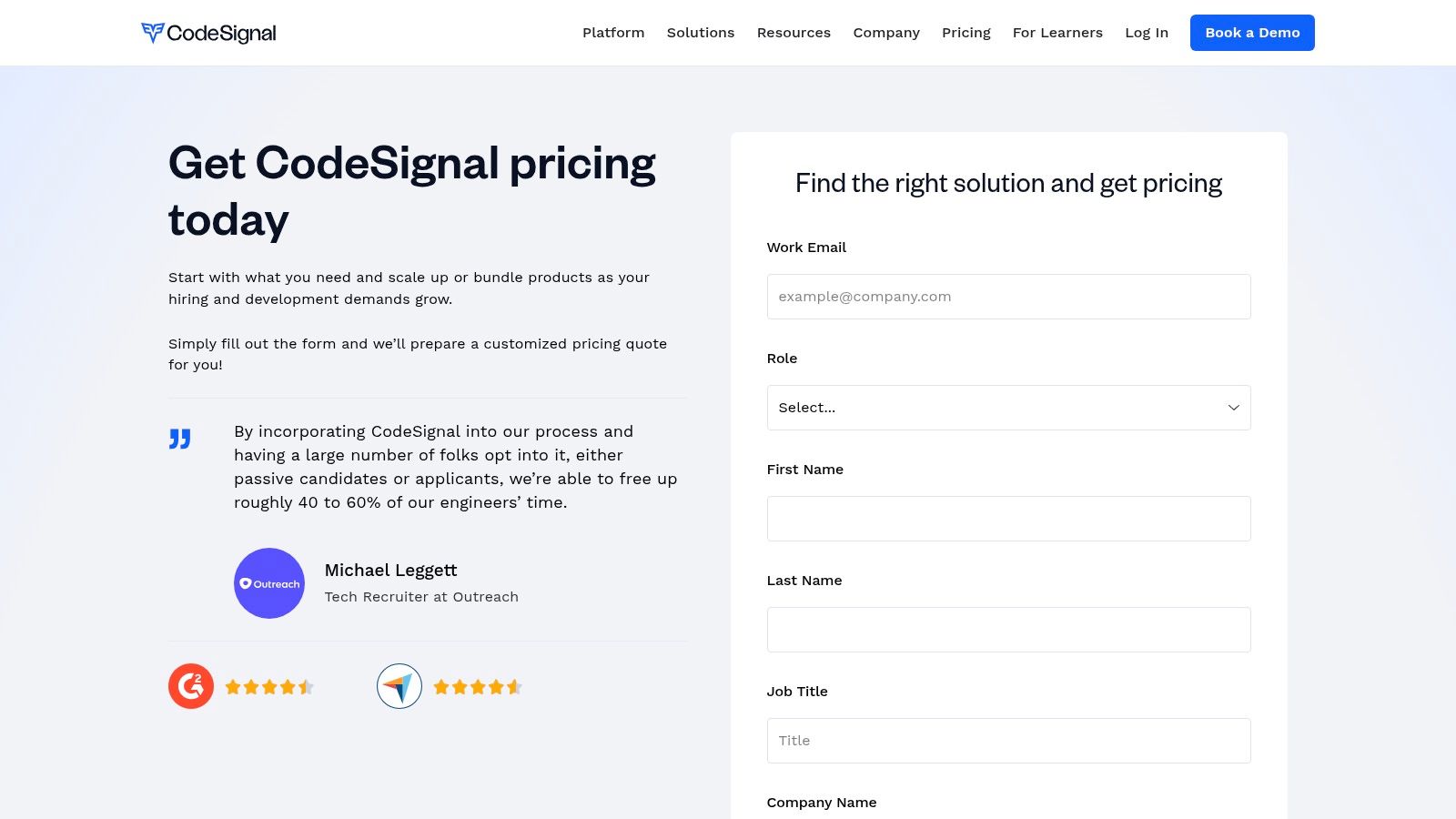
CodeSignal focuses on providing a high-fidelity, standardized signal of a candidate’s skills. It is known for its “Certified Assessments” like the General Coding Assessment (GCA), which are validated by industrial-organizational psychologists to predict on-the-job performance. The platform provides a modern IDE and detailed keystroke-by-keystroke replays of a candidate’s session.
Feature | Details |
|---|---|
Main 3 features | 1. Validated, role-based certified assessments. |
2. Detailed coding reports with keystroke replays. | |
3. Integrated platform for both asynchronous tests and live interviews. | |
Unique differentiation aka core USP | Its rigorous, scientific approach to assessment design and validation. CodeSignal’s focus on creating fair, predictive, and standardized tests makes it a trusted choice for companies looking to reduce bias and implement objective, data-driven hiring, especially for university and early-career recruiting. |
Use this if you prefer | A standardized, validated assessment that provides an industry-recognized benchmark (like the GCA score) for fairly comparing a large pool of candidates. |
Do not use this if you prefer | Highly customized, project-based assessments that simulate your company’s specific tech stack and day-to-day challenges. |
1 standout feature | The keystroke-by-keystroke session replay. It offers an incredibly detailed view of how a candidate approaches, solves, and refactors a problem. |
Pricing | Quote-based, tailored to the organization’s needs. |
Does it evaluate candidates by watching how they work? | Yes, through its detailed session replays, which capture the entire coding process. |
Best for | Organizations running large-scale hiring programs (especially for new grads) that need a fair, reliable, and scalable way to screen candidates. |
Main downside | The pricing is not transparent and is geared towards enterprise clients, making it less accessible for smaller teams. |
Does it show proof-of-work samples? | No, it focuses on performance within its standardized test environments. |
Does it have advanced proctoring? | Yes, it has robust plagiarism detection and suspicious activity flagging. |
Does it offer a free trial? | No, a demo must be requested. |
7. HackerRank
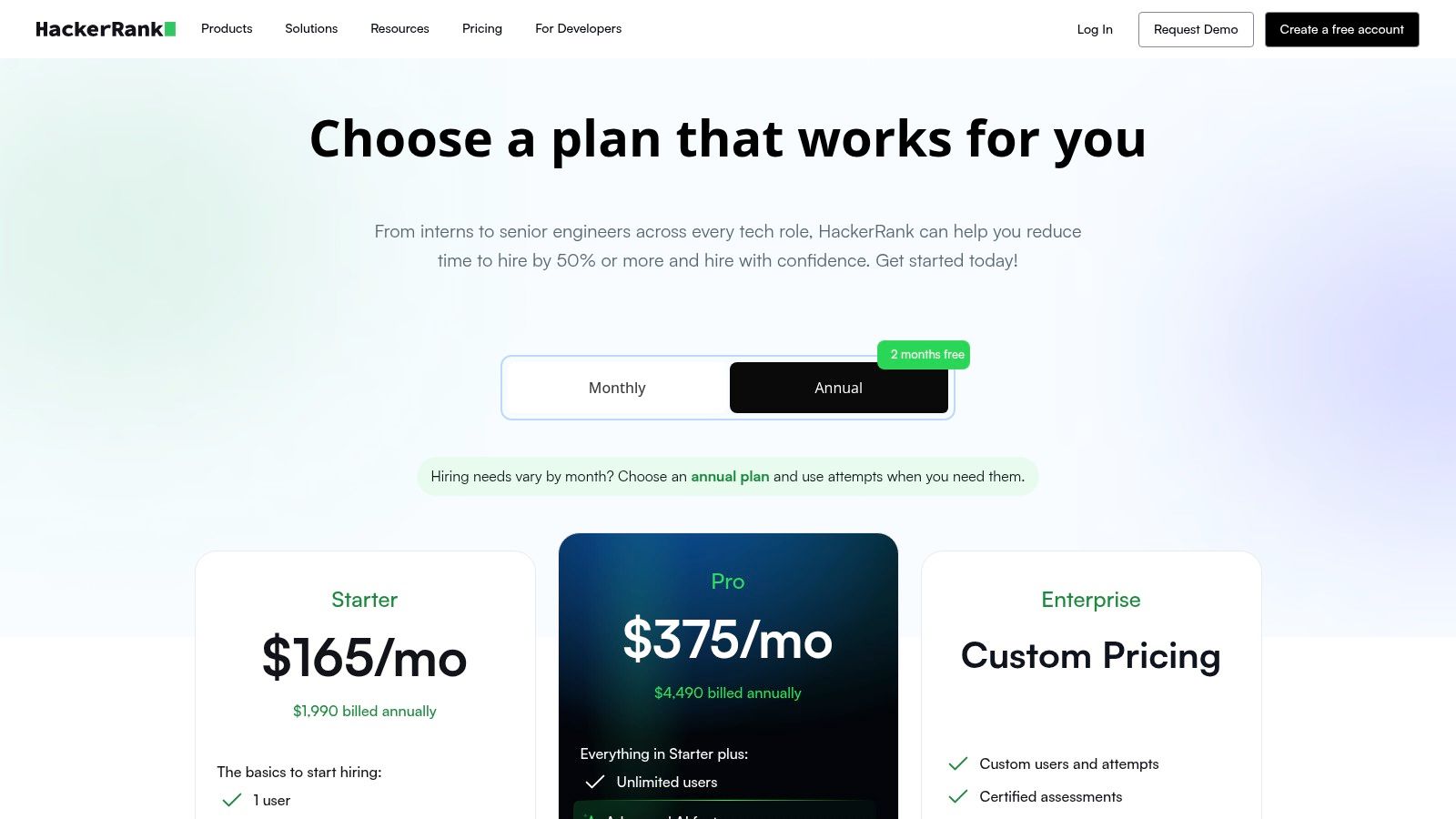
HackerRank is one of the most established and widely used platforms in the technical hiring space. It offers an end-to-end solution that covers screening tests, take-home projects, and live interviews. It’s particularly popular with large enterprises due to its scalability, extensive question library, and strong integration capabilities with major Applicant Tracking Systems.
Feature | Details |
|---|---|
Main 3 features | 1. A massive library of over 7,500 questions and challenges. |
2. An integrated platform for screening, projects, and live interviews. | |
3. AI-powered proctoring and extensive ATS integrations. | |
Unique differentiation aka core USP | Its comprehensive, scalable, end-to-end solution for enterprise hiring. HackerRank is built to handle thousands of candidates for large organizations, with robust features for maintaining integrity and standardizing the process across the board. The Screen-to-Interview ID match is a unique feature for ensuring candidate identity. |
Use this if you prefer | A standardized, algorithm-focused screening process that can efficiently filter very high volumes of candidates with strong cheating prevention. |
Do not use this if you prefer | Assessments that closely simulate real-world job tasks, such as debugging an existing codebase or working within a complex project structure. |
1 standout feature | The AI-powered proctoring add-on provides robust, scalable cheating prevention, including ID verification and plagiarism checks, which is critical for high-volume, remote hiring. |
Pricing | Subscription-based, with plans based on the number of test attempts. Higher-tier plans unlock more features and integrations. |
Does it evaluate candidates by watching how they work? | No, it primarily scores the final output of the code. |
Best for | Large enterprises and companies with high-volume, standardized hiring processes that need an efficient way to filter a large funnel of candidates. |
Main downside | The per-attempt pricing model can become very expensive, especially for companies with fluctuating hiring needs. The focus on algorithmic challenges is often criticized as not being representative of actual on-the-job skills. |
Does it show proof-of-work samples? | No, it’s challenge-based. |
Does it have advanced proctoring? | Yes, it offers a powerful AI add-on for proctoring. |
Does it offer a free trial? | Yes, a 14-day free trial is available for the entry-level Team plan. |
8. WeCP (WeCreateProblems)
WeCP is a technical assessment platform that helps organizations hire talent through automated screening tests and live interviews. It also has a strong focus on community engagement, allowing companies to host hackathons and coding competitions to build their employer brand and source candidates. The platform is known for its custom branding options and developer-friendly experience.
Feature | Details |
|---|---|
Main 3 features | 1. Support for various assessment types, including coding, MCQs, and project-based questions. |
2. A platform for hosting public or private hackathons and coding challenges. | |
3. In-depth analytics and performance reports. | |
Unique differentiation aka core USP | Its dual focus on assessment and developer engagement. WeCP isn’t just a screening tool; it’s also a platform for building a talent pipeline through community events like hackathons. |
Use this if you prefer | To not only screen active candidates but also proactively build a pipeline of passive talent through engaging coding competitions and hackathons. |
Do not use this if you prefer | A simple, straightforward tool for only sending out asynchronous screening tests. |
1 standout feature | The ability to host large-scale, branded hackathons to attract and identify top talent in a competitive and engaging format. |
Pricing | Quote-based pricing. |
Does it evaluate candidates by watching how they work? | No, it focuses on automated scoring of submissions. |
Best for | Tech companies that want to combine traditional screening with proactive employer branding and community engagement initiatives. |
Main downside | The platform may be more complex than needed for teams that just want a simple screening tool. |
Does it show proof-of-work samples? | Yes, for project-based assessments. |
Does it have advanced proctoring? | Yes, it includes features like tab proctoring and candidate window violation detection. |
Does it offer a free trial? | Yes, a free trial is available upon request. |
9. HireVue
HireVue is a large-scale hiring platform best known for its pioneering work in video interviewing. It combines on-demand video interviews with game-based cognitive assessments and technical coding challenges. The platform uses AI to analyze video responses and other data points to help recruiters identify top candidates, making it a powerful tool for high-volume, enterprise-level recruitment.
Feature | Details |
|---|---|
Main 3 features | 1. On-demand and live video interviewing. |
2. Game-based cognitive assessments. | |
3. Integrated coding challenges and technical assessments. | |
Unique differentiation aka core USP | Its AI-driven, video-first approach to hiring. HireVue goes beyond skills to assess communication, personality, and cognitive traits through a combination of video, games, and coding, all analyzed by its AI engine. |
Use this if you prefer | A comprehensive, enterprise-grade platform that automates the entire top-of-funnel screening process, using AI to analyze everything from code to conversational skills. |
Do not use this if you prefer | A lightweight, developer-focused tool specifically for coding assessments. |
1 standout feature | The use of AI to analyze video interviews for key competencies, providing recruiters with insights that go beyond a resume. |
Pricing | Quote-based, designed for enterprise customers. |
Does it evaluate candidates by watching how they work? | In a sense, yes, through the video interviews where candidates can explain their thought process. However, the coding part is typically auto-graded. |
Best for | Large, global enterprises (especially in industries like retail, consulting, and finance) that need to screen hundreds or thousands of candidates for a wide range of roles efficiently. |
Main downside | The platform’s reliance on AI for analyzing video interviews has faced scrutiny and debate regarding potential bias. It’s also a very heavy, complex platform that is not suitable for smaller companies. |
Does it show proof-of-work samples? | No. |
Does it have advanced proctoring? | Yes, the entire process is inherently proctored through video. |
Does it offer a free trial? | No, it’s an enterprise solution requiring a demo. |
10. Codility
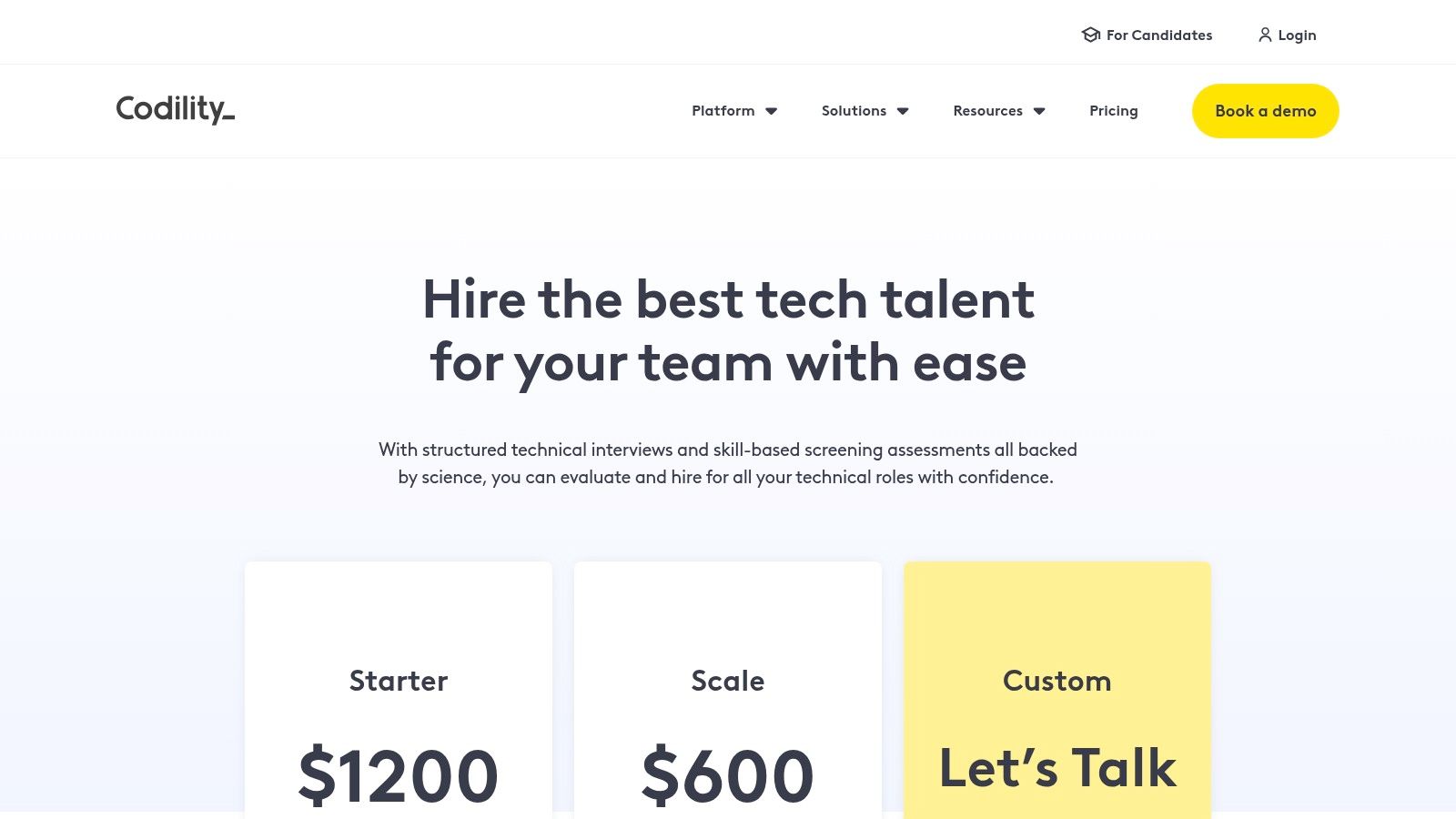
Codility is a robust technical assessment platform built for both screening candidates and conducting live interviews. It is highly regarded for its scientifically designed task library, strong anti-cheating measures, and features that support modern development workflows. Codility helps organizations standardize their technical hiring with role-based assessments that cover a wide spectrum of engineering skills.
Feature | Details | |
|---|---|---|
Main 3 features | 1. Extensive library of tasks, including bug-fixing, coding, and specialized challenges. | |
2. Integrated platform for both screening (CodeCheck) and live interviews (CodeLive). | ||
| ||
Unique differentiation aka core USP | Its balance between classic algorithmic assessment and evaluation of real-world skills, backed by a strong focus on assessment integrity and scientific methodology. The platform captures a candidate’s full thought process, providing a more reliable signal of their capabilities. | |
Use this if you prefer | Role-based assessments with powerful anti-cheating controls and a seamless transition from asynchronous screening to live technical interviews, all within one platform. | |
Do not use this if you prefer | Highly customized, real-world project watch-them-work tasks that involve a candidate’s local IDE or complex development environments. | |
1 standout feature | The detailed candidate reports that show not just the score but also the problem-solving process, including all submissions and test case results, giving deep insight into their approach. | |
Pricing | Transparent, subscription-based pricing for its lower tiers, with custom enterprise plans available. | |
Does it evaluate candidates by watching how they work? | Yes, through session playback features that allow reviewers to see how a candidate arrived at their solution. | |
Best for | Companies of all sizes that want a standardized, role-based screening process with strong integrity features and a high-quality candidate experience. | |
Main downside | While it includes bug-fixing tasks, the primary focus is still often on self-contained challenges rather than large, existing codebases. Some advanced features are locked behind more expensive plans. | |
Does it show proof-of-work samples? | No, assessments are challenge-based within the platform. | |
Does it have advanced proctoring? | Yes, it has robust plagiarism detection, IP tracking, and similarity checks. | |
Does it offer a free trial? | Yes, a 7-day free trial is available. |
11. HackerEarth
HackerEarth provides a suite of tools for developer assessment, interviews, and engagement. It’s known for its comprehensive platform that supports a wide variety of question types, from simple MCQs to complex full-stack application development projects. Like WeCP, it also has a strong community focus, enabling companies to run hackathons and coding challenges to source and engage talent.
Feature | Details |
|---|---|
Main 3 features | 1. Support for project-based questions that simulate real-world app development. |
2. A platform for remote interviews with a collaborative code editor. | |
3. Tools for hosting hackathons and engaging the developer community. | |
Unique differentiation aka core USP | Its focus on project-based assessments. HackerEarth allows you to assess candidates on their ability to build or modify a small, real-world application, which is a better predictor of job performance than simple algorithmic challenges. |
Use this if you prefer | To assess candidates on their ability to work with full-stack applications, frameworks, and libraries, not just isolated algorithms. |
Do not use this if you prefer | A simple, low-cost tool for basic algorithmic screening. |
1 standout feature | The support for full-stack project questions, where candidates work in a cloud-based IDE to build a complete application. |
Pricing | Quote-based pricing for its different product suites (Assessments, Interviews, etc.). |
Does it evaluate candidates by watching how they work? | To some extent. While it doesn’t record video, the project-based assessments provide a deep view into how a candidate structures code and builds an application. |
Best for | Companies hiring for full-stack, front-end, or back-end roles that want to assess skills in a realistic project environment. |
Main downside | The platform can be complex to set up, and creating good project-based questions requires significant effort. |
Does it show proof-of-work samples? | Yes, the completed project serves as a strong proof-of-work sample. |
Does it have advanced proctoring? | Yes, it offers proctoring with webcam snapshots, tab switching detection, and plagiarism checks. |
Does it offer a free trial? | Yes, a 14-day free trial is available. |
12. Vervoe
Vervoe is an AI-powered skills assessment platform that focuses on immersive, “day-in-the-life” watch-them-work tasks. It aims to predict job performance by testing candidates on the actual tasks they would perform in the role. Vervoe’s assessments often consist of a series of job-related tasks presented in various formats, such as responding to a customer email, analyzing a spreadsheet, or writing a short piece of code. The platform’s AI then grades and ranks the candidates.
Feature | Details |
|---|---|
Main 3 features | 1. Immersive, multi-format skill assessments (watch-them-work tasks). |
2. AI-powered grading and ranking of candidates. | |
3. A large library of pre-built assessments for various roles. | |
Unique differentiation aka core USP | Its AI-driven, multi-faceted watch-them-work task approach. Vervoe tries to replicate the variety of tasks in a real job and uses AI to evaluate performance across all of them, providing a single, ranked list of candidates. |
Use this if you prefer | To see how candidates handle a variety of job-related tasks and have AI automatically grade and rank them to save you time. |
Do not use this if you prefer | To have deep, manual control over the evaluation of complex coding tasks. The reliance on AI for grading may not be suitable for roles where nuance is critical. |
1 standout feature | The AI-powered ranking system that learns from your grading decisions to get better at predicting which candidates you will prefer over time. |
Pricing | Subscription-based, with pricing based on the number of active jobs. |
Does it evaluate candidates by watching how they work? | Not directly through video, but the watch-them-work tasks are designed to observe how they perform tasks. |
Best for | High-volume hiring for roles where performance can be assessed through a series of short, well-defined tasks (e.g., customer service, sales, junior developer roles). |
Main downside | The AI grading, while efficient, can feel like a “black box” and may not always capture the nuances of a candidate’s response, especially for complex technical problems. |
Does it show proof-of-work samples? | Yes, the completed tasks within the watch-them-work task serve as work samples. |
Does it have advanced proctoring? | Yes, it includes anti-cheating measures. |
Does it offer a free trial? | Yes, a free trial is available. |
13. Coderbyte
Coderbyte is a flexible and affordable platform for coding assessments and interviews. It has gained popularity for its straightforward pricing and comprehensive feature set, making it a strong alternative to more expensive enterprise tools. The platform offers a good mix of pre-built challenges, take-home projects, and a collaborative environment for live interviews.

Feature | Details |
|---|---|
Main 3 features | 1. Unlimited candidate assessments and administrator accounts on its enterprise plans. |
2. A library of challenges and support for various question types. | |
3. Integrated live interview and take-home project functionality. | |
Unique differentiation aka core USP | Its value proposition. Coderbyte offers a powerful suite of features, including unlimited assessments, at a price point that is often more competitive than the major enterprise players. This makes it an attractive option for companies looking to scale their hiring without unpredictable, usage-based costs. |
Use this if you prefer | A predictable, fixed-cost model with unlimited candidates and admins, ideal for managing a large hiring pipeline without variable expenses. |
Do not use this if you prefer | The most advanced, scientifically validated assessments or the highest-fidelity watch-them-work tasks on the market. |
1 standout feature | The unlimited candidate and admin model on enterprise plans, which provides exceptional value and predictable budgeting for scaling companies. |
Pricing | Subscription-based, with transparent pricing for smaller plans and quote-based for enterprise. |
Does it evaluate candidates by watching how they work? | It offers session recording, allowing reviewers to see the candidate’s process. |
Best for | Mid-size to large companies looking for a scalable and cost-effective alternative to usage-based assessment platforms like HackerRank. |
Main downside | While robust, its brand recognition and the size of its question library are not as extensive as some of the largest industry incumbents. |
Does it show proof-of-work samples? | Yes, for take-home projects. |
Does it have advanced proctoring? | Yes, it includes plagiarism detection, screen recording, and other proctoring features. |
Does it offer a free trial? | Yes, a 14-day free trial is available. |
14. CoderPad
CoderPad is best known for its live technical interview product. It provides a simple, fast, and reliable collaborative coding environment where an interviewer and candidate can work together in real-time. While it has expanded to offer asynchronous screening tests, its core strength and reputation lie in being the go-to tool for conducting one-on-one, synchronous coding interviews.
Feature | Details |
|---|---|
Main 3 features | 1. A fast and powerful collaborative IDE supporting over 30 languages. |
2. Built-in video/audio calling and a drawing mode for system design questions. | |
3. Asynchronous take-home assignments. | |
Unique differentiation aka core USP | Its laser focus on the live technical interview experience. CoderPad is designed to be the simplest and most reliable tool for a developer and an interviewer to jump into a shared environment and start coding together, with minimal setup or fuss. |
Use this if you prefer | A best-in-class tool specifically for conducting live, collaborative coding interviews. |
Do not use this if you prefer | A comprehensive, all-in-one platform for high-volume asynchronous screening with advanced proctoring and a massive question library. |
1 standout feature | Its speed and simplicity. An interview can be started with a single click, and the environment is designed to be intuitive for both interviewer and candidate, reducing technical friction. |
Pricing | Subscription-based, with plans based on the number of interviews conducted. |
Does it evaluate candidates by watching how they work? | Yes, this is its primary purpose. The interviewer directly observes the candidate’s work and thought process in real-time. |
Best for | Engineering teams of all sizes that need a reliable and easy-to-use tool for conducting live technical interviews. |
Main downside | Its asynchronous screening features are less mature and robust than those of dedicated screening platforms like HackerRank or Codility. |
Does it show proof-of-work samples? | Yes, the code written during the interview is saved and serves as a work sample from the session. |
Does it have advanced proctoring? | Not applicable for its primary use case, as the live interview is proctored by the human interviewer. |
Does it offer a free trial? | Yes, a 7-day free trial is available. |
15. TestDome
TestDome is a skills assessment platform that stands out for its simplicity and flexible, pay-as-you-go pricing model. It’s an excellent choice for companies with sporadic hiring needs or those who want to avoid long-term subscriptions. The platform offers a good range of tests for both programming and non-technical skills, making it a versatile and budget-friendly option.

Feature | Details |
|---|---|
Main 3 features | 1. Pay-as-you-go pricing with candidate “invite packs” that never expire. |
2. A library of over 2,000 questions covering programming and non-technical skills. | |
3. Support for custom questions and live interviews. | |
Unique differentiation aka core USP | Its transparent, commitment-free pricing. Unlike almost all competitors, TestDome does not require an annual subscription. You buy a pack of tests and use them whenever you need them, which is incredibly practical for small businesses or teams with fluctuating hiring demands. |
Use this if you prefer | A simple, pay-as-you-go pricing model with no subscription and a mix of technical and non-technical assessments. |
Do not use this if you prefer | The most advanced, AI-driven proctoring features or assessments that deeply simulate complex, real-world development environments. |
1 standout feature | The candidate invite packs that never expire. This provides maximum flexibility and removes the pressure to “use it or lose it” that comes with annual subscriptions. |
Pricing | Pay-per-candidate model. Users buy packs of invites, with costs decreasing with volume. |
Does it evaluate candidates by watching how they work? | No, it uses automated scoring. |
Best for | Startups, small businesses, and companies with intermittent hiring needs that prioritize budget-friendliness and simplicity. |
Main downside | Its brand recognition and question library are not as extensive as larger enterprise platforms. Its proctoring features are good but not as advanced as some competitors. |
Does it show proof-of-work samples? | No, the platform focuses on challenge-based questions. |
Does it have advanced proctoring? | Yes, it offers webcam and screen monitoring options. |
Does it offer a free trial? | Yes, a free trial is available which includes 5 candidate invites. |
16. Mercer Mettl
Mercer Mettl is a comprehensive talent measurement platform that is part of the global consulting firm, Mercer. It offers a vast and diverse suite of assessment tools that go far beyond coding. The platform provides solutions for technical/coding assessments, psychometric tests, cognitive assessments, and domain-specific knowledge tests. It is designed as an end-to-end platform for large enterprises to manage assessments for hiring, training, and development.
Feature | Details |
|---|---|
Main 3 features | 1. A massive and diverse library of assessments for a wide range of skills and roles. |
2. A highly secure and proctored examination platform. | |
3. Tools for not just hiring but also for learning and development assessments. | |
Unique differentiation aka core USP | Its enterprise-grade, scientifically-backed approach to talent measurement at scale, backed by a major global consulting firm. Mercer Mettl is not just a hiring tool but a strategic talent management platform. |
Use this if you prefer | An all-in-one, highly secure, enterprise-level platform to handle all of your company’s assessment needs, from campus hiring to leadership development. |
Do not use this if you prefer | A nimble, developer-centric tool that is easy to set up and use for a small engineering team. |
1 standout feature | Its advanced, AI-powered proctoring suite, which is one of the most robust and secure on the market, making it suitable for high-stakes examinations and certifications. |
Pricing | Quote-based, designed for enterprise clients. |
Does it evaluate candidates by watching how they work? | No, it primarily relies on automated scoring. |
Best for | Large enterprises, educational institutions, and government bodies that need a highly secure and scalable platform for a wide variety of assessments. |
Main downside | The platform is a very heavy, enterprise-focused solution that can be complex and expensive. It is not designed for the needs of a small startup or mid-sized company looking for a simple coding assessment tool. |
Does it show proof-of-work samples? | No. |
Does it have advanced proctoring? | Yes, it has one of the most advanced proctoring systems available. |
Does it offer a free trial? | No, a demo must be requested. |
Quick decision guide for choosing a coding interview platform
If your priority is… | Consider these tools… | Because… |
|---|---|---|
Seeing real on-the-job skills | Utkrusht, HackerEarth | They use watch-them-work tasks and project-based tasks that mimic actual work. |
High-volume algorithmic screening | HackerRank, LeetCode, Codility | They have massive question libraries and are built to filter thousands of candidates efficiently. |
Budget-friendliness and flexibility | TestDome, Coderbyte | They offer pay-as-you-go or competitive, fixed-cost subscription models. |
Best-in-class live interviews | CoderPad, HireHunch | They are laser-focused on providing a seamless, human-powered, real-time interview experience. |
Assessing the “whole candidate” | TestGorilla, iMocha, HireVue | They combine coding tests with assessments for personality, cognitive skills, and culture fit. |
Preventing cheating at all costs | Mercer Mettl, iMocha, Codility | They have the most advanced and robust AI-powered proctoring and anti-cheating features on the market. |
How to pick the right code assessment for your requirement, follow this simple decision making checklist
Choosing the right tool can feel complex, but you can simplify the process by focusing on what truly matters for your team. Use this checklist to guide your decision.
Does it assess for on-the-job skills? Check if the platform can test for practical skills relevant to your open roles. Does it go beyond algorithms to assess debugging, framework knowledge, or system design?
Is the candidate experience excellent? The best developers have options. A clunky, frustrating, or irrelevant test will turn them away. Look for a tool with a clean interface and engaging, respectful challenges.
Does it save your engineering team time? The ultimate goal is to reduce the time your engineers spend on bad interviews. Does the tool provide a clear, reliable signal so you only speak to the best candidates?
Does it offer proof-of-work? Can you see how a candidate solved a problem, not just their final score? Tools with session recordings or detailed project submissions offer much deeper insight.
Are the proctoring and anti-cheating features sufficient? Determine the level of integrity you need. For high-volume remote hiring, strong proctoring is essential. For live interviews, a human proctor is built-in.
Does the pricing model fit your hiring patterns? If you hire constantly, a subscription might be best. If you hire sporadically, a pay-as-you-go model like TestDome’s is more cost-effective.
Can you customize the assessments? The ability to create your own questions or tailor existing ones to your specific tech stack is crucial for accurately assessing fit.
Remember, always always try a product for a month, then evaluate which is right for your needs. Use free trials and demos to get a feel for the platform before committing.
Frequently Asked Questions
How do you assess a senior developer's coding skills?
Are coding assessment tools biased?
Can candidates cheat on code assessment tools?
What is the difference between asynchronous assessments and live coding interviews?
How long should a coding assessment be?
Stop relying on quizzes and resume guesswork.
With Utkrusht, you get deep, automated coding assessments built for real-world performance. Get started now and hire stronger developers with confidence.

Zubin leverages his engineering background and decade of B2B SaaS experience to drive GTM as the Co-founder of Utkrusht. He previously founded Zaminu, served 25+ B2B clients across US, Europe and India.
Want to hire
the best talent
with proof
of skill?
Shortlist candidates with
strong proof of skill
in just 48 hours


