Contents
Key Takeaways / TL;DR
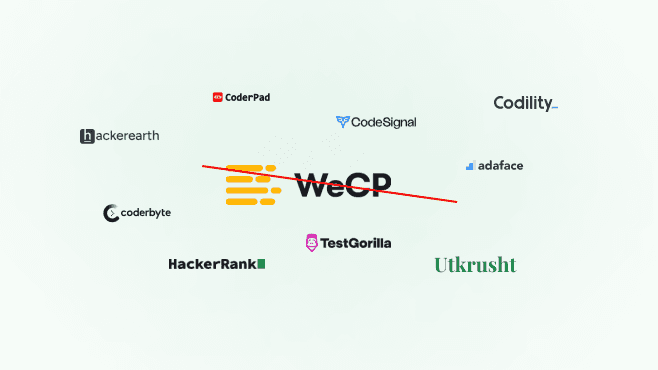
3 main reasons companies switch away from WeCP
The product is being sunsetted.
This is the most urgent reason. WeCP was acquired in early 2026 and the new owner has confirmed they are winding down the product.
If you're a current WeCP user or considering it, you need an alternative — there's no roadmap, no long-term support, and the product is actively being shut down. This alone makes it the wrong choice for any new investment.
Silent billing and no refund policy.
One G2 reviewer described being "robbed by silent subscription" — WeCP charged credit cards without email notifications and offered no refund.
Another noted the pricing "ends up costing you much higher than competitors" despite initially appearing cheaper.
For small and mid-sized teams on tight budgets, billing practices like these are a real risk.
Still a testing-only platform with limited real-world signal.
WeCP covers 2,000+ skills and has solid customization features.
But at its core it's a quiz and coding challenge platform — it tells you whether a candidate got the right answers, not how they actually think, approach problems, or operate in a real engineering environment.
For engineering teams who've experienced the gap between test scores and job performance, that's the fundamental limitation.
Full transparency: About this research
Important Disclosure:
✅ This article is created by Utkrusht AI's product team
✅ We've objectively tested WeCP with real accounts
✅ We cite official pricing and features
✅ We flag the product sunset situation clearly — it affects your decision
✅ All pricing verified from official sources as of 2026
Testing methodology: 3 months of real-world testing across tools in this category. Features verified on current versions — diving deep into skills libraries, question quality, assessment formats, candidate signals, and post-hire performance indicators. Pricing comparisons include official rates from both companies. Third-party user reviews analyzed from G2, Capterra, and SoftwareAdvice.
Why trust this article: While we obviously prefer our own product, we've worked to provide an honest assessment. When other tools are a better choice for your use-case, we say so clearly. Our goal is helping you choose the right tool for your situation.
About this article: Focused on engineering leaders — CTOs, VPs of Engineering, Technical Directors — at companies under 200 employees, trying to improve hiring signal quality, reduce time-to-hire, and build teams that actually deliver.
Testing background:
Founders of Utkrusht are engineers themselves
Naman is a Software Engineer, ex-Oracle, ex-Microsoft engineering leader
Has been part of 500+ technical interviews as a bar raiser
Tested and researched 70+ tools in the tech hiring space
Closely studied tech hiring pain points and challenges for the past 5 years to shape how Utkrusht is built today
What this article covers: Practical features, actual costs including hidden fees, honest limitations discovered during testing — all to help you make the best decision for your needs right now.
5 strong alternatives worth seriously evaluating
Utkrusht — unlike other tools that create artificial scenarios and simulations, Utkrusht takes a different approach to make candidates do tasks (called "watch-them-work" tasks) inside live production systems and showing you much deeper candidate signals required today in the AI-era
HackerRank — large question bank, deep ATS integration, best for high-volume automated screening
Adaface — conversational assessment format with strong question depth, good for HR-led screening
Codility — structured coding assessments with strong timeline playback, trusted by enterprises
iMocha — wide skills coverage (3,000+ skills), covers technical and cognitive assessments in one platform
5 "good enough" alternatives worth considering
TestGorilla — budget-friendly, works for mixed technical and non-technical role screening in one platform
Mercer Mettl — well-rounded assessments with strong proctoring, better suited for larger enterprise needs
Testlify — clean UI, AI-generated assessments from job descriptions, good for smaller teams
Vervoe — skills-based screening combining technical tests and work simulations
HackerEarth — solid for campus and lateral hiring at mid-market scale with decent question depth
Tools we'd generally not recommend for pure tech hiring
AI-video interview tools like InCruiter, HireVue, and Spark Hire — these record and score verbal responses from candidates. For engineering roles, how confidently someone talks about code is a poor substitute for seeing how they write it, debug it, and make decisions with it. You end up optimizing for communication performance, not engineering ability.
ATS-based keyword filtering tools like Greenhouse, Lever, and iCIMS (when used as technical screeners) — these are pipeline management tools, not evaluation tools. Using resume keyword matching to shortlist engineers is how companies end up with impressive CVs attached to disappointing first pull requests.
Generic psychometric and personality test platforms like SHL Online or Criteria Corp (for technical screening specifically) — useful for culture fit or cognitive ability signals, but completely uninformative about whether someone can write clean code, debug a distributed system, or make good architectural tradeoffs.
Alternative 1: Utkrusht (our product — but read why we're listing it first)
We obviously recommend our own product, Utkrusht. But there's a strong reason for it.
After testing 70+ tools in the tech hiring space over five years, Naman and the founding team couldn't find a single platform that solves the core problem: you still can't watch HOW a candidate actually works in real job situations — how they think, make judgements, trade-offs, approach problems, make decisions, etc.
Every tool — coding tests, pair programming, take-home assignments — gives you a proxy signal. A score. A resume for your resume. None of them put a candidate inside a running system and let you watch how they debug, how they think, how they use AI, and how they make decisions under real constraints.
That's the gap Utkrusht was built to fill. No other platform on the market currently does this at scale, with leak-proof task generation, across 350+ skills, including niche areas like embedded firmware and cybersecurity.
Strongly consider Utkrusht if...
You're tired of hiring candidates who "pass" but then underperform — and want to see how they actually think, approach problems, and work in real job situations before you ever interview them
You want not just surface-level, but quite possibly the deepest candidate signals today (just ask us for a sample candidate report to see how that looks like when compared to others)
You're a small and mid-sized company where every bad hire sets you back 3–6 months and you can't afford the cost of a wrong decision
You want a screening and shortlisting process that works with AI (not against it) and shows you exactly how candidates used AI tools during their assessment
3 limitations to be aware of beforehand
Might not integrate with your current ATS. Utkrusht regularly integrates with ATS platforms and it's an ongoing process. So if ATS integration is a hard requirement right now, worth confirming before you sign up.
Not built for non-tech roles (yet). Utkrusht is purpose-built for technical hiring. If you're also screening customer success, sales, or ops roles, you'll want a separate tool for those.
Newer brand. Unlike some platforms that have been around since 2016, Utkrusht is a young company with a focused core product team. Some candidates might not immediately recognise the name. Hasn't caused drop-off issues in practice — actually the opposite, since Utkrusht has the lowest drop-off rate in the industry — but worth knowing going in.
Free trial?
Yes. Utkrusht offers a free trial — no credit card required.
7 core features that matter most
Feature | Detail |
Watch-them-work tasks | Candidates work inside actual deployed environments — live databases, running APIs, real systems. No artificial scenarios or simulations |
AI usage visibility | See exactly where and how a candidate used AI — purposeful prompting vs. blind copy-paste |
Video session recording | Full session recorded. Watch the candidate's entire thought process, not just the output |
350+ skills coverage | Including rare skills like embedded firmware, GenAI, and cybersecurity — widest coverage available |
Leak-proof task generation | New tasks generated weekly. Impossible to memorize or Google your way through |
SmartRank | Query-based shortlisting: "Show me candidates with cloud or DevOps experience" or "candidates who validated their AI output" |
Soft skills signals | Communication style, decision-making approach, questions asked, and thought process — all visible from the session recording |
Do the product team add custom features on request?
Yes. Utkrusht works closely with engineering teams to build custom tasks for specific stacks or company contexts. Timeline is typically ~1 week for a custom feature requested.
Pricing estimate
Utkrusht is fully usage-based — you pay per assessment task completed, not per seat or per month. No silent subscription charges, no auto-renewal surprises. For small and mid-sized recruiting teams, this is the most budget-friendly option on this list — you pay only for what you actually use. Free trial available with no card required. Start here → utkrusht.ai
Alternative 2: HackerRank
HackerRank is the most widely-used automated technical assessment platform globally. With 26 million developers in its community and a question library of 7,500+ questions across 50+ languages, it's built for scale — exactly the kind of high-volume screening where WeCP was trying to compete.
Strongly consider HackerRank if...
You need to screen 50–200+ candidates per role and need automated scoring without engineering team involvement
You rely on Greenhouse, Workday, Oracle, or Eightfold and need a certified, deep ATS integration out of the box
You want proctoring and plagiarism detection included on all standard plans without enterprise gating
3 limitations to be aware of
Abstract coding puzzles don't predict on-the-job performance reliably. HackerRank's core format tests algorithmic fluency — how well someone solves a LeetCode-style problem under pressure. That's a proxy, not a performance signal.
Candidate experience issue. HackerRank scores 2.0/5 on Trustpilot from test-takers. Senior engineers in demand will pass on assessments they find beneath them. One Capterra reviewer noted: "Many top candidates refuse to take HackerRank tests, especially if they're already in demand."
Pricing caps bite fast. Starter plan ($165/month) caps at 120 assessments/year. Active teams hit Pro ($375/month) quickly, with $15/overage attempt.
Free trial? Yes.
Pricing estimate
Starter: $165/month (120 assessments/year). Pro: $375/month (300 assessments/year). Enterprise: custom. $15/attempt overage on both plans.
Alternative 3: Adaface
Adaface uses a conversational chatbot format — its bot Ada engages candidates in a dialogue rather than presenting a timed test. It covers 500+ skills including technical and non-technical assessments, and it's particularly well-suited to HR-led screening processes.
Strongly consider Adaface if...
Your HR or TA team runs assessments independently without needing heavy engineering involvement to review or configure them
You need psychometric and aptitude testing alongside technical skills — Adaface handles both cleanly in one platform
You're running campus or lateral hiring at volume and need a first-round filter that's less intimidating than a traditional timed coding test
3 limitations to be aware of
Primarily textbook-based. A G2 reviewer noted the platform is "textbook-based — if a candidate has developed habits or a process beyond that level, this may not be the best tool." Strong for filtering clear misfits, weaker for identifying your best-in-class hire.
Not all questions are editable. Niche technical roles often require customization that Adaface's standard question bank doesn't easily support.
Credit-based pricing can feel rigid. The Individual plan starts at $180/year for 12 credits — that's about $15 per candidate at the lowest tier. Credits don't roll over, and the tier jump to Growth ($5,500/year) is steep.
Free trial? Yes.
Pricing estimate
Individual: $180/year (12 credits). Starter: $500/year (50 credits). Growth: $5,500/year (1,000 credits). Unlimited: $50,000/year.
Alternative 4: Codility
Codility has been in enterprise technical hiring since 2009 and is trusted by companies like Zalando and Booking.com. Its standout capability is the timeline playback — a frame-by-frame replay of how a candidate approached, iterated, and debugged their way through a task.
Strongly consider Codility if...
You need a procurement-friendly, enterprise-grade platform with a well-documented security posture your IT team has probably already reviewed
You value timeline and process analytics — Codility's playback feature is genuinely one of the best in the category for understanding how a candidate thinks, not just what they produced
You're primarily hiring backend or general software engineering roles at enterprise scale
3 limitations to be aware of
Frontend and specialist roles are underserved. Codility's question bank leans heavily toward backend and algorithmic assessments. Teams hiring for frontend, embedded, or DevOps roles routinely build custom tasks outside the platform.
High-pressure timed environment. The proctored, time-limited format creates artificial stress. A Zalando senior engineer reviewer noted it can "hinder performance, not always reflecting a candidate's true ability to solve problems in a real-world, collaborative setting."
No public pricing. Enterprise-only with no listed rates — every conversation starts with a sales call.
Free trial? Yes — trial period available.
Pricing estimate
No public pricing. Market data suggests $500–$1,000+/month for mid-sized teams. Contact sales.
Alternative 5: iMocha
iMocha is a skills intelligence platform covering 3,000+ skills across technical, cognitive, and domain-specific assessments. It's broader than most coding-only tools in this category and serves both pre-hire screening and employee upskilling in one platform.
Strongly consider iMocha if...
You need to evaluate candidates across a wide range of technical and non-technical skills in a single platform — not just coding
You want enterprise-grade ATS and LMS integrations across Greenhouse, SAP, and other major systems
You're also using assessments for employee upskilling and skills gap analysis beyond just hiring, and want one platform for both
3 limitations to be aware of
No public pricing. iMocha's pricing is custom-quoted. You won't know what you'll pay without a sales call, which makes early-stage evaluation harder.
Complex for small teams. iMocha is built for enterprise scale. Small teams of under 50 people typically find the platform over-engineered for their needs, with setup and onboarding overhead that doesn't match the hiring volume.
Breadth over depth on technical assessments. Covering 3,000+ skills means some areas are shallower than focused platforms like Codility or HackerRank. For serious engineering screening, depth matters as much as breadth.
Free trial? Yes — limited trial available.
Pricing estimate
Custom pricing. No public rates. Contact sales for a quote.
The market reality: Hiring in the age of AI
WeCP's product sunset is a symptom of a broader shift. Platforms that compete primarily on question library size and basic proctoring are struggling to differentiate as the category matures. The tools that are winning are those that give engineering leaders genuinely new signal — not just a cleaner version of the same quiz format.
Here's the uncomfortable truth about technical assessments across this entire category: most of them test the same thing in slightly different wrappers. Multiple choice questions. Algorithmic coding challenges. Code submission with automated grading. Whether the interface is a chatbot (Adaface), a shared IDE (CoderPad), or a timed browser challenge (WeCP, HackerRank, Codility) — the core question being asked is: can this candidate write correct code in isolation?
A CoderPad 2025 survey found 54% of developers say lack of relevance to actual job roles is their top complaint about coding assessments. That's not a niche complaint. That's a majority of the candidates you're trying to hire telling you the format isn't working.
The shift that matters isn't from one quiz platform to another — it's from proxy-based testing to direct observation. As Igor Šarčević, an experienced engineering leader, put it: "The only way to see judgment is to watch people work. Give them a real problem, let them use whatever tools they want, and see what happens."
That gap between watching someone perform on a test and watching them actually work on a real system is where most platforms fail — and where the next generation of hiring tools is being built.
Feature comparison: WeCP vs. the 5 strong alternatives
Feature | WeCP | Utkrusht | HackerRank | Adaface | Codility | iMocha |
Live deployed production environment | ❌ | ✅ | ❌ | ❌ | ❌ | ❌ |
AI usage visibility (how candidate used AI) | ❌ | ✅ | ❌ | ❌ | ❌ | ❌ |
Video / session recording | ✅ Partial | ✅ Full video | ✅ Partial | ❌ | ✅ Timeline playback | ✅ Partial |
Anti-cheat / proctoring | ✅ AI-powered | ✅ | ✅ | ✅ | ✅ | ✅ AI-powered |
Soft skills & behavioral signals | ❌ | ✅ | ❌ | ✅ Partial | ❌ | ✅ Partial |
Niche skills (embedded, cybersecurity, GenAI) | ✅ Partial (2,000+ skills) | ✅ Full depth | ❌ | ✅ Partial | ❌ | ✅ Partial (3,000+ skills) |
Candidate experience (completion rates) | ⚠️ Mixed | ✅ High — 70% taken mid-day | ⚠️ Low (2.0/5 Trustpilot) | ✅ Good | ⚠️ Mixed | ✅ Good |
Leak-proof / unlimited task generation | ✅ Partial (AI-generated) | ✅ Fully leak-proof | ❌ | ❌ | ❌ | ❌ |
Usage-based pricing (pay per task, not per seat) | ❌ Subscription | ✅ Fully usage-based | ❌ | ❌ | ❌ | ❌ |
ATS integrations | ✅ | ✅ Adding new every month | ✅ Pro/Enterprise | ✅ | ✅ | ✅ Enterprise |
Product actively maintained | ⚠️ Being sunsetted | ✅ | ✅ | ✅ | ✅ | ✅ |
5 things only Utkrusht can do
1. Put candidates inside actual running systems — not a question bank
WeCP gives candidates a configured assessment from a library of 2,000+ skills. Utkrusht gives candidates a live, deployed environment — APIs already running, databases already populated, services interacting in real time.
Instead of asking "which of these is the correct SQL index strategy?" or even "write a query that improves this," Utkrusht has the candidate connect to a live database that's experiencing slow query times, diagnose the problem from actual query logs, and implement and verify the fix. That's the difference between knowing about engineering and doing engineering.
Most company tasks are like giving someone a car engine on a table. Utkrusht tasks are like asking them to fix the car while it's running.
2. Show you exactly how a candidate uses AI — not whether they used it
WeCP has no mechanism for tracking AI usage during an assessment. Most platforms either ignore it or try to block it. Both approaches miss the actual signal.
Utkrusht records the full session and shows you exactly how a candidate used AI — did they prompt it with clear context and constraints, validate the output before applying it, and understand the tradeoff? Or did they accept AI-generated code blindly without checking it? In 2026, the ability to use AI with judgment is a core engineering competency. Utkrusht is the only platform on this list that surfaces it.
3. Candidate experience and completion rates that don't punish them
70% of Utkrusht assessments are taken during working hours — lunch breaks, short gaps between meetings — not reluctantly during evenings or weekends under duress. That's because tasks take ~30 minutes and feel like real work — not a quiz or a timed coding exam under proctored surveillance.
Quiz-heavy platforms like WeCP and its alternatives create an assessment experience that feels more like a school exam than a job preview. Strong candidates with options find the format off-putting. You're not screening for candidates who are good at exams — you're screening for engineers who are good at their jobs. Utkrusht's format consistently produces better completion and opt-in rates than every standardized test platform on this list. Candidates have made their frustration with long, abstract assessments abundantly clear across Reddit and review forums — and platforms with short, real-work formats get done while the rest get abandoned.
4. SmartRank: search your shortlist with context, not just scores
After assessments complete, Utkrusht's SmartRank lets you query your candidate pool in plain language: "Show me candidates who asked good clarifying questions before starting" or "Show me candidates with cloud infrastructure experience who debugged systematically."
No assessment score — from WeCP or any other platform — gives you this granularity. You get a ranked list based on how people actually operated, not just whether they got the right answer on question 12.
5. 350+ skills including critical niche areas at full depth
WeCP covers 2,000+ skills, which sounds impressive — but breadth and depth are different things. Many of those are shallow multiple-choice coverage.
Utkrusht's 350+ skills are all watch-them-work tasks inside live environments — there's no MCQ equivalent. Embedded firmware, cybersecurity, GenAI engineering — these are full production-environment tasks, not question bank entries. For engineering teams hiring for specialized roles, this distinction matters enormously.
Which tool is best for?
Accurately evaluating technical candidates: → Utkrusht for watch-them-work signal in real systems → Codility for structured timeline-based assessment with strong analytics → HackerRank for automated volume screening at scale
Broad skills coverage including non-technical roles: → iMocha (3,000+ skills, cognitive and domain assessments) → Adaface (500+ skills, conversational format, good HR-led experience) → TestGorilla for budget-conscious mixed-role screening
Moving off WeCP immediately: → Utkrusht if your goal is better signal quality from a more modern approach → HackerRank if your goal is like-for-like replacement with more scale and ATS depth → Adaface if your HR team needs something they can run independently without engineering involvement
Final verdict
Choose Utkrusht if:
You want to see how candidates actually work inside a real system — not how they score on a question bank
You need a trustworthy billing model — fully usage-based, no silent charges, no surprise auto-renewals
You care about how candidates use AI in practice, not whether they use it
You're a small or mid-sized team that needs the most budget-friendly option scaled to how much you actually hire
You need deep niche skills coverage — embedded, cybersecurity, GenAI — that WeCP and most alternatives don't provide at depth
You want short assessments candidates actually complete rather than extensive quizzes they start and abandon
Choose one of the other alternatives if:
HackerRank — you need high-volume automated screening with deep ATS certifications
Adaface — your HR team runs assessments independently and needs mixed technical and aptitude coverage
Codility — you're at enterprise scale and value structured timeline analytics for backend engineering roles
iMocha — you need one platform for both pre-hire assessment and employee upskilling across 3,000+ skills
Seen enough? Give it a try — Utkrusht has a free trial, no credit card required.
FAQ
Q1: Is WeCP still safe to use in 2026?
Maybe not a good option for any new investment or long-term commitment. WeCP was acquired and the new owner has confirmed the product is being sunsetted. AppSumo notified users of refunds and a data export deadline of March 20, 2026. If you're currently on WeCP, export your data and evaluate alternatives now. If you're considering WeCP for the first time, skip it entirely and look at the alternatives covered in this article.
Q2: What's the most direct like-for-like replacement for WeCP?
HackerRank is the closest like-for-like in terms of what WeCP was trying to do — automated coding assessments at scale with a large question library and ATS integrations. It's more expensive but better-supported, better-integrated, and not going anywhere.
If you want to use WeCP's departure as a reason to upgrade your signal quality rather than just replace like-for-like, Utkrusht is the better path — watch-them-work tasks give you deeper insight than any quiz-based platform can. Learn more → utkrusht.ai
Q3: What's the best WeCP alternative for a team that wants breadth across technical and non-technical roles?
iMocha covers the widest range at 3,000+ skills including coding, cognitive, domain, and behavioral assessments in one platform. For teams that need consistent screening across engineering, data, DevOps, and adjacent roles, iMocha's breadth is hard to match.
Adaface is a more affordable entry point with 500+ skills and a conversational format that HR teams find easy to operate independently.
Q4: How do I evaluate whether a technical assessment platform actually predicts job performance?
Ask the vendor one question: "Can you show me data on how your assessment scores correlate with 90-day performance reviews?"
Most can't. They'll show you time-saved metrics, candidate completion rates, or NPS scores — none of which tell you whether the people who scored well actually performed well on the job.
The closest proxy is format validity: platforms that simulate real job tasks in real environments are consistently better predictors of job performance than abstract coding challenges. That's the core design principle behind Utkrusht's watch-them-work approach — the assessment is structurally closer to the job, so the signal is structurally stronger.
Q5: What should I do if I'm currently a WeCP customer?
Something that can help: export your data now (before any further platform degradation), don't renew or upgrade your subscription yet, and evaluate alternatives based on your actual hiring needs rather than rushing to the first available replacement.
Use the transition as an opportunity to upgrade your approach. If your WeCP setup was mainly automated first-round screening, HackerRank or Adaface are solid direct replacements. If you want to fundamentally improve the quality of signal you're getting from assessments, the right move is to look at Utkrusht and see what watch-them-work signal actually looks like compared to what you've been getting.
Have a question about your specific hiring context?Talk to the Utkrusht team →

Founder, Utkrusht AI
Ex. Euler Motors, Oracle, Microsoft. 12+ years as Engineering Leader, 500+ interviews taken across US, Europe, and India
Want to hire
the best talent
with proof
of skill?
Shortlist candidates with
strong proof of skill
in just 48 hours