Contents
Key Takeaways / TL;DR
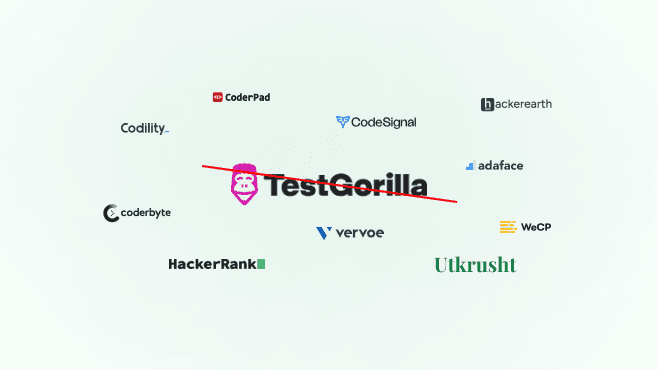
3 main reasons companies switch away from TestGorilla
Mandatory 12-month lock-in with no monthly option.
TestGorilla's Core plan starts at $1,700/year — and there is no month-to-month option on any paid tier.
One Capterra reviewer finished a single hire, emailed support nearly 20 times asking to cancel, and was offered only a 3-month pause.
Another reviewer called it "intentionally misleading" to enforce 12-month commitments on what feels like a monthly tool. For small teams with one-off or seasonal hiring, you'll pay $1,700 whether you use it for 2 months or 12.
Coding challenges are Plus-plan only — not available on Core.
For engineering leaders who want TestGorilla specifically for technical hiring, this is a critical gap: the coding assessment capability is entirely absent from the entry plan.
The Plus plan requires a custom pricing conversation.
TestGorilla also covers the major languages but limits coverage for specialized or emerging stacks — with tests that focus primarily on algorithmic challenges and single-file exercises rather than realistic multi-file engineering work.
Customer support gets rigid when money is involved.
TestGorilla's Trustpilot score is 3.9/5 — notably lower than its G2 score of 4.5/5. The gap points to where the real pain sits:
Trustpilot captures more organic complaints, and billing and cancellation dominate those reviews.
One verified reviewer described the support response on billing issues as offering "only a rigid 3-month pause" after 20 support contacts. Product questions get answered quickly; contract questions don't.
Full transparency: About this research
Important Disclosure:
✅ This article is created by Utkrusht AI's product team
✅ We've objectively tested TestGorilla with real accounts
✅ We cite official pricing and features
✅ We recommend TestGorilla when it's genuinely the better fit for your needs
✅ All pricing verified from official and third-party sources as of 2026
Testing methodology: 3 months of hands-on evaluation across platforms in this category. Features verified on current versions — test library breadth, customisation depth, anti-cheat capabilities, ATS integrations, and post-hire correlation for both technical and non-technical roles. Pricing benchmarked from Capterra, TestTrick, and Willo pricing analysis. Third-party reviews analysed from G2 (1,400+ reviews), Capterra (265 reviews), and Trustpilot (1,700+ reviews).
Why trust this article: While we obviously prefer our own product, we've worked to provide an honest assessment. When other tools are a better choice for your use-case, we say so clearly. Our goal is helping you choose the right tool for your situation.
About this article: Written for HR managers, talent acquisition leads, and engineering leaders at companies under 200 employees — particularly those who liked the idea of TestGorilla but hit friction on pricing structure, technical depth, or cancellation policies.
Testing background:
Founders of Utkrusht are engineers themselves
Naman is a Software Engineer, ex-Oracle, ex-Microsoft engineering leader
Has been part of 500+ technical interviews as a bar raiser
Tested and researched 70+ tools in the tech hiring space
Closely studied tech hiring pain points and challenges for the past 5 years to shape how Utkrusht is built today
What this article covers: Practical features, actual costs including hidden pricing structure issues, honest limitations discovered during testing — all to help you make the best decision for your needs right now.
5 strong alternatives worth seriously evaluating
Utkrusht — unlike other tools that create artificial scenarios and simulations, Utkrusht takes a different approach to make candidates do tasks (called "watch-them-work" tasks) inside live production systems and showing you much deeper candidate signals required today in the AI-era
Adaface — conversational assessment format with 500+ skills, stronger on technical depth than TestGorilla, credit-based pricing that avoids annual lock-in on lower tiers
Toggl Hire — skills-first ATS hybrid with free entry plan, better candidate experience, and starts at $17/month without annual commitments
Canditech — job simulation platform with AI proficiency testing built in, $75/month entry, and no forced annual lock-in at the Team level
Xobin — pre-employment screening covering technical, psychometric, and cognitive assessments, with more flexible pricing than TestGorilla's rigid annual structure
5 "good enough" alternatives worth considering
TestDome — pay-per-candidate model ($20 for a 5-pack) with no subscription, better for teams with infrequent or unpredictable hiring
Equip — $1/candidate pay-as-you-go, the most flexible pricing model in the category for low-volume or project-based hiring
Skillfully — AI-powered job simulations claiming 50% faster screening, used by Bloomberg and McKinsey, newer entrant worth evaluating for role-specific simulations
EmployTest — focused on workplace skills and role readiness testing, lower price point than TestGorilla, good for admin, ops, and customer-facing roles
Criteria Corp — structured cognitive, personality, and skills assessments with strong predictive validity research behind the methodology
Tools we'd generally not recommend for pure tech hiring
General-purpose form builders used as assessments like Typeform, Jotform, and Google Forms — they're free, but there's no scoring, no anti-cheat, no structured reporting, and no way to objectively compare candidates. Using them for engineering screening means you're essentially running a self-graded quiz.
Behavioural-only platforms like Culture Amp and Lattice when applied to hiring — both are excellent employee engagement and performance tools, but they don't evaluate pre-hire skills. Using culture-fit frameworks to screen engineering candidates before you've established they can do the job is the wrong sequence entirely.
Job board add-on assessments like Indeed Assessments or LinkedIn Skill Assessments — low signal, high volume. Everyone passes. The bar is set to reduce friction for candidates, not to give hiring managers meaningful differentiation. One reviewer noted they tell you very little about who is genuinely qualified.
Alternative 1: Utkrusht (our product — but read why we're listing it first)
We obviously recommend our own product, Utkrusht. But there's a strong reason for it.
After testing 70+ tools in the tech hiring space over five years, Naman and the founding team couldn't find a single platform that solves the core problem: you still can't watch HOW a candidate actually works in real job situations — how they think, make judgements, trade-offs, approach problems, make decisions, etc.
Every tool — coding tests, pair programming, take-home assignments — gives you a proxy signal. A score. A resume for your resume. None of them put a candidate inside a running system and let you watch how they debug, how they think, how they use AI, and how they make decisions under real constraints.
That's the gap Utkrusht was built to fill. No other platform on the market currently does this at scale, with leak-proof task generation, across 350+ skills, including niche areas like embedded firmware and cybersecurity.
Strongly consider Utkrusht if...
You're tired of hiring candidates who "pass" but then underperform — and want to see how they actually think, approach problems, and work in real job situations before you ever interview them
You want not just surface-level, but quite possibly the deepest candidate signals today (just ask us for a sample candidate report to see how that looks like when compared to others)
You're a small and mid-sized company where every bad hire sets you back 3–6 months and you can't afford the cost of a wrong decision
You want a screening and shortlisting process that works with AI (not against it) and shows you exactly how candidates used AI tools during their assessment
3 limitations to be aware of beforehand
Might not integrate with your current ATS. Utkrusht regularly integrates with ATS platforms and it's an ongoing process. So if ATS integration is a hard requirement right now, worth confirming before you sign up.
Not built for non-tech roles (yet). Utkrusht is purpose-built for technical hiring. If you're also screening customer success, sales, or ops roles, you'll want a separate tool for those.
Newer brand. Unlike TestGorilla, which was founded in 2019 and has over 1,400 G2 reviews from small businesses across every industry, Utkrusht is a young company with a focused core product team. Some candidates might not immediately recognise the name. Hasn't caused drop-off issues in practice — actually the opposite, since Utkrusht has the lowest drop-off rate in the industry — but worth knowing going in.
Free trial?
Yes. Utkrusht offers a free trial — no credit card required.
7 core features that matter most
Feature | Detail |
Watch-them-work tasks | Candidates work inside actual deployed environments — live databases, running APIs, real systems. No artificial scenarios or simulations |
AI usage visibility | See exactly where and how a candidate used AI — purposeful prompting vs. blind copy-paste |
Video session recording | Full session recorded. Watch the candidate's entire thought process, not just the output |
350+ skills coverage | Including rare skills like embedded firmware, GenAI, and cybersecurity — widest depth available for technical roles |
Leak-proof task generation | New tasks generated weekly. Impossible to memorize or Google your way through |
SmartRank | Query-based shortlisting: "Show me candidates who validated AI outputs before applying them" or "candidates with prior backend systems experience" |
Soft skills signals | Communication style, decision-making approach, questions asked, and thought process — all visible from the session recording |
Do the product team add custom features on request?
Yes. Utkrusht works closely with engineering teams to build custom tasks for specific stacks or company contexts. Timeline is typically ~1 week for a custom feature requested.
Pricing estimate
Utkrusht is fully usage-based — you pay per assessment task completed, not per seat or annual subscription. No $1,700/year lock-in, no 12-month commitments, no credit packs that expire whether you use them or not. For small and mid-sized recruiting teams, this is the most budget-friendly option on this list — you pay only for what you actually use. Free trial available with no card required. Start here → utkrusht.ai
Alternative 2: Adaface
Adaface uses a conversational chatbot format — Ada guides candidates through scenario-based dialogue rather than a timed, proctored test environment. It covers 500+ skills including both technical and non-technical assessments, with a tone that reviewers consistently find less anxiety-inducing than traditional quiz platforms.
Strongly consider Adaface if...
You want stronger technical depth than TestGorilla at a comparable price — Adaface's technical question quality is consistently rated higher than TestGorilla's in head-to-head comparisons, especially for developer and QA roles
Your HR team runs assessments independently without engineering involvement — the conversational format is easier for non-technical recruiters to configure and interpret
You hire across lateral and campus technical roles at volume and want a first-round filter that feels less intimidating to candidates than a standard timed coding test
3 limitations to be aware of
Credit-based pricing scales steeply. Individual plan at $180/year gives 12 credits. The gap to Growth ($5,500/year for 1,000 credits) is steep — there's no comfortable mid-tier for teams doing 50–200 assessments per year.
Still primarily textbook-based. Reviewers note the questions reflect knowledge rather than applied problem-solving — good for filtering clear misfits, weaker at identifying your best hire from a competitive pool.
No session recording or deep behavioral signal. Adaface gives you a score and a conversation transcript. It doesn't show you how candidates approached problems or made decisions under pressure.
Free trial? Yes.
Pricing estimate
Individual: $180/year (12 credits). Starter: $500/year (50 credits). Growth: $5,500/year (1,000 credits). Unlimited: $50,000/year.
Alternative 3: Toggl Hire
Toggl Hire is a skills-first assessment and applicant tracking hybrid, built specifically for remote-first teams. It replaces resume screening with skills tests at the top of the funnel, combines async video interviews and homework assignments in one pipeline, and operates without forcing annual commitments at accessible price points.
Strongly consider Toggl Hire if...
You want to replace resume screening entirely — Toggl Hire's entire workflow is designed around this, with auto-ranked candidates by skills test score from the first step
You need a combined assessment and ATS tool in one lightweight platform — handling testing, video, pipeline management and ATS integrations without separate subscriptions
You're a remote-first or distributed team — Toggl Hire was built for async, timezone-independent hiring and has a strong track record with digital agencies and distributed SaaS companies
3 limitations to be aware of
180+ skills is narrower than TestGorilla's library. Toggl Hire covers mainstream roles well but has thinner coverage for niche technical or specialist positions.
Technical engineering depth is limited. Good for product, marketing, operations, and junior-mid engineering roles. Not designed for deep senior engineering evaluation.
ATS capabilities overlap awkwardly if you're already on Greenhouse or Lever. For teams with established ATS workflows, the combined tool creates redundancy rather than simplification.
Free trial? Yes — free plan available.
Pricing estimate
Free plan available. Starter: $17/month. Premium: $34/month. Business: $67/month. Enterprise: $399/month (30 active jobs, unlimited tests and candidates). Annual discounts available.
Alternative 4: Canditech
Canditech is a job simulation assessment platform with one distinctly innovative feature for 2026: ChatGPT is embedded directly inside assessments, so you can evaluate not just whether candidates can complete tasks, but how they interact with AI tools in real time. It covers 500+ ready-made tests across technical and non-technical skills with auto-scoring.
Strongly consider Canditech if...
You want job simulation-style assessments that go beyond MCQ — candidates complete realistic tasks in the role rather than answering knowledge questions, which produces stronger on-the-job performance correlation
AI proficiency testing is a priority — Canditech's ChatGPT-in-assessment feature is the most direct way to evaluate how candidates use AI tools during a task, a capability no other direct TestGorilla alternative on this list offers
You want better candidate experience than TestGorilla — Canditech reviewers consistently note the platform feels like "a test drive of the role" to candidates, which improves completion rates
3 limitations to be aware of
500+ tests is narrower than TestGorilla's library. For teams needing a very wide range of non-technical role tests, TestGorilla or Toggl Hire have broader coverage.
Smaller review base. Canditech has 52 G2 reviews versus TestGorilla's 1,400+. The ratings are strong, but there's less historical evidence to draw on.
Enterprise customisation features are still maturing. Very large teams with complex multi-department assessment workflows may find Canditech's enterprise tooling less mature than established platforms.
Free trial? Yes — no credit card required.
Pricing estimate
Team plan: $75/month (billed annually) for 50 candidates. Higher tiers scale with candidate volume. Pay-per-candidate model also available. Enterprise custom pricing.
Alternative 5: Xobin
Xobin is a pre-employment assessment platform covering technical, psychometric, cognitive, and behavioural dimensions in one tool. It's designed for companies that want the breadth of TestGorilla — mixed technical and non-technical screening — with more flexible pricing and stronger cognitive assessment depth.
Strongly consider Xobin if...
You need technical, cognitive, and personality assessments together without paying TestGorilla Plus prices for every feature
You're hiring for roles where psychometric and cognitive signals matter alongside technical skills — finance, consulting, analytics, and senior operations roles where thinking patterns are as important as hard skills
You want more pricing flexibility than TestGorilla's rigid annual structure — Xobin's plans are more accessible for teams with variable or seasonal hiring volumes
3 limitations to be aware of
Smaller brand presence than TestGorilla. Xobin has a smaller review base, which means less social proof for HR decision-makers evaluating tools through their networks.
Candidate experience is less polished. Some reviewers note the candidate-facing interface is less refined than TestGorilla or Toggl Hire's cleaner designs.
Customer support responsiveness varies. Unlike TestGorilla's fast product support (despite billing friction), Xobin's support has mixed reviews on response times.
Free trial? Yes — free trial available.
Pricing estimate
Xobin pricing starts around $40–$80/month for SMB plans. Enterprise pricing on request. More flexible than TestGorilla's mandatory annual structure.
The market reality: Hiring in the age of AI
TestGorilla's 2025 State of Skills-Based Hiring report found that 78% of organisations using skills assessments reported improvements in quality of hire. That's a compelling stat — and it's genuine evidence that structured assessment beats resume screening.
But "better than resumes" is a low bar in 2026. The question isn't whether you should assess candidates before interviewing them — you should. The question is what kind of assessment gives you signal that actually predicts whether someone will perform in your specific role, with your specific team, in 2026's AI-augmented engineering environment.
TestGorilla's tests are well-designed for general cognitive ability, personality fit, and broad skill knowledge. Where the gap appears is for engineering roles specifically — where the difference between a candidate who scores 85% on a JavaScript knowledge test and one who can actually navigate a broken Node.js service in production is enormous, and TestGorilla's format doesn't surface it.
SHRM's 2025 Skills-Based Hiring research found 56% of employers now use assessments to evaluate candidates, and 78% of those report improved hiring quality. The next frontier isn't whether to assess — it's what you're actually assessing. Knowledge tests predict knowledge. Watch-them-work tasks in live environments predict performance. For engineering leaders, that distinction is the one that matters.
Feature comparison: TestGorilla vs. the 5 strong alternatives
Feature | TestGorilla | Utkrusht | Adaface | Toggl Hire | Canditech | Xobin |
Live deployed production environment | ❌ | ✅ | ❌ | ❌ | ❌ | ❌ |
AI usage visibility (how candidate used AI) | ❌ | ✅ | ❌ | ❌ | ✅ ChatGPT in-test tracking | ❌ |
Video / session recording | ✅ Video responses (Plus only) | ✅ Full session video | ❌ | ✅ Async video | ✅ Video responses | ✅ Video responses |
Anti-cheat / proctoring | ✅ Full-screen monitoring | ✅ | ✅ | ✅ | ✅ Tab-switch, copy-paste, location | ✅ |
Soft skills & behavioral signals | ✅ Personality tests | ✅ From live session | ✅ Partial | ✅ Partial | ✅ Personality + communication | ✅ Psychometric |
Technical depth for engineering roles | ⚠️ Plus plan only | ✅ Deep — live systems | ✅ Better than TestGorilla | ⚠️ Basic | ✅ Coding + SQL | ✅ Moderate |
No annual lock-in | ❌ All paid plans annual | ✅ Usage-based | ✅ Partial (lower tiers) | ✅ Monthly options available | ✅ Monthly available | ✅ |
Candidate experience (completion rates) | ✅ Good | ✅ High — 70% taken mid-day | ✅ Good | ✅ Very good | ✅ Good | ✅ Good |
Leak-proof / unlimited task generation | ❌ | ✅ | ❌ | ❌ | ❌ | ❌ |
Free plan available | ✅ Limited | ✅ Free trial | ✅ Free trial | ✅ Free plan | ✅ Free trial | ✅ Free trial |
ATS integrations | ✅ 40+ | ✅ Adding new every month | ✅ | ✅ Greenhouse, Workable, Zapier | ✅ | ✅ |
5 things only Utkrusht can do
1. Give engineering candidates an actual live system to work in — not an algorithmic quiz
TestGorilla's coding tests cover the major languages with algorithmic challenges and single-file exercises. Utkrusht gives candidates a live, deployed environment — a real API already running, a database already populated with data, a service already interacting with other services — and asks them to fix something that's actually broken.
Instead of "write a function that finds the longest palindrome in a string" (TestGorilla Core, which doesn't even have coding challenges) or even a Plus-plan algorithmic challenge, Utkrusht has the candidate connect to a production endpoint that's returning 500 errors under load, read the actual logs, diagnose the cause, and push the fix.
Most company tasks are like giving someone a car engine on a table. Utkrusht tasks are like asking them to fix the car while it's running.
2. Show you how candidates use AI in practice — not block it as cheating
TestGorilla's anti-cheat tools monitor for full-screen mode and flag suspicious behaviour. Like most platforms, it treats AI tool use as an integrity concern.
Utkrusht records the full session and shows you exactly how a candidate used AI — what they asked, how they prompted, whether they understood and validated the output, or just copy-pasted without checking. The difference between those two candidates is enormous in production. Utkrusht is the only platform that surfaces it clearly.
3. Candidate experience and completion rates that don't punish them
70% of Utkrusht assessments are taken during working hours — during lunch, between meetings — not as an obligation on evenings or weekends. Tasks take ~30 minutes and feel like genuine engineering work.
TestGorilla's multi-test stacked assessments can run 60–90 minutes. One CTO reviewer on Capterra noted candidates found certain tasks "irrelevant for assessing their skills and are unwilling to complete them." That's the exact dynamic that filters out strong candidates who won't tolerate irrelevant tests — not bad candidates. Short, real-work assessments get completed. Long abstract ones don't. Candidates on Reddit and review forums make this point consistently and loudly.
4. SmartRank: find your best candidates beyond a cognitive + personality score
TestGorilla's automated ranking combines cognitive ability, role skill score, and personality profile into a candidate comparison dashboard. It's useful for mixed-role hiring.
Utkrusht's SmartRank lets you query the technical shortlist in plain language: "Show me candidates who diagnosed a problem systematically before writing any code" or "Show me candidates who consistently validated AI output before committing changes." That level of behavioural granularity — specific to how an engineer actually worked through a real problem — is not available in any test score.
5. 350+ skills at depth for the roles where TestGorilla's library thins out
TestGorilla covers a wide range of mainstream technical and non-technical assessments. For generalist mixed-role hiring, this breadth is its strength.
For specialist engineering roles — embedded firmware, cybersecurity, GenAI infrastructure, distributed systems engineering — TestGorilla's library doesn't go deep enough. These are the roles where wrong hires hurt most and where shallow knowledge tests are least predictive. Utkrusht's 350+ skills are all live-environment watch-them-work tasks, covering the specialist technical domains that TestGorilla and most of its alternatives simply don't have.
Which tool is best for?
Deep technical hiring signal for engineering roles: → Utkrusht — watch-them-work in real systems, deepest signal per candidate available → Canditech — job simulations with AI proficiency testing, better than TestGorilla on signal quality for mid-level technical roles
Mixed-role hiring across technical and non-technical teams: → TestGorilla — broadest ready-made test library with the fastest setup; strong for volume screening across many role types → Toggl Hire — cleaner interface, more flexible pricing, and a combined ATS + assessment tool if you want fewer subscriptions → Adaface — stronger technical depth than TestGorilla, conversational format HR teams can run independently
Teams with low or seasonal hiring volume: → TestDome — pay-per-candidate, no subscription, clean work-sample questions → Equip — $1/candidate pay-as-you-go, lowest friction entry for infrequent hiring → Utkrusht — usage-based, you only pay when you actually hire
Psychometric and cognitive assessment priority: → Xobin or Criteria Corp — stronger cognitive and psychometric methodology than TestGorilla → Bryq — cognitive-personality pairing with role benchmarking
Final verdict
Choose Utkrusht if:
You're hiring engineers and want signal beyond a test score — how candidates actually operate inside real systems, use AI purposefully, and make decisions under real constraints
You care about AI usage visibility as a core signal — what candidates do with AI tools in practice, not whether they passed an algorithmic test
You're a small or mid-sized team where TestGorilla's $1,700/year lock-in doesn't match your actual hiring frequency
You need deep specialist coverage — embedded, security, GenAI engineering — that TestGorilla's library doesn't reach
You want short, real-work tasks that candidates complete willingly rather than multi-test stacks that take 90 minutes and cause drop-off
Choose TestGorilla if:
You're doing mixed-role hiring across engineering, marketing, sales, and operations and want one tool with a broad ready-made library for all of them
You hire consistently throughout the year and the $1,700/year pricing makes sense — you're not paying for 12 months of inactivity
You want the widest test coverage in the market for non-technical soft skill, cognitive ability, and personality assessment in one platform
Your team needs a well-documented, widely-recognised platform for internal stakeholder sign-off — TestGorilla's brand recognition is a real advantage here
Seen enough? Give it a try — Utkrusht has a free trial, no credit card required.
FAQ
Q1: Why is TestGorilla's Trustpilot score (3.9) lower than its G2 score (4.5)?
The gap points to where the real friction is. G2 reviews are primarily written by HR managers and team admins — the buyers — who are evaluating product functionality and ease of use. Trustpilot captures more organic, unsolicited reviews from the full user base, and billing, cancellation, and contract complaints dominate there.
The pattern is consistent: TestGorilla's product genuinely works well for screening candidates. The frustration concentrates around the 12-month lock-in, the difficulty of cancelling, and the rigidity of customer support when money is involved. If you're confident you'll use the platform continuously for a full year, the product experience is solid. If you're unsure about hiring volume, the contract structure is a real risk.
Q2: Is TestGorilla's free plan actually useful?
The free plan gives access to five essential skills tests and five custom questions per assessment — enough to evaluate the platform and run one or two real assessments before committing. What's not included: most of the test library, personality assessments, coding challenges, video questions, and advanced anti-cheat features.
One Capterra reviewer noted: "The free trial is very limited — we never got full access to the personality or technical assessments we needed." The free plan is a genuine taste test, not a working tool. Budget for at least the Core plan ($1,700/year) if you're doing real hiring.
Q3: What's the best TestGorilla alternative for a startup that hires only a few people per year?
TestDome or Equip for infrequent, pay-as-you-go technical screening — no annual commitment, pay per assessment. Toggl Hire's free plan if you also want async video and pipeline management at zero cost.
Utkrusht if your primary focus is engineering hires — usage-based pricing means you pay per task only when you're actively hiring, with no floor cost during quiet periods. Start here → utkrusht.ai
Q4: Can TestGorilla replace a dedicated coding assessment tool for engineering hiring?
Only at the Plus plan level — and even then, with limitations. The Core plan has no coding challenges at all. The Plus plan adds them, but the challenges focus on algorithmic problems and single-file exercises rather than the kind of multi-file, real-system work that predicts senior engineering performance.
For companies hiring junior engineers where basic coding fluency is the bar, TestGorilla Plus is workable. For mid-to-senior engineers, specialist roles, or any situation where real-system judgment matters, a dedicated platform — Codility, HackerRank, or Utkrusht for watch-them-work signal — gives you meaningfully better signal than TestGorilla's coding library.
Q5: How does Canditech's AI proficiency testing compare to Utkrusht's AI usage visibility?
Canditech's approach: embed ChatGPT inside the assessment and track how candidates interact with it — what they typed, what the AI responded, how that influenced their final answer. It's a genuine innovation over platforms that either block AI or ignore it entirely.
Utkrusht's approach: record the entire session as video. You see everything — what tools the candidate opened (not just ChatGPT), how they formulated prompts, whether they validated AI output before applying it, where they overrode AI suggestions with their own judgment, and where they deferred to AI without checking.
The signal is richer because the observational window is the full session, not just AI tool interactions.
For teams where AI usage behaviour is a core signal — which in 2026 it increasingly is — Utkrusht's full-session recording gives more complete visibility than Canditech's embedded tool tracking.
Have a question about your specific hiring context?Talk to the Utkrusht team →

Founder, Utkrusht AI
Ex. Euler Motors, Oracle, Microsoft. 12+ years as Engineering Leader, 500+ interviews taken across US, Europe, and India
Want to hire
the best talent
with proof
of skill?
Shortlist candidates with
strong proof of skill
in just 48 hours