Contents
Key Takeaways
Skill assessment platforms have become essential for modern hiring, allowing companies to validate candidate competency with objective, repeatable evaluations.
Platforms vary widely in depth and capability, from basic MCQ tools to full watch-them-work tasks that replicate real engineering challenges.
The most effective platforms offer realistic environments, automation, AI scoring, and deep analytics, providing a far stronger signal than resumes or interviews alone.
Choosing the right tool requires understanding role complexity, required skill depth, budget, and integration needs—not all platforms suit all teams.
A well-selected assessment platform reduces mis-hires, accelerates hiring, and expands access to diverse, high-performing candidates.
Hiring the right technical talent is a critical challenge for engineering leaders. Traditional methods often fail to predict on-the-job performance, leading to costly hiring mistakes.
The core problem is the disconnect between what a resume claims and what a candidate can actually do when faced with real-world engineering problems. This gap leads to wasted time, delayed projects, and a frustrating hiring process.
Quick glance — here are the top 14 skill assessment platforms which are top-rated across the globe
iMocha: A comprehensive skills intelligence platform with a vast library for various roles.
HackerRank: A market leader for screening and interviewing developers at scale.
Utkrusht: Our platform. A platform that assesses candidates by watching them work. Only platform that evaluates candidates in live production environments
HireHunch: An interview-as-a-service platform with a network of vetted interviewers.
Codility: An enterprise-focused platform for evaluating and interviewing engineers.
Devskiller: A platform that uses realistic work sample tests to verify tech skills.
CodinGame: Engages developers with game-based challenges and assessments.
CodeSignal: A technical assessment platform known for its advanced IDE and framework-based tasks.
HackerEarth: Offers tools for assessment, interviews, and hackathons to engage developers.
Vervoe: Uses AI-powered watch-them-work tasks and multimedia to test on-the-job skills.
LeetCode: A popular platform for developers to practice and for companies to source talent.
Coderbyte: Provides coding challenges and assessments for screening and interviews.
CoderPad: A collaborative IDE built for live technical interviews.
TestDome: Offers work-sample tests for programming and other professional skills.
What is skill assessment?
Skill assessment is the process of measuring an individual’s proficiency in a specific area. In technical hiring, it moves beyond resume claims to objectively verify if a candidate possesses the necessary skills to perform a job successfully.
This involves testing for hard skills like programming languages, system design, or debugging, as well as soft skills like communication and problem-solving.
Effective skill assessment provides concrete evidence of a candidate’s abilities. Instead of relying on self-reported experience, it uses standardized tests, coding challenges, or watch-them-work tasks to generate objective data.
This data-driven approach helps reduce hiring bias and improves the quality of hires by ensuring decisions are based on merit and actual capability, not just credentials. It’s the difference between asking a pilot if they can fly and putting them in a flight simulator.
What is a skill assessment platform?
A skill assessment platform is a software tool designed to automate and standardize the process of evaluating candidate skills. These platforms provide a centralized environment for creating, distributing, and analyzing assessments for technical and non-technical roles. They replace manual, inconsistent screening methods with efficient, data-driven workflows.
These platforms offer features like pre-built test libraries, real-time coding environments, and anti-cheating mechanisms to ensure fair and accurate evaluations.
By using a dedicated skill assessment platform, engineering leaders can save significant time, reduce unconscious bias, and gain deeper insights into a candidate’s true potential before committing to a lengthy interview process.
Detailed comparison of the top 14 skill assessment platforms
1. iMocha
iMocha is a skills intelligence platform that offers a vast library of over 2,500 skill tests. It covers a wide range of domains, including IT skills, coding, domain skills, and cognitive aptitude, making it a versatile choice for organizations with diverse hiring needs.
Main 3 Features:
Extensive Test Library: Covers a massive range of technologies and job roles.
AI-Powered Proctoring: Robust features to ensure the integrity of remote assessments.
Skills Intelligence: Provides analytics on team skill gaps and proficiency levels.
Unique Differentiation (Core USP): Its sheer breadth of ready-to-use assessments and its focus on providing “skills intelligence” beyond just pre-hire screening.
Use this if you prefer X: A single platform to assess a wide variety of roles, not just tech, with strong analytics.
Do not use this if you prefer Y: Deep, real-world watch-them-work tasks over a large volume of quiz-style questions.
1 Standout Feature: The ability to create custom tests combining various skill types (e.g., coding, aptitude, and communication) in one assessment.
Pricing: Custom pricing based on company size and usage. Requires a demo.
Does it evaluate candidates by watching how they work in real-life situations? Partially, through project-based questions, but it’s not its core focus compared to platforms like Utkrusht.
Best For: Large enterprises needing a comprehensive solution for diverse, high-volume hiring.
Main Downside: The platform can feel complex, and the cost may be prohibitive for smaller companies.
Does it show proof-of-work samples? Yes, it provides code playback and project submissions.
Does it have advanced proctoring or cheating mechanisms? Yes, it offers strong AI-based proctoring with window violation detection and IP tracking.
Does it offer a free trial? Yes, a free trial is available.
2. HackerRank
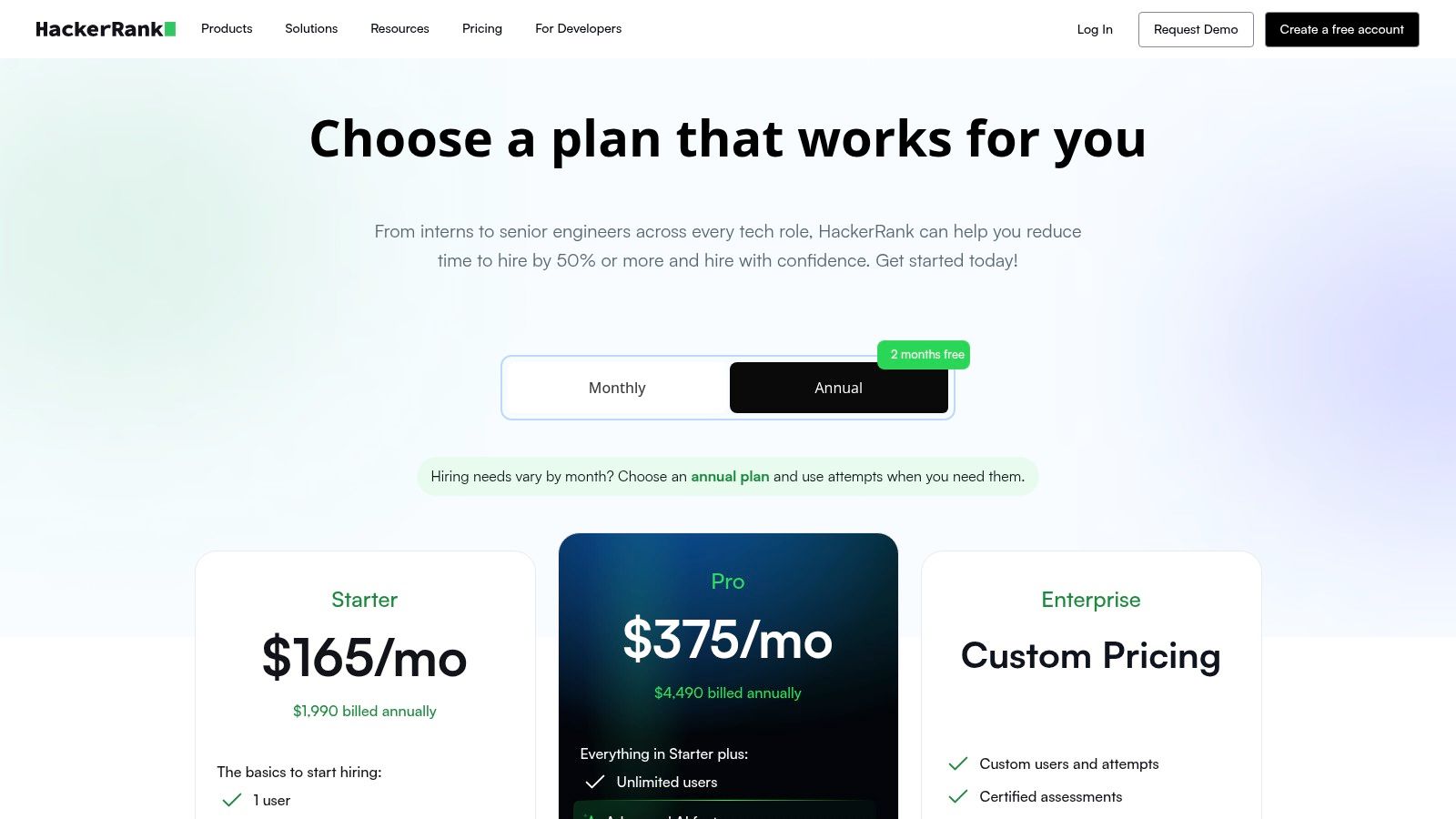
HackerRank is a dominant player in the tech assessment space, widely used by enterprises to screen and interview developers at scale. It offers a comprehensive suite of tools from initial coding tests to live collaborative interview environments.
Main 3 Features:
Screen: A large library of challenges to screen candidates asynchronously.
Interview: A live, collaborative coding environment with whiteboarding features.
Developer Skills Platform: Tools to benchmark and upskill internal engineering teams.
Unique Differentiation (Core USP): Its end-to-end platform that covers the entire technical hiring funnel, from screening to interviewing, backed by a strong brand in the developer community.
Use this if you prefer X: A scalable, enterprise-grade platform for high-volume technical screening with strong anti-plagiarism.
Do not use this if you prefer Y: Assessments that focus on practical, day-to-day bug fixing and system tasks over algorithmic challenges.
1 Standout Feature: The integrated workflow from asynchronous screening to a live interview on the same platform.
Pricing: Tiered plans (Team, Enterprise) with pricing available upon request.
Does it evaluate candidates by watching how they work in real-life situations? It offers project-style questions that simulate real tasks, but its foundation is in algorithmic challenges.
Best For: Companies hiring a large number of developers and needing a standardized, scalable process.
Main Downside: Can be expensive, and some developers feel the challenges are too academic and not representative of actual work.
Does it show proof-of-work samples? Yes, through code playback and project submissions.
Does it have advanced proctoring or cheating mechanisms? Yes, it has robust proctoring and plagiarism detection.
Does it offer a free trial? No, but it offers a limited free plan for individuals.
3. Utkrusht
Utkrusht is a modern skill assessment platform for mid-sized companies designed to show you how candidates actually work.
It replaces traditional quizzes with high-fidelity, real-world watch-them-work tasks, allowing you to watch candidates solve bugs, refactor code, and make trade-offs just like they would on your team.

Main 3 Features:
Real-World Job Watch-them-work tasks: Candidates fix bugs on an EC2 server, optimize live SQL queries, or implement features in a realistic dev environment.
Video Proof-of-Work: Every session is recorded, giving hiring managers an unfiltered view of the candidate’s problem-solving process.
Ranked Shortlist: Delivers an evidence-based, ranked shortlist of the top candidates within 48 hours.
Unique Differentiation (Core USP): It assesses candidates by allowing hiring managers to watch them perform actual job tasks in real-life situations. Instead of asking candidates to explain Docker, it asks them to fix a broken Docker setup. This provides verifiable proof-of-work.
Use this if you prefer X: To see how a candidate actually solves real-world engineering problems before you interview them. It’s ideal for small engineering teams (under 1000 employees) that value practical skills over theory.
Do not use this if you prefer Y: A high-volume, top-of-funnel filter using simple MCQs or if you primarily hire for junior roles where algorithmic knowledge is the main focus.
1 Standout Feature: The video recordings of candidates navigating a full-fledged development environment to solve a practical problem.
Pricing: Custom pricing available upon request. Known to be the most budget-friendly option compared to others on this list, especially for mid-sized engineering teams.
Does it evaluate candidates by watching how they work in real-life situations? Yes, this is its entire methodology.
Best For: Engineering teams who need to verify hands-on coding and system-level skills with undeniable proof.
Main Downside: The in-depth assessments may be too intensive for very high-volume, entry-level screening funnels.
Does it show proof-of-work samples? Yes, it provides full video recordings of the candidate’s session.
Does it have advanced proctoring or cheating mechanisms? Yes, it has built-in proctoring and behavior analysis.
Does it offer a free trial? Information is available upon booking a demo.
4. HireHunch
HireHunch is an interview-as-a-service platform that provides a network of freelance, vetted interviewers from top tech companies. It helps engineering teams scale their hiring process by outsourcing the technical interview stage.
Main 3 Features:
Interviewer Network: Access to a pool of experienced engineers to conduct technical interviews.
Structured Interviews: Provides pre-defined interview structures and questions for consistency.
Detailed Feedback: Delivers comprehensive interview feedback and recommendations.
Unique Differentiation (Core USP): It focuses on human-led interviews rather than automated assessments, augmenting your team’s capacity with external experts.
Use this if you prefer X: To scale your interview process without overburdening your current engineering team.
Do not use this if you prefer Y: An automated, asynchronous platform for initial candidate screening.
1 Standout Feature: The quality and caliber of its interviewer network.
Pricing: Typically a per-interview pricing model.
Does it evaluate candidates by watching how they work in real-life situations? Not in the same way as a watch-them-work task platform. It facilitates live interviews, which can include practical questions.
Best For: Startups and scale-ups experiencing rapid growth and needing to conduct more interviews than their team can handle.
Main Downside: It can become costly at scale and relies on the quality of third-party interviewers.
Does it show proof-of-work samples? It provides interview recordings and detailed feedback reports.
Does it have advanced proctoring or cheating mechanisms? Proctoring is managed by the live interviewer.
Does it offer a free trial? They may offer pilot programs for new clients.
5. Codility
Codility is an enterprise-focused platform that helps companies assess the technical skills of developers. It offers tools for both remote screening (CodeCheck) and live technical interviews (CodeLive), with a strong emphasis on real-world engineering problems.
Main 3 Features:
CodeCheck: Automated assessments to screen candidates’ coding skills.
CodeLive: A collaborative platform for conducting remote technical interviews.
Evidence-Based Hiring: Provides detailed reports and analytics to support hiring decisions.
Unique Differentiation (Core USP): Its focus on evidence-based hiring for enterprises, with robust tools that support a fair and predictive evaluation process.
Use this if you prefer X: A platform that helps you build a consistent and objective technical hiring process across your entire organization.
Do not use this if you prefer Y: A lightweight, budget-friendly tool for occasional hiring.
1 Standout Feature: The “Fundamental Knowledge” tasks that test understanding of core programming concepts beyond just algorithms.
Pricing: Custom enterprise plans. Requires a demo.
Does it evaluate candidates by watching how they work in real-life situations? Yes, its “Real-Life Tasks” are designed to simulate on-the-job challenges.
Best For: Large technology companies looking to standardize their technical hiring practices globally.
Main Downside: The platform is enterprise-focused and may be too expensive and complex for smaller businesses.
Does it show proof-of-work samples? Yes, through code playback and performance reports.
Does it have advanced proctoring or cheating mechanisms? Yes, it includes plagiarism detection and other proctoring features.
Does it offer a free trial? No, access is through a paid enterprise plan.
6. Devskiller
Devskiller focuses on verifying technical skills with its “RealLifeTesting™” methodology. The platform allows candidates to work on projects using the same tools, frameworks, and libraries they would use on the job, providing a realistic assessment experience.
Main 3 Features:
RealLifeTesting™: Assessments based on real-world coding tasks and work samples.
Broad Tech Stack Support: Supports a wide range of languages, frameworks, and libraries.
End-to-End Platform: Covers screening, interviewing, and upskilling in one tool.
Unique Differentiation (Core USP): Its commitment to realistic work-sample tests that mirror the entire development workflow, including using Git and managing dependencies.
Use this if you prefer X: To test a candidate’s ability to work with specific frameworks and libraries, not just their knowledge of a programming language.
Do not use this if you prefer Y: Simple algorithmic challenges for top-of-funnel screening.
1 Standout Feature: The ability to test a candidate’s full workflow, from cloning a repository to running unit tests.
Pricing: Subscription-based plans with pricing available upon request.
Does it evaluate candidates by watching how they work in real-life situations? Yes, this is the core of its methodology.
Best For: Companies that want to test skills in a specific tech stack (e.g., React, Django, Spring).
Main Downside: Creating highly customized, realistic tests can be time-consuming for the hiring team.
Does it show proof-of-work samples? Yes, it captures the entire project submission.
Does it have advanced proctoring or cheating mechanisms? Yes, it includes plagiarism detection and screen recording.
Does it offer a free trial? Yes, a free trial is available.
7. CodinGame
CodinGame takes a unique approach to skill assessment by using game-based challenges to engage and evaluate developers. It’s both a community platform for developers to hone their skills and a tool for companies to screen and source talent.
Main 3 Features:
Game-Based Assessments: Fun and engaging challenges that test coding skills.
Community Sourcing: Access to a large community of active developers.
Customizable Tests: Ability to create assessments tailored to specific job requirements.
Unique Differentiation (Core USP): Its gamified approach makes the assessment process more engaging and enjoyable for candidates, improving the candidate experience.
Use this if you prefer X: A more creative and engaging way to assess developers, especially for roles where problem-solving and creativity are key.
Do not use this if you prefer Y: Straightforward, real-world bug-fixing or enterprise application development tasks.
1 Standout Feature: The competitive, community-driven aspect that attracts passionate developers.
Pricing: Custom pricing for business solutions.
Does it evaluate candidates by watching how they work in real-life situations? No, its focus is on gamified, abstract problem-solving rather than simulating a corporate dev environment.
Best For: Companies looking to improve their employer brand and attract talent through engaging, non-traditional assessments.
Main Downside: The game-based format may not be a good fit for all roles or accurately reflect the day-to-day work of a corporate developer.
Does it show proof-of-work samples? Yes, it shows the code submitted for each challenge.
Does it have advanced proctoring or cheating mechanisms? It has plagiarism detection, but proctoring is less of a focus due to the nature of the platform.
Does it offer a free trial? Yes, a trial is available for its business solutions.
8. CodeSignal
CodeSignal is a technical assessment and interview platform designed to help companies go “beyond resumes” in their hiring. It is known for its advanced IDE and framework-based assessments that provide a realistic development experience.
Main 3 Features:
Pre-Screen: Standardized tests and custom assessments to screen candidates.
Tech Screen: Live interviews conducted by CodeSignal’s experts.
Interview: A collaborative IDE for conducting remote technical interviews.
Unique Differentiation (Core USP): Its “Coding Score,” a standardized measure of a developer’s skills, and its focus on providing a best-in-class developer experience within its assessments.
Use this if you prefer X: A modern, developer-friendly platform with a strong focus on framework-specific tasks.
Do not use this if you prefer Y: A more budget-friendly or lightweight solution for simple screening.
1 Standout Feature: The advanced IDE that supports features like a built-in file system, terminal, and support for multi-file projects.
Pricing: Enterprise-focused pricing available on request.
Does it evaluate candidates by watching how they work in real-life situations? Yes, its framework-based tasks are designed to be highly realistic.
Best For: Tech companies that want to assess candidates in a modern development environment and value a strong candidate experience.
Main Downside: It is one of the more expensive options on the market.
Does it show proof-of-work samples? Yes, it provides detailed session recordings and code playback.
Does it have advanced proctoring or cheating mechanisms? Yes, it has robust proctoring and plagiarism detection tools.
Does it offer a free trial? No, it is primarily an enterprise solution.
9. HackerEarth
HackerEarth offers a suite of tools for technical skill assessment and developer engagement. Its platform includes tools for screening candidates (Assess), conducting remote interviews (FaceCode), and hosting hackathons and coding challenges.
Main 3 Features:
Assess: A library of questions and project-based challenges for screening.
FaceCode: A live coding interview tool with a built-in IDE.
Hackathons: A platform for engaging the developer community and sourcing talent.
Unique Differentiation (Core USP): Its dual focus on assessment and developer engagement, allowing companies to both evaluate and attract talent through a single platform.
Use this if you prefer X: To combine your hiring assessments with developer branding and community engagement activities like hackathons.
Do not use this if you prefer Y: A platform solely focused on deep, realistic watch-them-work tasks without the community-building features.
1 Standout Feature: The ability to host large-scale, public or private hackathons to source and identify top talent.
Pricing: Subscription plans for different business sizes, with pricing available on request.
Does it evaluate candidates by watching how they work in real-life situations? It offers project-based questions that can simulate real-world tasks.
Best For: Companies that want to build a strong employer brand within the developer community while also streamlining their hiring process.
Main Downside: The platform can feel less focused than competitors that specialize only in assessment or interviewing.
Does it show proof-of-work samples? Yes, through code submissions and project files.
Does it have advanced proctoring or cheating mechanisms? Yes, it includes proctoring and plagiarism detection.
Does it offer a free trial? Yes, a free trial is available.
10. Vervoe
Vervoe uses AI-powered watch-them-work tasks to test how candidates would perform on the job. It allows for a variety of question types, including coding, video responses, and spreadsheet tasks, giving a more holistic view of a candidate’s skills.
Main 3 Features:
AI-Assisted Grading: AI helps to grade submissions, learning from hiring manager feedback.
Multimedia Assessments: Combines code, video, audio, and documents to create immersive job previews.
Extensive Test Library: Over 300 pre-built assessments for a variety of roles.
Unique Differentiation (Core USP): Its AI-powered grading for complex, open-ended tasks and its ability to blend technical and soft skill assessments into a single, seamless experience.
Use this if you prefer X: A flexible platform that can assess a wide range of skills beyond just coding, with the help of AI to speed up grading.
Do not use this if you prefer Y: Deep, live-environment watch-them-work tasks where you can watch the candidate’s every move.
1 Standout Feature: The ability of its AI to learn and adapt to your specific grading preferences for qualitative responses.
Pricing: Offers a Pay & Go plan and subscription tiers, with transparent pricing on its website.
Does it evaluate candidates by watching how they work in real-life situations? It simulates work situations through multimedia tasks, but not typically in a live, interactive development environment.
Best For: Small to medium-sized businesses that need a fast, flexible, and user-friendly way to assess a mix of hard and soft skills.
Main Downside: The AI grading may require an initial training period to become highly accurate.
Does it show proof-of-work samples? Yes, it provides all candidate submissions, including code files and video responses.
Does it have advanced proctoring or cheating mechanisms? It has basic proctoring, with more advanced features on higher-tier plans.
Does it offer a free trial? Yes, a 7-day free trial is available.
11. LeetCode
LeetCode is primarily known as a platform for developers to practice for technical interviews. However, it also offers assessment tools for companies to screen candidates, leveraging its vast library of coding problems.
Main 3 Features:
Large Problem Library: Thousands of algorithmic problems widely used in tech interviews.
Company-Specific Questions: Access to problems reportedly asked by top tech companies.
Contests: Regular coding contests that attract competitive programmers.
Unique Differentiation (Core USP): Its massive community of active developers and its reputation as the go-to platform for interview preparation.
Use this if you prefer X: To test candidates on classic, algorithm-heavy problems that are common in FAANG-style interviews.
Do not use this if you prefer Y: To assess skills in a realistic, multi-file project environment with specific frameworks.
1 Standout Feature: The discussion forums for each problem, which provide valuable insights into different solutions.
Pricing: Offers premium subscriptions for individuals and assessment tools for businesses with pricing on request.
Does it evaluate candidates by watching how they work in real-life situations? No, its focus is almost exclusively on algorithmic and data structure problems.
Best For: Companies that use a traditional, algorithm-focused interview process and want to source candidates who excel in competitive programming.
Main Downside: The problems can be disconnected from the day-to-day reality of most software engineering jobs.
Does it show proof-of-work samples? It shows the final code submission.
Does it have advanced proctoring or cheating mechanisms? Basic plagiarism detection is available.
Does it offer a free trial? No, but much of the content is free for individuals.
12. Coderbyte
Coderbyte provides a platform for screening, interviewing, and take-home projects. It’s known for its ease of use and a good balance of features for companies of all sizes, from startups to enterprises.
Main 3 Features:
Large Challenge Library: A mix of algorithmic challenges and real-world application building tasks.
Plagiarism Detection: Tools to identify copied code from online sources.
Flexible Platform: Supports everything from short screening challenges to multi-day take-home projects.
Unique Differentiation (Core USP): Its simplicity and affordability, making it an accessible option for companies that don’t need the complexity of enterprise-grade platforms.
Use this if you prefer X: A straightforward, cost-effective tool for coding assessments without a steep learning curve.
Do not use this if you prefer Y: The most advanced IDE features or deep, live-environment system tasks.
1 Standout Feature: The ability to automatically score open-ended questions using AI.
Pricing: Transparent, subscription-based pricing on its website, including a free trial.
Does it evaluate candidates by watching how they work in real-life situations? It offers project-based challenges, but not the level of live watch-them-work task of platforms like Utkrusht or Devskiller.
Best For: Small to medium-sized businesses looking for an affordable and easy-to-use coding assessment tool.
Main Downside: The IDE and proctoring features are less advanced than some of the more expensive competitors.
Does it show proof-of-work samples? Yes, it provides code playback and project submissions.
Does it have advanced proctoring or cheating mechanisms? Yes, it has robust plagiarism detection and some proctoring features.
Does it offer a free trial? Yes, a 14-day free trial is available.
13. CoderPad
CoderPad is a tool built specifically for the live technical interview. Its main product is a simple, fast, and reliable collaborative IDE that allows the interviewer and candidate to write and execute code together in real-time.
Main 3 Features:
Collaborative IDE: A fast and intuitive environment for live coding interviews.
Drawing Mode: A virtual whiteboard for system design and architectural discussions.
Focus on Interviews: The platform is purpose-built to facilitate a great live interview experience.
Unique Differentiation (Core USP): Its laser focus on the live interview experience, prioritizing speed and simplicity over a wide range of features.
Use this if you prefer X: A dedicated, best-in-class tool for conducting live remote coding interviews.
Do not use this if you prefer Y: An all-in-one platform that also handles asynchronous screening assessments.
1 Standout Feature: Its simplicity and reliability. It just works, allowing the focus to remain on the candidate and the problem.
Pricing: Per-user subscription plans with transparent pricing on its website.
Does it evaluate candidates by watching how they work in real-life situations? It can, depending on the problem given by the interviewer during the live session.
Best For: Any company that conducts remote technical interviews and wants a simple, reliable tool for the job.
Main Downside: It is not a screening platform; it is designed for the interview stage only.
Does it show proof-of-work samples? Yes, it saves the code and output from each interview session (a “pad”).
Does it have advanced proctoring or cheating mechanisms? Not applicable, as it’s a tool for live, supervised interviews.
Does it offer a free trial? Yes, a free trial is available.
14. TestDome
TestDome provides work-sample tests that are designed to predict real-world job performance. It offers a library of tests for various roles, including programming, IT, and customer service, with a focus on practical, problem-solving questions.
Main 3 Features:
Work-Sample Tests: Questions that require candidates to solve realistic problems.
Evidence-Based Methodology: Uses statistical analysis to ensure its tests are predictive of job performance.
Affordable Pricing: Transparent, per-candidate or subscription-based pricing.
Unique Differentiation (Core USP): Its strong commitment to scientific methodology and creating tests that are statistically proven to be effective predictors of job success.
Use this if you prefer X: A scientifically validated, no-nonsense approach to skill testing with a focus on realistic problems.
Do not use this if you prefer Y: A platform with a highly advanced, modern IDE or live interview capabilities.
1 Standout Feature: Every question is validated to ensure it correlates with job performance.
Pricing: Transparent pricing on its website, with options to pay per candidate or via subscription.
Does it evaluate candidates by watching how they work in real-life situations? Its questions are designed to be realistic, but it does not offer full watch-them-work tasks in a live environment.
Best For: Companies of all sizes that value a data-driven, evidence-based approach to hiring.
Main Downside: The user interface can feel a bit dated compared to more modern platforms.
Does it show proof-of-work samples? Yes, it provides the candidate’s answers and code submissions.
Does it have advanced proctoring or cheating mechanisms? It uses various methods, including cheat detection and question pooling.
Does it offer a free trial? Yes, it offers a free trial with access to a limited number of tests.
Free vs. paid coding assessment platforms
Choosing between a free and a paid skill assessment platform depends on your hiring volume, the need for advanced features, and your commitment to providing a top-tier candidate experience.
Feature | Free Versions | Paid Versions |
|---|---|---|
Test Library | Limited access to basic tests and question types. | Full access to a comprehensive library, including advanced, role-specific tests. |
Customization | Little to no ability to customize tests or branding. | Full customization of assessments, branding, and candidate communication. |
Proctoring | Basic or no anti-cheating features. | Advanced AI-powered proctoring, plagiarism detection, and identity verification. |
Integrations | No integrations with Applicant Tracking Systems (ATS). | Seamless integrations with major ATS platforms like Greenhouse, Lever, and Workday. |
Candidate Volume | Strictly limited number of candidates or assessments per month. | Scalable plans to support high-volume hiring with predictable costs. |
Support | Community or email-based support with slower response times. | Dedicated customer support, account managers, and priority assistance. |
Analytics | Basic reports on candidate scores. | In-depth analytics, benchmarking, and reporting to measure ROI and improve processes. |
While free plans are great for occasional hiring or for trying out a platform, a paid plan is essential for any company serious about building a scalable, fair, and efficient technical hiring process.
Quick decision guide for choosing a coding interview platform
If you need… | Then consider these top options… |
|---|---|
The most realistic watch-them-work tasks | Utkrusht, Devskiller |
Enterprise-grade, high-volume screening | HackerRank, Codility, CodeSignal |
A huge library of diverse tests (tech & non-tech) | iMocha, TestGorilla |
To scale your live interview capacity | HireHunch, CoderPad |
An engaging, gamified candidate experience | CodinGame |
A budget-friendly and easy-to-use tool | Coderbyte, TestDome, Utkrusht |
Developer engagement through hackathons | HackerEarth |
AI-powered grading for varied skills | Vervoe |
How to pick the right skill assessment platform for your requirement, follow this simple decision making checklist
Define Your Primary Goal: Are you trying to reduce time-to-hire, improve quality of hire, or reduce bias? Your main goal will dictate which features are most important.
Identify the Skills to Assess: Are you testing for raw algorithmic ability, framework knowledge, or real-world problem-solving? Choose a platform that specializes in the right type of assessment.
Consider the Candidate Experience: A clunky or irrelevant test will turn off top candidates. Look for platforms with modern IDEs and engaging, respectful challenges.
Evaluate Anti-Cheating Features: How important is proctoring and plagiarism detection to your process? Ensure the platform’s capabilities meet your security needs.
Check for ATS Integration: A platform that integrates with your existing Applicant Tracking System will save significant administrative overhead.
Analyze the Pricing Model: Does a per-candidate, subscription, or per-hire model make the most sense for your hiring volume and budget?
Run a Pilot Program: Never buy a platform based on a sales demo alone. Shortlist 2-3 options and test them with your team on a live role. Always, always try a product for a month, then evaluate which is right for your needs.
Frequently Asked Questions
How does a skill assessment platform reduce hiring bias?
Can these platforms detect cheating, like a candidate using ChatGPT?
What is the difference between an assessment and a live coding interview?
How much time should we expect to save by using a skill assessment platform?
Are skill assessment platforms only for hiring senior engineers?
Stop guessing which candidates can actually do the job.
Utkrusht gives you deeper insights, automated scoring, and role-specific assessments built for real-world performance. Get started now and build stronger teams.

Founder, Utkrusht AI
Ex. Euler Motors, Oracle, Microsoft. 12+ years as Engineering Leader, 500+ interviews taken across US, Europe, and India
Want to hire
the best talent
with proof
of skill?
Shortlist candidates with
strong proof of skill
in just 48 hours


