
Contents
Key Takeaways
TL;DR
Most technical interviews test how well someone talks about code, not whether they can write it. A hiring manager who has run 500+ developer interviews found that 75% of candidates stumble on simple screening questions, and 9 out of 10 fail FizzBuzz despite claiming a decade of experience.
This guide breaks down what actually predicts good engineers, with a practical framework, a comparison table of testing methods, and mistakes to avoid.
Key Takeaways
Resumes and interviews alone are unreliable signals. Confident talking does not equal working code, as the FizzBuzz story makes painfully clear.
Simple tests catch the biggest problems fastest. A basic algorithm task filters out unqualified candidates before expensive interview time is spent.
No single method covers everything. Combining automated assessments, targeted interviews, and real code review produces the strongest signal.
Fewer, sharper rounds beat more, longer ones. Candidates drop off after five or more rounds, according to LinkedIn's 2023 Talent Trends data.
Automating the first filter saves the most time. Teams and agencies handling high volume benefit most from objective, scalable screening tools.
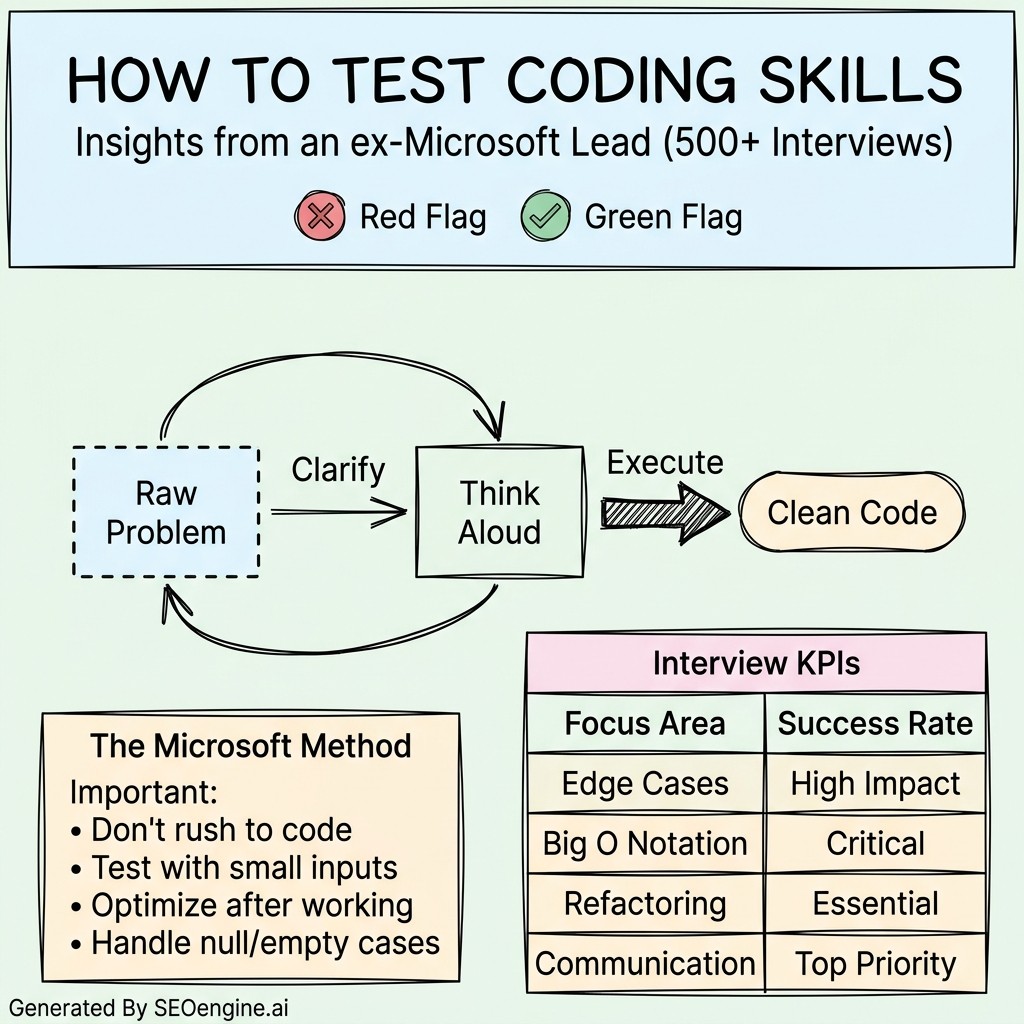
Why great interviews keep producing bad hires
A hiring manager once shared a story that still circulates in engineering circles. He was screening remote candidates for a mid-sized company, each claiming 10+ years of C# experience.
The screening process was simple: 45 minutes, three easy problems. Review a code snippet against requirements. Look at a data flow diagram and spot the performance bottleneck. Check if a SQL query with three simple tables actually works.
About 75% of candidates gave decent answers to these. Not great, but workable. Then came the final test, done live in Coderpad with syntax highlighting and code completion turned on.
FizzBuzz. Print numbers 1 to 100. Multiples of 3 print “Fizz.” Multiples of 5 print “Buzz.” Multiples of both print “FizzBuzz.” No trick, no ambiguity, no edge cases hidden in the wording.
9 out of 10 candidates could not write it.
These were people with a decade or more of professional software experience. This is the gap between what a resume says and what a person can actually do at a keyboard, and it’s exactly why testing coding skills the right way matters more than any other part of the hiring process.
Companies building technical assessment tools, including Utkrusht AI, recognize this problem as foundational to effective hiring.
Why do resumes and interviews lie so often?
Resumes describe intentions, not proof. A candidate can list “expert in React” the same way they’d list a hobby, with no verification behind it.
Interviews compound the problem because they reward talking about code more than writing it. A confident explanation of a project can mask the fact that the candidate never wrote the tricky parts themselves.
One engineering director summed it up: “They promise the entire world on a resume, but when asked why or how they picked a particular technology on their project, they cannot explain anything.” That disconnect between claimed depth and actual understanding is the single biggest reason technical screening fails.
What makes testing coding skills so hard to get right?
Testing coding skills is hard because the goal isn’t just “can this person code.” It’s “can this person code the way our team needs, under real constraints, without someone reviewing every line.”
3 things make this genuinely difficult:
Interview performance doesn’t equal job performance. Some candidates freeze under live pressure but write excellent code alone. Others talk a great game and produce fragile commits.
Bias creeps in easily. A candidate who “seems smart” or shares a background with the interviewer often gets more benefit of the doubt than the data supports.
Time is scarce. A CTO who blocks 5 to 8pm every day for interviews is losing roughly 30% of the week just to screening, long before the strongest candidates even reach a final round.
Why do some excellent talkers turn out to be poor coders?
Verbal fluency and coding ability are different skills entirely. Someone can describe what a sorting algorithm does without ever having implemented one correctly.
This happens because interview prep culture rewards memorized explanations. Candidates study common interview questions and rehearse answers, which builds confident delivery without building underlying skill.
A hiring manager described spotting this pattern after the fact: “We hired a person who interviewed sooo well! But when I saw their first GitHub commit, I knew we were in trouble.” The interview and the actual work told two different stories, and by then the offer was already signed.
What are the main ways to test coding skills?
There isn’t one perfect method. Most engineering teams combine two or three of these, depending on the role and how many candidates they need to process.
Resume and portfolio review: Fast but unreliable alone. Good for filtering obvious mismatches, weak for verifying real skill.
Live coding interviews: A candidate solves a problem while an interviewer watches, often on a whiteboard or shared screen. Reveals thought process but adds performance anxiety.
Take-home projects: A small, realistic task done independently over a few days. Closer to real work conditions, but time-consuming for candidates and prone to outside help.
Automated skill assessments: Structured, timed coding tests scored by objective criteria. Fast to scale, weaker at judging communication or design thinking.
Pair programming sessions: The candidate and an engineer solve something together. Strong signal on collaboration, but resource-heavy and hard to run at volume.
GitHub or portfolio code review: Looking at actual commits the candidate has written. Genuine signal when available, but many candidates have no public code history.
How do take-home projects compare to live coding interviews?
Take-home projects tend to produce work closer to a candidate’s real ability because there’s no clock ticking in front of an audience. A 2023 Triplebyte hiring survey found candidates rated take-home assignments as less stressful and more representative of daily work than whiteboard-style interviews.
Live coding interviews, on the other hand, reveal how someone thinks out loud, which matters for roles involving pair programming or fast-paced debugging.
The trade-off comes down to what a role actually requires. A backend engineer working mostly solo benefits more from take-home evaluation. A support engineer who debugs live with customers benefits from an interview that mirrors that pressure.
Just as Utkrusht AI structures its assessments to match real-world working conditions, organizations should align their testing methods to how engineers will actually perform on the job.
Should hiring managers trust GitHub commits over a resume?
Yes, when they’re available, because commits show what a person actually wrote rather than what they claim to have contributed. A resume line like “led migration to microservices” says nothing about whether that person wrote code or coordinated a meeting.
GitHub history isn’t foolproof either. Many strong engineers work entirely on private repos at previous employers and have no public commit trail at all. Treat it as one useful signal, not a pass/fail gate.
Comparison: which testing method fits your hiring needs?
Method | Time-Efficient | Predicts Job Performance | Scales to 100+ Candidates | Low Bias |
|---|---|---|---|---|
Resume screening | ✅ | ❌ | ✅ | ❌ |
Live coding interview | ❌ | ✅ | ❌ | ❌ |
Take-home project | ❌ | ✅ | ❌ | ✅ |
Automated skill assessment | ✅ | ✅ | ✅ | ✅ |
Pair programming session | ❌ | ✅ | ❌ | ❌ |
GitHub/portfolio review | ✅ | ✅ | ❌ | ❌ |
The pattern here is clear. Methods that scale well, like resume screening, tend to predict job performance the least. Methods that predict performance well, like pair programming, tend to eat up enormous engineer time. Automated skill assessments are the rare method that checks most boxes at once, which is why they’ve become the default first filter for teams processing high candidate volume.
A practical framework for testing coding skills
Building a screening process doesn’t need to be complicated. A simple, repeatable structure beats an ad hoc approach every single time.
Start with a short automated skill test. Keep it under 30 minutes, focused on core logic and problem-solving, not trivia.
Review a real piece of code, not a puzzle. Ask candidates to critique or debug an existing snippet against stated requirements.
Add one simple algorithm task, done live. Something like FizzBuzz filters out the candidates who cannot code at all, fast.
Reserve deep technical interviews for finalists only. By this stage, only strong candidates should remain, so the time investment is justified.
Verify with a real-world artifact when possible. A GitHub link, a past project, or a small take-home task adds a final layer of proof.
What should the first screening round actually look like?
The first round should filter out candidates who cannot code, not evaluate who the best hire is. That distinction changes everything about how the round is designed.
Keep questions simple and unambiguous, similar to the code review, data flow, and SQL examples described earlier. There aren’t supposed to be many wrong answers. The goal is measuring how many issues a candidate can spot and how they reason through a problem, not testing memorization.
Following this with a short, live coding task like FizzBuzz adds a final, unforgiving check. If a candidate cannot write ten lines of working logic in a language they claim ten years of experience with, no amount of confident talking should change the outcome.
How many interview rounds does a team actually need?
Most roles need somewhere between two and four rounds: one screening test, one technical deep-dive, and one final conversation focused on collaboration and role fit. A fourth round, often a system design or architecture discussion, applies mainly to senior positions.
Adding more rounds beyond this rarely improves signal quality. It mostly adds scheduling friction and candidate drop-off, especially for competitive roles where strong engineers have other offers on the table.
According to LinkedIn’s 2023 Talent Trends report, candidates who experience more than five interview rounds are significantly more likely to withdraw before an offer is made. Shorter, sharper processes tend to close stronger hires faster.
What mistakes do companies repeatedly make when testing developers?
Even experienced hiring teams fall into predictable traps. Recognizing them early saves months of bad hires and wasted engineering hours.
Relying on resumes as the main filter. A polished resume correlates weakly with actual coding ability, especially for roles where technical writing skills overlap with coding skills.
Skipping the boring basics. Teams often jump straight to complex system design questions, skipping simple checks like FizzBuzz that catch the most obvious mismatches fastest.
Letting one strong interviewer’s gut feeling override data. A charismatic candidate can talk a panel into ignoring weak technical answers.
Burning senior engineer time on early screening. A director who blocks five evenings a week for first-round interviews is spending expensive time on candidates who could be filtered earlier.
Not testing communication alongside code. A brilliant coder who cannot explain a decision creates friction on teams that rely on code review and collaboration.
How can recruitment agencies screen at scale without losing quality?
Staffing agencies face a different version of this problem. Instead of hiring one or two engineers a year, they’re often shortlisting for dozens of roles across multiple clients at once. Volume becomes the bottleneck, not skill judgment.
“I have a bunch of resumes. How do I figure out who is the right person for this job?” is a common frustration among recruitment directors managing hundreds of applicants for a single tech role.
The fix is layering automated coding assessments before any human review happens. This is where solutions like Utkrusht AI fit into the process, filtering candidates through an objective coding test before a recruiter or technical interviewer spends a single minute on a call.
One recruitment director noted, “By adding it as the first layer of assessment, I was able to ensure only the relevant candidates are invited for an interview, which saved my time.”
A well-designed automated first round typically achieves:
Faster time-to-shortlist, often cutting screening time by more than half
Reduced dependency on senior engineers for early-stage filtering
More consistent scoring criteria across every candidate, reducing interviewer bias
Better correlation between test scores and later on-the-job performance
Frequently asked questions
What is the fastest way to test a developer’s coding skills?
A short, automated coding assessment focused on core logic problems is the fastest reliable method. It typically takes 20 to 30 minutes and filters out candidates who cannot code before any interview time is spent.
Why do so many experienced developers fail FizzBuzz?
Many candidates memorize interview talking points without practicing actual coding regularly, especially if their day-to-day role shifted toward management or architecture. FizzBuzz exposes this gap because it requires writing working logic on the spot, not describing a concept.
Is a take-home coding test better than a live interview?
It depends on the role. Take-home tests reduce performance anxiety and better reflect independent work, while live interviews reveal how a candidate thinks and communicates under pressure. Many teams use both for different stages.
How many rounds should a technical interview process have?
Two to four rounds typically works best: an initial screening test, a technical interview, and a final culture or role-fit conversation. Senior roles sometimes add a system design round.
Can GitHub profiles replace technical interviews?
No. GitHub commits offer useful evidence of real coding ability, but many strong engineers have no public repositories due to private employer code. Use it as supporting evidence, not a sole deciding factor.
How can recruitment agencies screen hundreds of candidates efficiently?
Layering an automated coding assessment as the first filter lets agencies rank candidates objectively before any manual review. This cuts screening time significantly while keeping the strongest candidates visible to recruiters faster.
What’s the biggest mistake companies make when testing coding skills?
Skipping simple checks and jumping straight to complex system design questions. Basic tests like reviewing a code snippet or writing FizzBuzz catch the most obvious mismatches before wasting time on advanced evaluation.
Bringing it all together
The FizzBuzz story at the start of this guide isn’t an outlier. It’s a pattern repeated across thousands of technical interviews every year, where confident resumes and polished interview answers mask a basic inability to write working code.
Testing coding skills well means combining the right tools for each stage: a fast objective filter first, targeted human interviews second, and real code evidence wherever it’s available. Teams that skip the first step end up burning senior engineering hours on candidates who should have been filtered out in minutes.
Start by adding one simple, automated coding check before your next round of interviews. Platforms like Utkrusht AI exist specifically to handle that first filter, allowing technical leaders to spend their limited interview hours on candidates who’ve already proven they can code.

Founder, Utkrusht AI
Ex. Euler Motors, Oracle, Microsoft. 12+ years as Engineering Leader, 500+ interviews taken across US, Europe, and India
Want to hire
the best talent
with proof
of skill?
Shortlist candidates with
strong proof of skill
in just 48 hours


