Contents
Key Takeaways
Technical interview platforms are now essential infrastructure for CTOs, enabling scalable, objective, and faster evaluation of engineering talent.
The strongest platforms combine live interviews with watch-them-work tasks, offering a blend of real-time collaboration, coding environments, and automated scoring.
Modern tools reduce bias and inconsistency, using standardized tasks and structured rubrics to ensure fair evaluation across all candidates.
Integrations with ATS, AI-assisted feedback, and real-world coding environments streamline the hiring workflow and save significant engineering time.
Choosing the right platform depends on your hiring goals—deep technical assessments, pair programming, asynchronous coding tasks, or all-in-one evaluation suites.
Hiring the right engineers is a critical decision, yet traditional methods often fail. Resumes show past work, not current skills, and whiteboard interviews test abstract problems, not real-world abilities. This disconnect leads to costly hiring mistakes and slows innovation. A modern technical interview platform solves this by providing a standardized, skill-centric environment to evaluate talent accurately. This guide helps you navigate the crowded market of assessment tools.
We’ll compare the top platforms, explaining what they are, why they’re essential, and what features matter. You’ll learn about different assessment methods, from quizzes to advanced real-watch-them-work tasks that show how a candidate truly works. This article will equip you with the insights to select a platform that identifies top talent and aligns with your engineering culture.
A quick glance: top 14 technical interview platforms
Here are the top-rated technical interview platforms that engineering leaders across the globe rely on.
iMocha: A skills assessment platform with a vast library of tests for various technical and non-technical roles.
HackerRank: An end-to-end platform for screening and interviewing developers at scale, popular among enterprise companies.
Utkrusht: A unique platform that assesses candidates by having them perform real-life job tasks in simulated environments. Only platform that offers pay-per-usage, no monthly/annual pricing
HireHunch: An interview-as-a-service platform that provides a network of expert interviewers to conduct technical screens.
Codility: A platform focused on predicting real-life skills through structured screening tests and live interviews.
Devskiller: A technical screening and online interview platform powered by the RealLifeTesting™ methodology.
CodinGame: A screening platform known for its gamified assessments that make the candidate experience engaging.
CodeSignal: A technical assessment platform used by enterprises to screen and interview talent with skills-aligned tests.
HackerEarth: A comprehensive platform offering assessments and live interviews with a large question library.
Vervoe: An AI-powered skills assessment tool that uses watch-them-work tasks to test how candidates perform on the job.
LeetCode: Primarily a platform for developers to practice coding, but its assessment tools are used by some companies for screening.
Coderbyte: An affordable and easy-to-use platform for screening and interviewing candidates with coding challenges.
CoderPad: A popular tool for live collaborative coding interviews, focusing on a realistic pair-programming experience.
TestDome: A platform that provides automated skills testing with a focus on work-sample questions.
What is a technical interview?
A technical interview is a specialized evaluation process used by companies to assess a candidate’s technical skills, knowledge, and problem-solving abilities for a specific role. Unlike a standard behavioral interview, it focuses on practical competencies.
This can involve writing code, solving algorithmic challenges, discussing system design, or debugging a piece of software. The goal is to verify that a candidate possesses the hands-on capabilities required to succeed in the job.
What is a technical interview platform?
A technical interview platform is a software solution designed to standardize, automate, and enhance the technical evaluation process. It provides a controlled environment where hiring managers can assess candidates’ skills in a consistent and objective manner.
These platforms move beyond resumes and verbal claims. They offer tools like shared coding editors, automated assessments, real-world project watch-them-work tasks, and proctoring features. The ultimate goal is to get a reliable signal on a candidate’s true ability to perform the job, saving engineering teams time and reducing hiring bias.
Comparing the top 14 technical interview platforms
1. iMocha
Main 3 Features: Vast skill library with over 2,500 tests, AI-powered proctoring, and custom assessment creation.
Unique Differentiation (Core USP): Its extensive library covers a wide range of skills beyond just coding, including domain-specific and soft skills.
Use This If You Prefer: A single platform to assess a wide variety of roles, not just software engineers.
Do Not Use This If You Prefer: A deep focus on realistic, hands-on watch-them-work tasks for senior engineering roles.
1 Standout Feature: AI-LogicBox, which allows for assessing skills in a pseudo-coding environment without needing a specific language compiler.
Pricing: Custom pricing available upon request.
Does it evaluate candidates by watching how they work in real-life situations? No, it primarily uses question-based assessments and coding challenges.
Best For: Large enterprises that need to screen for a diverse set of technical and functional skills at scale.
Main Downside: The experience can feel more like a standardized test than a watch-them-work task of actual work.
Does it show proof-of-work samples? It shows solutions to challenges, but not the process of solving real-world tasks.
Does it have advanced proctoring or cheating mechanisms? Yes, it has robust AI-powered proctoring.
Does it offer a free trial? Yes.
2. HackerRank
Main 3 Features: Comprehensive question library, integrated screening and live interview modules, and strong enterprise-level integrations.
Unique Differentiation (Core USP): It’s an end-to-end solution trusted by many large tech companies for high-volume hiring.
Use This If You Prefer: An all-in-one platform with a strong brand reputation and extensive features for scaling.
Do Not Use This If You Prefer: Assessments that mirror a developer’s day-to-day project work and environment.
1 Standout Feature: Role-specific assessments for positions like front-end, back-end, and DevOps.
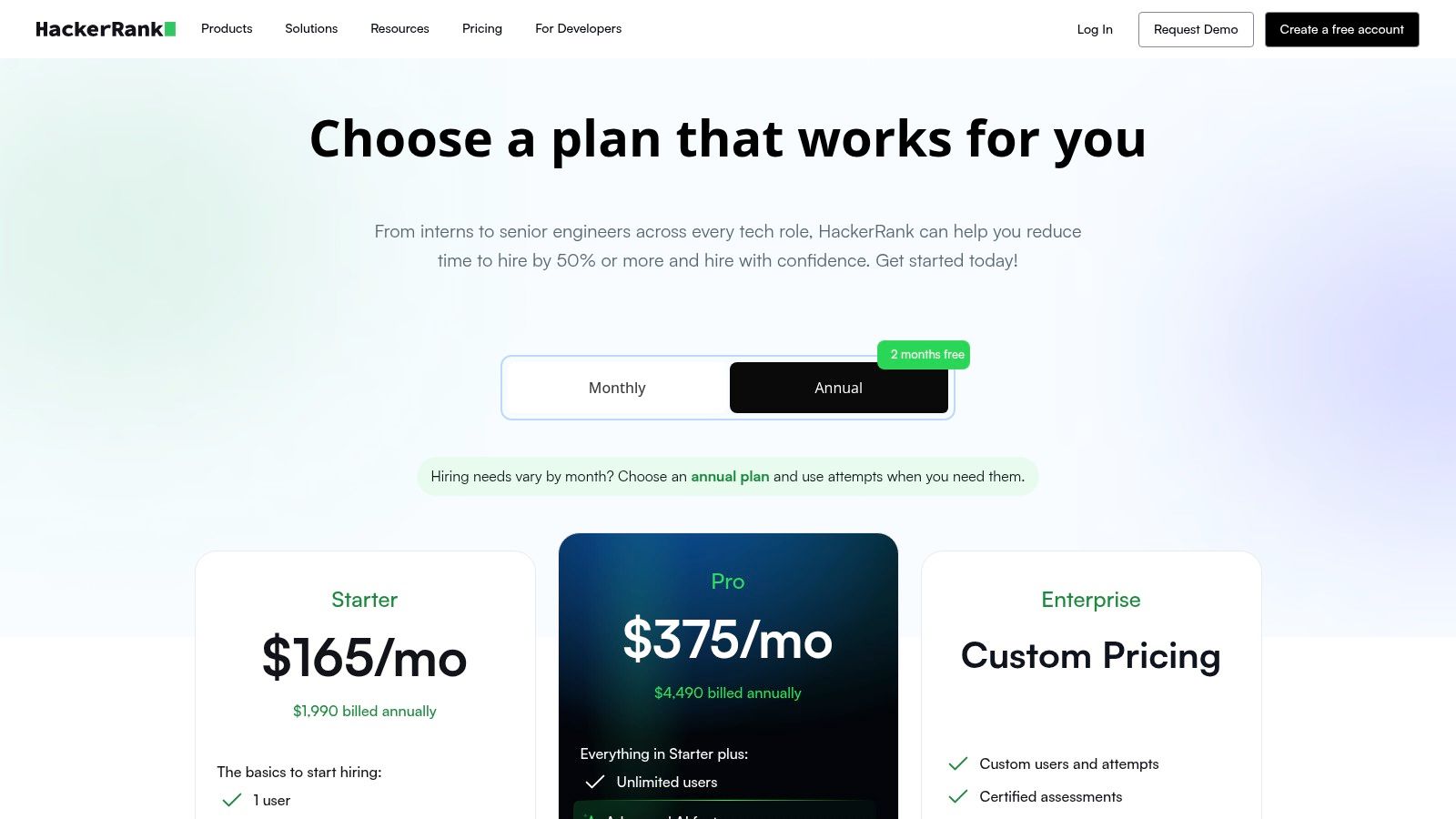
Pricing: Starts at $100/month for the Starter plan, with custom pricing for Enterprise. See the HackerRank pricing page.
Does it evaluate candidates by watching how they work in real-life situations? No, its focus is on algorithmic challenges and standardized tests.
Best For: Companies of all sizes, especially enterprises, looking to standardize technical screening at scale.
Main Downside: The per-attempt pricing model can become expensive during hiring surges.
Does it show proof-of-work samples? It provides code solutions, but not a view into how candidates solve complex, multi-step problems.
Does it have advanced proctoring or cheating mechanisms? Yes, it offers robust proctoring and plagiarism detection.
Does it offer a free trial? Yes, a 14-day trial is available.
3. Utkrusht
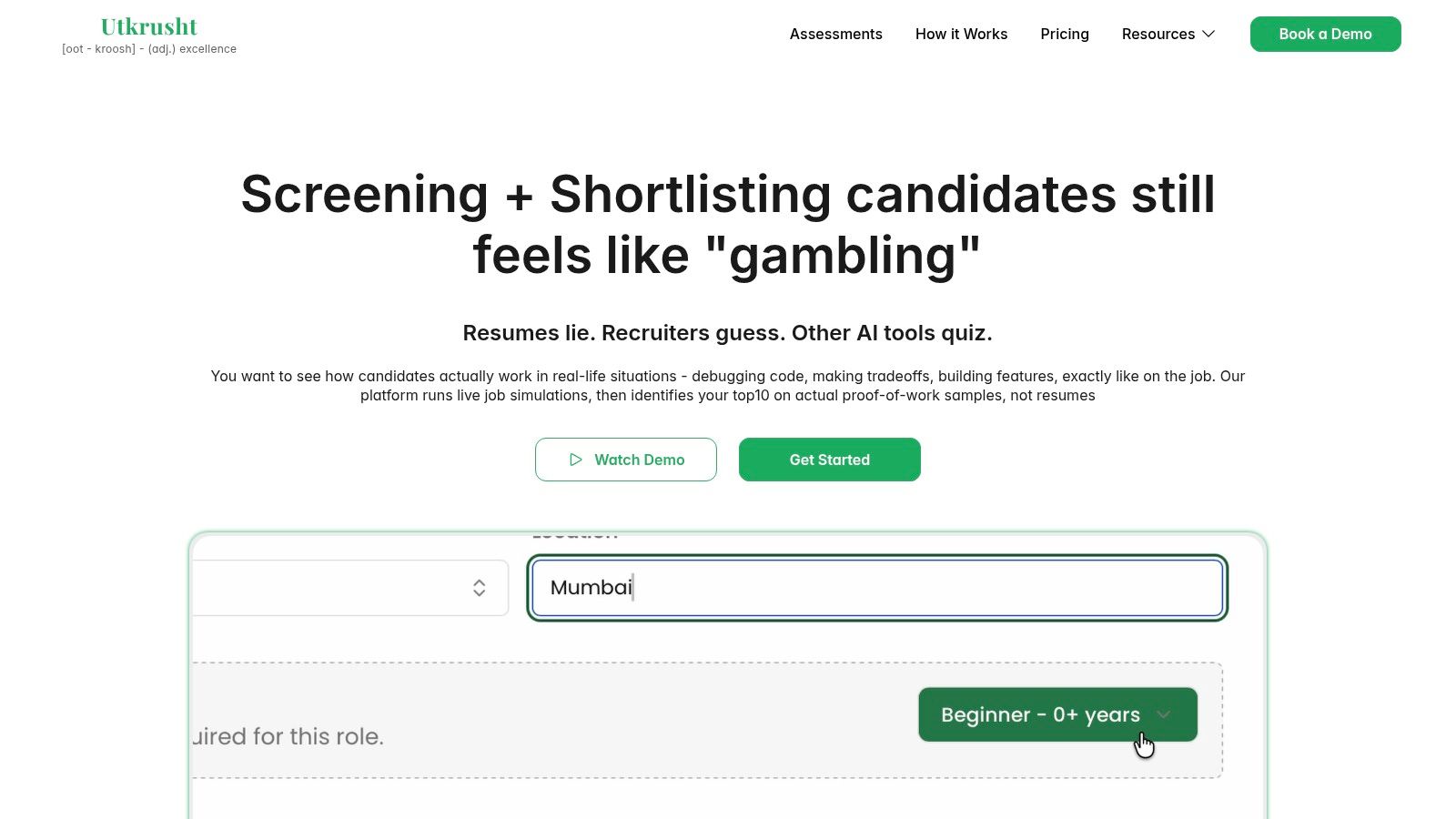
Main 3 Features: High-fidelity real-watch-them-work tasks, video-recorded work sessions, and a stack-ranked shortlist of top candidates.
Unique Differentiation (Core USP): Utkrusht assesses candidates by letting hiring managers watch how they work in real-life job situations. Instead of abstract puzzles, candidates fix bugs on an EC2 server, optimize a live SQL database, or refactor code in a familiar IDE.
Use This If You Prefer: To see undeniable proof of a candidate’s practical skills and problem-solving process, especially for small engineering teams (under 1000 employees).
Do Not Use This If You Prefer: A high volume of generic, multiple-choice questions or algorithmic quizzes for initial screening.
1 Standout Feature: The delivery of a stack-ranked Top 10 shortlist with video evidence, saving over 60 hours of engineering time per hire.
Pricing: Only platform that offers pay-per-usage, no monthly/annual pricing. Also, custom pricing upon request. It is positioned as the most budget-friendly option compared to competitors.
Does it evaluate candidates by watching how they work in real-life situations? Yes, this is its core methodology.
Best For: Small to medium-sized engineering teams that need to make high-conviction hires based on actual job performance.
Main Downside: The watch-them-work task-based approach may require more initial setup to align with a company’s specific tech stack.
Does it show proof-of-work samples? Yes, it provides full video recordings of the candidate’s work session as proof.
Does it have advanced proctoring or cheating mechanisms? Yes, sessions are recorded with cheat-detection.
Does it offer a free trial? Yes, by requesting a demo. Explore how Utkrusht.Ai’s watch-them-work task-based approach compares to other platforms.
4. HireHunch
Main 3 Features: A network of vetted interview experts, calibrated and structured interviews, and detailed candidate feedback reports.
Unique Differentiation (Core USP): It’s an Interview-as-a-Service model that outsources the first-round technical interview to external experts.
Use This If You Prefer: To free up your internal engineering team from the burden of conducting repetitive initial screens.
Do Not Use This If You Prefer: To keep the entire interview process in-house and have your own engineers assess cultural fit early on.
1 Standout Feature: The ability to scale interviewing capacity up or down on demand without hiring more engineers.
Pricing: Custom pricing based on interview volume.
Does it evaluate candidates by watching how they work in real-life situations? It depends on the interviewer, but it’s typically a live coding session, not a full environment watch-them-work task.
Best For: High-growth startups and enterprises looking to standardize their interview process and save engineering hours.
Main Downside: You are placing trust in an external network to represent your company and assess talent accurately.
Does it show proof-of-work samples? It provides detailed reports and sometimes recordings, but not asynchronous work samples.
Does it have advanced proctoring or cheating mechanisms? The human interviewer acts as the proctor.
Does it offer a free trial? No, it’s a service-based model.
5. Codility
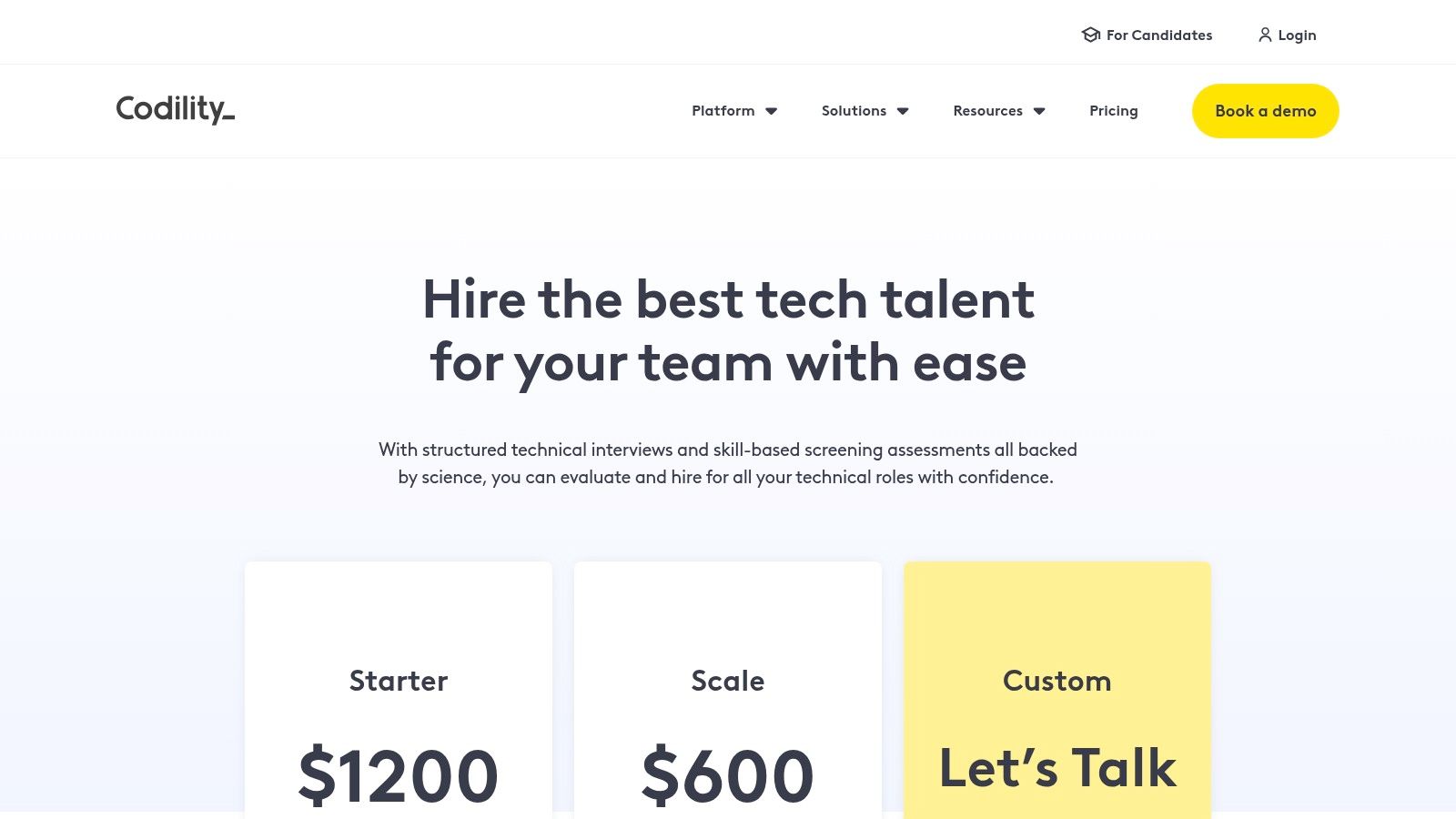
Main 3 Features: Curated task library, invite-based pricing model, and integrated “CodeLive” for virtual interviews.
Unique Differentiation (Core USP): Its focus on scientifically validated tasks and a predictable, invite-based pricing model simplifies budgeting.
Use This If You Prefer: Transparent pricing and a structured assessment process that emphasizes fundamental coding skills.
Do Not Use This If You Prefer: Assessing skills beyond algorithms, such as system debugging or using specific frameworks.
1 Standout Feature: The invite-based system provides cost predictability, avoiding surprise overage fees.
Pricing: Starts at $468/month for 100 invites per year. See the Codility pricing page.
Does it evaluate candidates by watching how they work in real-life situations? No, it uses coding challenges in an online editor.
Best For: Teams that value a fair, consistent, and scalable process for testing core programming abilities.
Main Downside: A strong focus on algorithms might not be the best predictor for all software engineering roles.
Does it show proof-of-work samples? It shows the candidate’s final code and a playback of their solution.
Does it have advanced proctoring or cheating mechanisms? Yes, it includes plagiarism detection and proctoring.
Does it offer a free trial? Yes, a 14-day trial is available.
6. Devskiller
Main 3 Features: RealLifeTesting™ methodology, support for a wide range of tech stacks, and strong ATS integrations.
Unique Differentiation (Core USP): The RealLifeTesting™ approach aims to mirror real-world work by testing candidates with their entire project files and tech stack.
Use This If You Prefer: To test candidates on their ability to work with a full codebase, not just isolated algorithms.
Do Not Use This If You Prefer: A simple, quick-to-set-up algorithmic challenge for mass screening.
1 Standout Feature: The ability to create assessments that require candidates to navigate and understand an existing codebase.
Pricing: Custom pricing available upon request.
Does it evaluate candidates by watching how they work in real-life situations? Yes, its methodology is designed to do this.
Best For: Companies that need to assess skills related to specific frameworks and large codebases.
Main Downside: Setting up realistic, project-based assessments can be more time-consuming than using a pre-made quiz.
Does it show proof-of-work samples? Yes, the entire project submitted by the candidate serves as a work sample.
Does it have advanced proctoring or cheating mechanisms? Yes.
Does it offer a free trial? Yes.
7. CodinGame
Main 3 Features: Gamified coding challenges, a large community of developers, and assessments for over 40 technologies.
Unique Differentiation (Core USP): Its use of gamification makes the assessment process more engaging and enjoyable for candidates.
Use This If You Prefer: A positive and fun candidate experience, especially for screening junior to mid-level developers.
Do Not Use This If You Prefer: A serious, corporate-style assessment process for senior or leadership roles.
1 Standout Feature: The “Clash of Code” feature, which lets developers compete in real-time coding battles.
Pricing: Part of the CoderPad offering; custom pricing is available.
Does it evaluate candidates by watching how they work in real-life situations? No, it uses games and puzzles to test coding skills.
Best For: Companies looking to improve their employer brand and attract talent with a unique assessment experience.
Main Downside: Gamified challenges may not accurately reflect the day-to-day responsibilities of a corporate software engineer.
Does it show proof-of-work samples? It shows the code used to solve the game or puzzle.
Does it have advanced proctoring or cheating mechanisms? Yes.
Does it offer a free trial? Yes.
8. CodeSignal
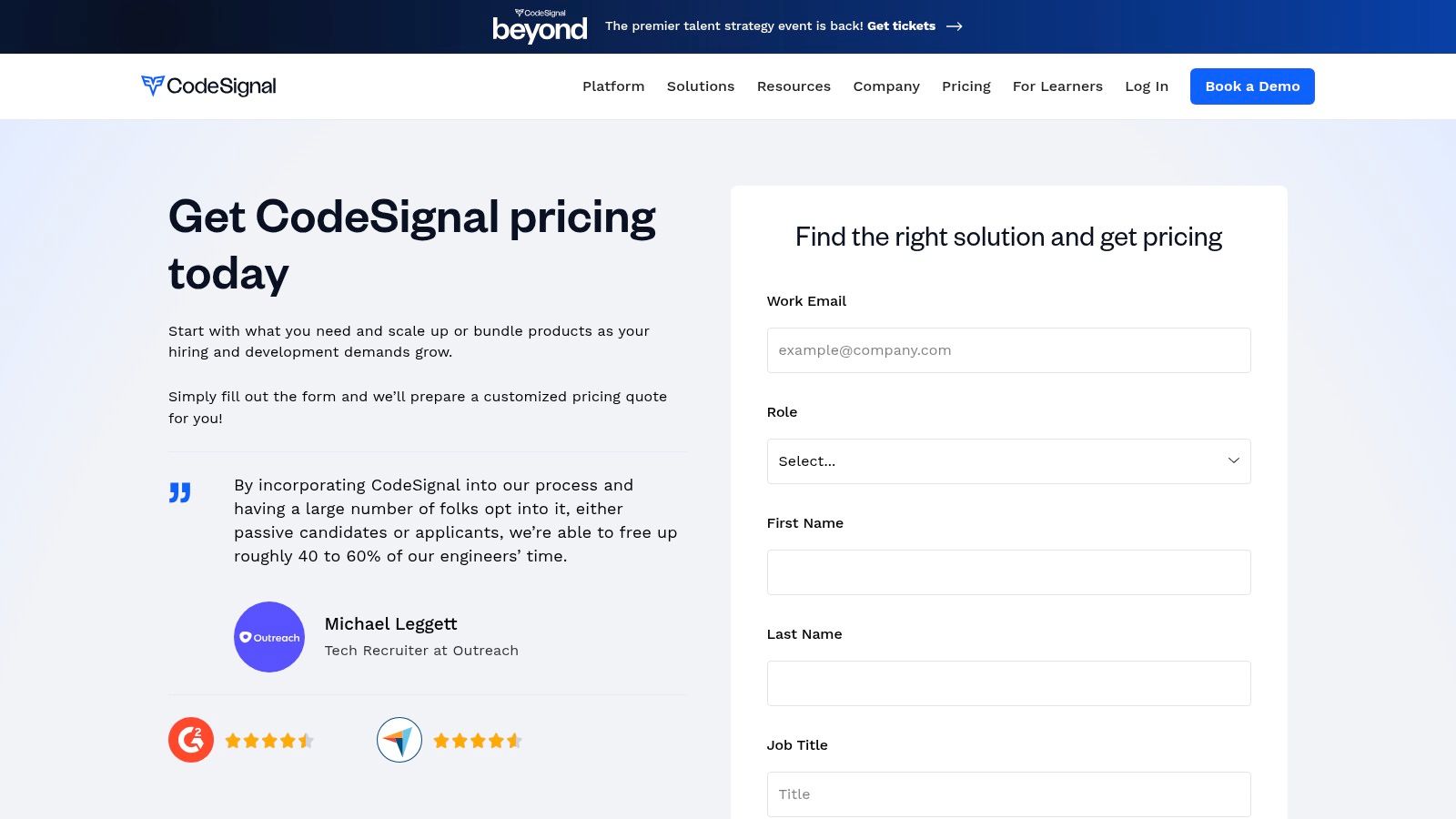
Main 3 Features: Skills-aligned assessments, an advanced IDE for live interviews, and enterprise-grade analytics.
Unique Differentiation (Core USP): Its focus on creating validated, job-relevant assessments for large-scale, enterprise hiring.
Use This If You Prefer: A data-driven approach to hiring with robust analytics and features for large organizations.
Do Not Use This If You Prefer: Simple, off-the-shelf tests or a platform with transparent pricing for small teams.
1 Standout Feature: The “Pre-Screen” and “Tech Screen” products provide standardized scores that can be used across multiple companies.
Pricing: Primarily enterprise-focused with custom pricing. See the CodeSignal pricing page.
Does it evaluate candidates by watching how they work in real-life situations? It aims for job-relevance but is still primarily a simulated testing environment. For a different approach, you can explore the features of alternative platforms.
Best For: Large technology companies that need a scalable and compliant technical assessment platform.
Main Downside: Opaque pricing and a sales-led approach can be a barrier for smaller businesses.
Does it show proof-of-work samples? It provides detailed reports on performance but not a holistic work sample from a real environment.
Does it have advanced proctoring or cheating mechanisms? Yes, it has very advanced proctoring features.
Does it offer a free trial? No, requires a demo and sales engagement.
9. HackerEarth
Main 3 Features: A vast question library, assessments for a wide range of skills (including psychometric), and a live interview tool (FaceCode).
Unique Differentiation (Core USP): Its combination of deep technical assessments with psychometric testing provides a more holistic candidate profile.
Use This If You Prefer: A platform with transparent pricing for smaller businesses and a broad range of assessment types.
Do Not Use This If You Prefer: A simple, focused platform without the complexity of numerous question types and features.
1 Standout Feature: The inclusion of psychometric tests to evaluate soft skills alongside technical abilities.
Pricing: Starts at $119/month for the Startup plan. See the HackerEarth pricing page.
Does it evaluate candidates by watching how they work in real-life situations? No, it primarily uses coding challenges and project-style questions in its IDE.
Best For: SMBs and enterprises that want to evaluate both hard and soft skills in their technical candidates.
Main Downside: The credit-based system can lead to unexpected costs if hiring volume increases.
Does it show proof-of-work samples? It shows project submissions and code solutions.
Does it have advanced proctoring or cheating mechanisms? Yes, with AI-powered proctoring.
Does it offer a free trial? Yes, a 14-day trial is available.
10. Vervoe
Main 3 Features: AI-powered grading, customizable assessments with various question types, and a focus on watch-them-work tasks.
Unique Differentiation (Core USP): It uses AI to score a wide range of media-rich responses (video, audio, text) to simulate on-the-job tasks.
Use This If You Prefer: To assess a blend of technical, communication, and soft skills through immersive, task-based assessments.
Do Not Use This If You Prefer: A dedicated, high-fidelity live coding environment for pair programming.
1 Standout Feature: AI-powered scoring that can analyze and rank candidates based on complex, open-ended responses.
Pricing: Starts at $228/month for the Starter plan.
Does it evaluate candidates by watching how they work in real-life situations? Yes, its “day-in-the-life” watch-them-work tasks are designed for this.
Best For: High-volume hiring where a mix of hard and soft skills needs to be evaluated efficiently.
Main Downside: Its live coding capabilities are not as robust as specialized platforms like CoderPad.
Does it show proof-of-work samples? Yes, the candidate’s responses to the watch-them-work tasks serve as work samples.
Does it have advanced proctoring or cheating mechanisms? Yes.
Does it offer a free trial? Yes.
11. LeetCode
Main 3 Features: A massive library of algorithmic coding problems, a large and active community, and company-specific assessment contests.
Unique Differentiation (Core USP): It is the de-facto platform for competitive programming and interview preparation, making it a familiar environment for many developers.
Use This If You Prefer: To test candidates on classic data structures and algorithms that are common in FAANG-style interviews.
Do Not Use This If You Prefer: To assess practical, on-the-job skills like debugging, system design, or framework knowledge.
1 Standout Feature: The sheer volume and quality of its algorithmic problems, which are a primary resource for interview prep.
Pricing: Offers a premium subscription for individuals; company assessment pricing is available upon request.
Does it evaluate candidates by watching how they work in real-life situations? No, it is exclusively focused on algorithmic problems.
Best For: Companies that prioritize algorithmic problem-solving skills in their screening process.
Main Downside: Over-reliance on LeetCode-style problems can filter out great engineers who excel at practical tasks but not abstract puzzles.
Does it show proof-of-work samples? It only shows the code solution to the specific problem.
Does it have advanced proctoring or cheating mechanisms? Yes, for official contests and company assessments.
Does it offer a free trial? No free trial for company assessment tools.
12. Coderbyte
Main 3 Features: Affordable pricing, an easy-to-use interface, and a library of challenges and multiple-choice questions.
Unique Differentiation (Core USP): Its simplicity and affordability make it one of the most accessible platforms for small businesses and startups.
Use This If You Prefer: A straightforward, no-frills screening tool that is budget-friendly and quick to implement.
Do Not Use This If You Prefer: Advanced enterprise features, deep analytics, or high-fidelity watch-them-work tasks.
1 Standout Feature: The ability to host public challenges to source candidates from its user base.
Pricing: Starts at $49/month for a limited plan, with full access from $199/month.
Does it evaluate candidates by watching how they work in real-life situations? No, it focuses on coding challenges and quizzes.
Best For: Startups and small businesses that need a simple and cost-effective way to screen candidates.
Main Downside: The platform is less feature-rich compared to enterprise-grade solutions like HackerRank or CodeSignal.
Does it show proof-of-work samples? It provides code solutions to the challenges.
Does it have advanced proctoring or cheating mechanisms? Yes, including plagiarism detection and webcam proctoring.
Does it offer a free trial? Yes, a 14-day trial is available.
13. CoderPad
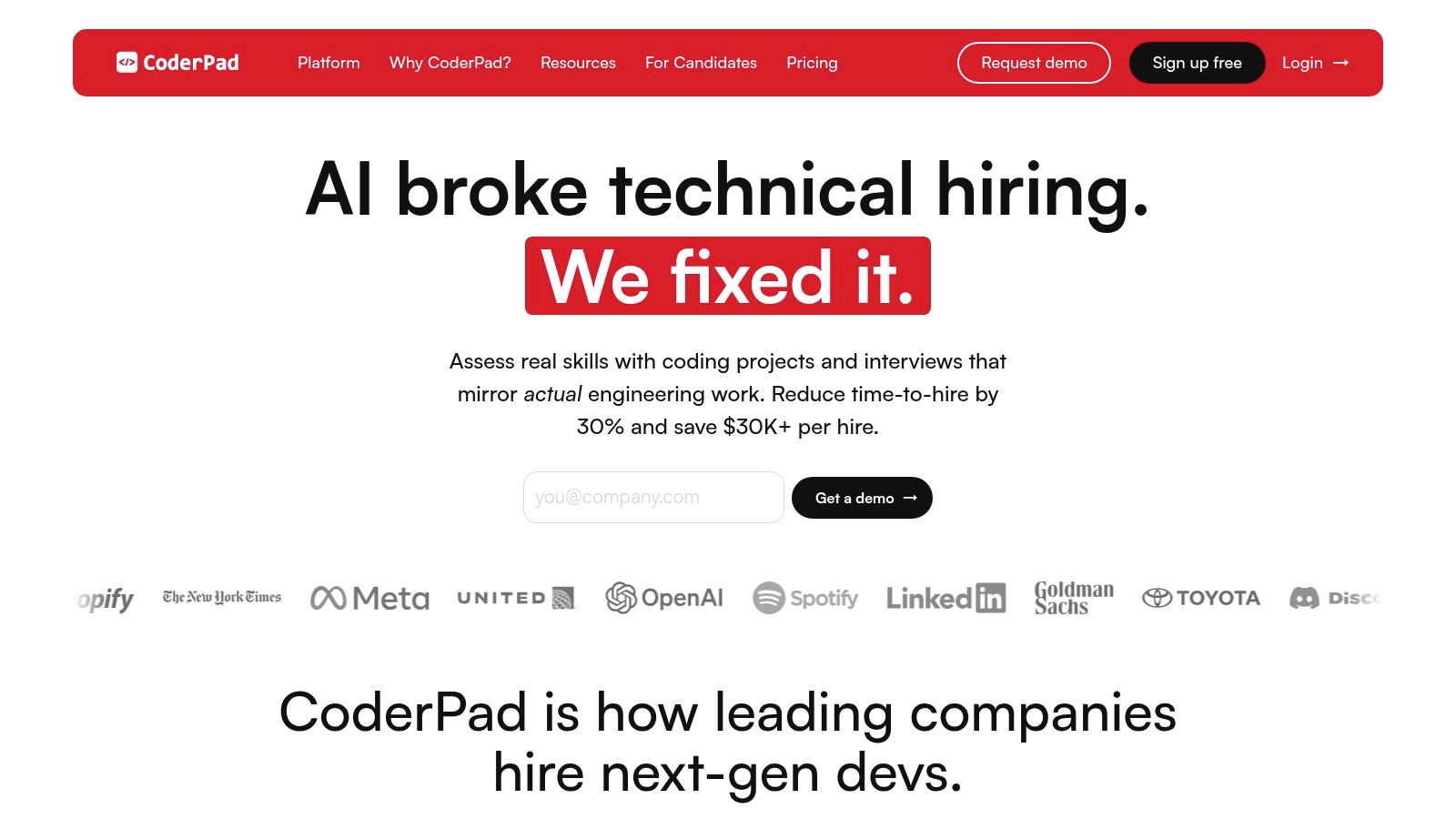
Main 3 Features: A realistic and fast live coding environment (pad), code playback functionality, and an integrated virtual whiteboard.
Unique Differentiation (Core USP): It provides the industry-leading environment for live, collaborative pair-programming interviews.
Use This If You Prefer: A top-tier candidate experience for live technical interviews that closely mimics a real development environment.
Do Not Use This If You Prefer: An all-in-one platform with deep features for asynchronous screening (though this is available via their CodinGame acquisition).
1 Standout Feature: The code playback feature, which allows interviewers to review a candidate’s thought process keystroke-by-keystroke.
Pricing: Offers a free plan for light usage; paid plans start at $250/month. See the CoderPad website.
Does it evaluate candidates by watching how they work in real-life situations? The live interview environment is very realistic, but it’s not a full system watch-them-work task.
Best For: Teams that heavily rely on live pair-programming as a core part of their interview process.
Main Downside: The platform is primarily focused on live interviews, with screening as a separate, integrated product.
Does it show proof-of-work samples? Yes, the entire coding session and its playback serve as a work sample.
Does it have advanced proctoring or cheating mechanisms? Not relevant for its live interview format, as the interviewer is present.
Does it offer a free trial? Yes, a free plan is available.
14. TestDome
Main 3 Features: Automated skills testing, a large library of work-sample questions, and fair, evidence-based scoring.
Unique Differentiation (Core USP): Its strong emphasis on using work-sample questions that require candidates to solve realistic problems.
Use This If You Prefer: To quickly screen candidates using high-quality, pre-made tests that reflect real-world tasks.
Do Not Use This If You Prefer: A platform for conducting live, collaborative coding interviews.
1 Standout Feature: Questions are calibrated to accurately estimate a candidate’s skill level relative to other professionals.
Pricing: Based on the number of candidates, starting from $20 per candidate with bulk discounts.
Does it evaluate candidates by watching how they work in real-life situations? Its questions are designed to be realistic work samples, but it’s an asynchronous testing environment.
Best For: Companies that want to replace resume screening with automated, evidence-based skills tests.
Main Downside: It’s a screening tool and does not include a live interview environment.
Does it show proof-of-work samples? Yes, the candidate’s answers to the work-sample questions are proof of their skills.
Does it have advanced proctoring or cheating mechanisms? Yes, it includes various anti-cheating measures.
Does it offer a free trial? Yes, a free trial is available.
Quick decision guide for choosing a coding interview platform
Product | Use it if you need… | Main Advantage |
|---|---|---|
iMocha | To assess a wide variety of technical and non-technical skills at scale. | Massive skill library beyond just code. |
HackerRank | An end-to-end platform for high-volume screening and interviews. | Industry standard, all-in-one solution. |
Utkrusht | Undeniable proof of on-the-job skills through real-work watch-them-work tasks. | High-fidelity watch-them-work tasks, budget-friendly. |
HireHunch | To outsource first-round technical interviews to save engineering time. | Interview-as-a-Service model. |
Codility | Predictable pricing and a focus on fundamental programming skills. | Transparent, invite-based pricing model. |
Devskiller | To test candidates on their ability to work with a full codebase. | RealLifeTesting™ methodology. |
CodinGame | An engaging, gamified assessment to improve candidate experience. | Fun, game-based challenges. |
CodeSignal | A data-driven, enterprise-grade platform for validated assessments. | Advanced analytics and enterprise features. |
HackerEarth | A holistic evaluation of both technical and psychometric skills. | Broad skill coverage and transparent SMB pricing. |
Vervoe | To assess a mix of hard and soft skills with AI-powered watch-them-work tasks. | AI-graded, “day-in-the-life” tasks. |
LeetCode | To screen candidates on classic data structures and algorithms. | Premier platform for algorithmic problems. |
Coderbyte | A simple, affordable screening tool for startups and small businesses. | Simplicity and budget-friendly pricing. |
CoderPad | A best-in-class environment for live, collaborative pair programming. | Superior live coding experience. |
TestDome | Automated, evidence-based screening using realistic work-sample questions. | High-quality, work-sample questions. |
How to pick the right technical interview platform for your requirement
Choosing the right platform is critical. A mistake can lead to wasted budget, a poor candidate experience, and ultimately, bad hires. Follow this simple decision-making checklist to guide your evaluation.
Define Your Core Problem: Are you trying to save engineering time? Reduce bias? Get a stronger signal on skills? Your primary goal should guide your choice. A team drowning in interviews needs a different solution (like Utkrusht or HireHunch) than a team struggling with biased assessments.
Align with Your Hiring Philosophy: Do you believe in algorithmic puzzles or real-world problems? Your platform should reflect your company’s view on what makes a great engineer. If your team values practical problem-solving, choose a platform built on watch-them-work tasks.
Consider the Candidate Experience: Put yourself in the candidate’s shoes. Is the platform intuitive? Is the assessment relevant and respectful of their time? A frustrating experience can drive away top talent, even if they are interested in the role.
Evaluate the Signal Quality: The entire point of a platform is to provide a reliable signal of a candidate’s ability. Ask for case studies or data on how the platform’s results correlate with on-the-job performance. Platforms that show you how a candidate works provide a much stronger signal than those that just give you a score.
Check for Integrations: Does the platform integrate with your Applicant Tracking System (ATS) and other HR tools? Seamless integration saves time and reduces administrative overhead for your talent acquisition team.
Analyze the Total Cost of Ownership: Look beyond the sticker price. Consider factors like implementation time, training requirements, and potential overage fees. A cheaper platform with a poor signal might cost you more in the long run due to bad hires.
Run a Pilot Program: Never commit based on a sales demo alone. Insist on a trial or a small-scale pilot. Run a few candidates through the platform and gather feedback from your engineering team. Always, always try a product for a month, then evaluate which is right for your needs.
Frequently Asked Questions
What is the main difference between a platform like HackerRank and a watch-them-work task-based platform like Utkrusht?
How do technical interview platforms handle cheating?
Can these platforms assess skills beyond coding, like system design or DevOps?
Are these platforms biased against candidates from non-traditional backgrounds?
What is the typical ROI of investing in a technical interview platform?
Stop wasting engineering hours on inconsistent interviews.
Utkrusht delivers structured, realistic assessments that reveal true capability. Get started now and hire faster with confidence.

Zubin leverages his engineering background and decade of B2B SaaS experience to drive GTM as the Co-founder of Utkrusht. He previously founded Zaminu, served 25+ B2B clients across US, Europe and India.
Want to hire
the best talent
with proof
of skill?
Shortlist candidates with
strong proof of skill
in just 48 hours


