Contents
TL;DR
The software development landscape has undergone a dramatic shift in 2026, with 84% of developers using or planning to use AI tools in their day-to-day tasks, while traditional developers relied on manual coding and linear methodologies.
Modern (and strong) developers today work with AI assistants, cloud-native architectures, and agile workflows, whereas their predecessors are navigating waterfall models, physical documentation, and limited collaboration tools.
Understanding these differences helps companies evaluate real-world capabilities rather than outdated theory-based knowledge, similar to how Utkrusht AI designs technical assessments that measure actual job performance through real-world watch-them-work tasks instead of traditional resume screening.
Understanding the shift in software development
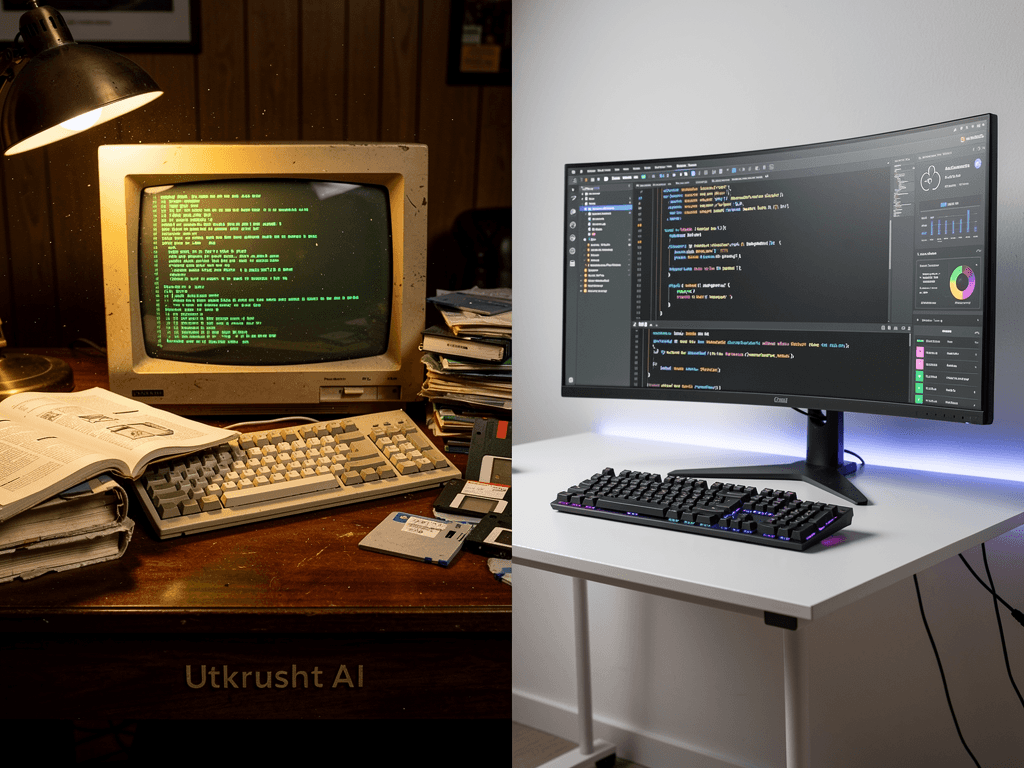
Software development has transformed more in the past decade than in the previous thirty years combined.
What began as a field dominated by academics and mainframe operators has evolved into a dynamic, fast-paced industry where innovation happens daily. This transformation extends far beyond the tools developers use; it fundamentally reshapes how they think, work, and deliver value.
Traditional software development emerged in an era of scarcity. Computer time was expensive, access was limited, and mistakes carried heavy financial costs.
Programmers would arrive at the office at some ungodly hour in the morning to get dedicated time on the mainframe, working within rigid constraints that shaped every aspect of their workflow.
Today’s modern developers operate in an environment of abundance. Cloud computing provides unlimited scalability, AI tools accelerate routine tasks, and collaboration happens instantly across continents.
This shift from scarcity to abundance has fundamentally altered the developer mindset, skill requirements, and career trajectories.
How did traditional developers approach problem-solving?
Traditional developers operated within strict methodological frameworks that emphasized planning over adaptation. Waterfall, the original traditional method of software development, is a linear method in which there is a big emphasis on collecting requirements and designing the software architecture before doing development and testing.
This approach reflected the economic realities of early computing. Making changes after deployment was prohibitively expensive, so developers invested heavily in upfront design. Documentation became sacred, specifications grew to hundreds of pages, and change requests triggered extensive review processes.
The waterfall methodology created predictable timelines but struggled with evolving requirements. It is very hard to adjust the feature set in the middle of development, which often happens as problems are uncovered in development or changing business environments change what is needed in the software.
What defines the modern developer approach?
Modern developers embrace uncertainty and iterative improvement. Using the Agile approach, teams develop in short sprints or iterations, each of which includes a defined duration and list of deliverables, but in no particular order.
This fundamental shift allows teams to respond to changing market conditions, user feedback, and technological advances without derailing entire projects.
The modern approach prioritizes working software over comprehensive documentation. Developers release smaller increments more frequently, gathering real-world feedback that guides subsequent development. This creates a feedback loop impossible under traditional methodologies.
According to a 2025 TechReport 71% of organizations now apply Agile approaches, citing increased speed to market and team productivity as primary advantages. This widespread adoption demonstrates that modern methods deliver measurable business value in today’s competitive environment.
Development tools and technology stack comparison
The tools developers use daily reveal perhaps the starkest contrast between old and new approaches. These aren’t merely different brands of similar products; they represent fundamentally different philosophies about how software should be created, tested, and deployed.
What tools did traditional developers rely on?
Traditional developers worked with limited toolsets that required extensive manual effort. Their development environment included:
Text Editors and Command-Line Interfaces: Before modern integrated development environments (IDEs), developers wrote code in basic text editors. Today, to create a GUI, you use user interface widgets built into your favorite IDE. You drag and drop components, call a few functions, and declare some logic. It’s magic.
Physical Documentation: Version control meant physically filing code printouts. Teams maintained thick binders of specifications, and sharing code updates required manual coordination. Collaboration happened through memos, not messages.
Manual Testing Procedures: Quality assurance teams executed test plans by hand, documenting results in spreadsheets. Regression testing consumed weeks of calendar time, and bugs discovered late in the cycle could derail entire releases.
Limited Collaboration Tools: Communication happened primarily through email, phone calls, and in-person meetings. Remote work was rare, and distributed teams faced significant coordination challenges.
What modern tools do today’s developers use?
Modern developers work with sophisticated tool ecosystems that automate routine tasks and accelerate development cycles. VS Code has captured about 74% of the developer market for good reason: it’s free, extensible, and works everywhere.
AI-Powered Coding Assistants: The most transformative shift involves AI integration. Platforms such as GitHub Copilot, Claude with Claude Code, Cursor, and Windsurf now serve as smart coding partners, offering real-time suggestions, improved code quality, automated documentation, and efficient refactoring.
These tools don’t just autocomplete code; they understand context, suggest optimizations, and even generate entire functions based on natural language descriptions. Around 41% of all code written in 2025 is AI-generated. Developers still review and refine this output, but AI now handles repetitive and routine coding work, allowing teams to focus on design, problem-solving, and system architecture.
Cloud-Native Development Platforms: Modern developers build, test, and deploy applications entirely in cloud environments. Tools like AWS Lambda, Azure Functions, and Google Cloud Platform provide infrastructure as code, enabling developers to spin up complex environments with simple configuration files.
Automated CI/CD Pipelines: A February 2024 review of GitHub repositories found that 32.7 percent had implemented CI/CD technologies. Automated delivery has become a standard way to release code.
Collaborative Development Environments: Git and GitHub revolutionized version control, enabling simultaneous collaboration by distributed teams. Using GitHub and Git is the industry standard for version control. Git is the underlying technology, while GitHub provides a cloud-based hosting service with powerful collaboration features.
Key technology and skills comparison
Technology Area | Traditional Developers | Modern Developers |
|---|---|---|
Version Control | CVS, manual file management | Git, GitHub, distributed workflows |
Development Environment | Basic text editors, command-line tools | VS Code, JetBrains IDEs, cloud IDEs |
Testing Approach | Manual test execution, limited automation | Automated testing, TDD, continuous integration |
AI Tool Usage | None | 84% using AI coding assistants daily |
Deployment Process | Manual deployment, lengthy release cycles | Automated CI/CD, multiple releases daily |
Collaboration Tools | Email, phone, in-person meetings | Slack, Teams, real-time code collaboration |
How has programming language selection changed?
Traditional developers typically specialized deeply in one or two programming languages throughout their entire careers. COBOL, C, and early versions of Java dominated enterprise development for decades. Developers could spend years mastering a single language because the technology landscape changed slowly.
Modern developers operate in a polyglot environment. While Python and JavaScript continue to lead the programming landscape, with JavaScript running 98% of websites, newer programming languages are gaining traction for specialized tasks. JavaScript remains foundational for web development, supported by frameworks such as React, Angular, and Vue.
The modern developer’s toolbox includes:
Multiple Programming Languages: Developers routinely work with JavaScript for frontend, Python for data processing, Go for microservices, and Rust for performance-critical components, all within the same project.
Framework Proficiency: Beyond languages, modern developers must master frameworks. React is still king in 2026. Vue and Angular have their places, but the ecosystem constantly evolves with new options emerging regularly.
Specialized Technologies: Rust prioritizes memory safety and high performance, making it ideal for systems programming and blockchain applications. Go excels in cloud computing and microservices thanks to its efficient concurrency model. Kotlin simplifies Android development and is increasingly used for enterprise-level applications.
This breadth requirement means modern developers focus more on learning how to learn than on mastering any single technology. The ability to quickly adapt to new languages, frameworks, and tools has become more valuable than deep expertise in legacy systems.
Learning models
How developers acquire their skills reveals another fundamental difference between traditional and modern approaches. The educational landscape has diversified dramatically, offering multiple pathways into the profession that didn’t exist a generation ago.
What was the traditional education path for developers?
Traditional developers followed a predictable educational trajectory. Most software developers had a bachelor’s degree in Computer Science. Computer science degrees are an excellent way to gain in-depth knowledge of computer science principles, such as algorithms, data structures, and programming languages.
This four-year degree program emphasized theoretical foundations. Computer science degrees take a broader, more general scope and cover more topics. Because degree programs take longer than bootcamps, they can also delve deeper into some topics.
A typical computer science curriculum explores the theories and practices of computing with an emphasis on math and logic. Common areas include computer architecture, algorithms, databases, and information security.
The traditional model assumed that strong theoretical foundations would enable developers to adapt as technologies evolved. Graduates understood computer science fundamentals but often needed additional training to become productive in real-world development environments.
How do modern developers learn their craft?
Modern developers access multiple educational pathways, each offering different trade-offs between depth, speed, and cost. The traditional four-year degree remains valuable but no longer represents the only viable option.
Coding Bootcamps: These intensive programs emerged to address industry talent shortages. Bootcamps typically last several months and are known for their rigorous and immersive nature.
The curriculum focuses on current industry needs, including coding languages and frameworks like JavaScript, Python, and Ruby on Rails. Teaching methods emphasize project-based learning, real-world applications, and mentorship.
Research shows these programs deliver results. According to research from Switchup, the average percentage of coding bootcamps alumni and four-year college alumni hired by the five largest tech companies was similar: 6.03% and 6.60%, respectively.
Self-Directed Online Learning: Modern developers increasingly teach themselves through online platforms, documentation, and community resources. YouTube tutorials, interactive coding platforms, and open-source projects provide learning opportunities that didn’t exist for traditional developers.
Continuous Learning Culture: Perhaps most importantly, modern developers embrace continuous learning as a career-long commitment. Millennials value higher education, as it became a societal expectation during their formative years, shaping their belief that a college degree is essential for success and career advancement. Consequently, they prefer environments that promote continuous learning and skill development.
The technology landscape changes so rapidly that initial education, regardless of format, represents only the beginning. Modern developers expect to learn new languages, frameworks, and paradigms throughout their careers.
Bootcamp vs. degree: modern options compared
Factor | Traditional CS Degree | Modern Coding Bootcamp |
|---|---|---|
Duration | 4 years | 3-6 months |
Average Cost | $35,000-$80,000 | $10,000-$15,000 |
Focus | Theory and fundamentals | Practical, job-ready skills |
Curriculum Depth | Comprehensive, broad foundation | Focused, current technologies |
Time to Employment | 4+ years | 6-12 months |
Employer Perception | Widely recognized credential | Increasingly accepted |
Collaboration and communication styles
How developers work together has transformed as dramatically as the tools they use. The shift from collocated teams to distributed collaboration, from formal documentation to agile ceremonies, and from rigid hierarchies to self-organizing teams represents a cultural revolution in software development.
How did traditional developers collaborate?
Traditional development teams worked primarily in physical proximity. Collaboration happened through scheduled meetings, formal code reviews, and extensive documentation. A baby boomer who prefers formal emails and in-person meetings may find it challenging to connect with a Gen Z employee who favors text messages, digital summaries and virtual meetings.
Communication followed established protocols. Requirements flowed from business analysts to architects to developers to testers in a linear fashion. Each handoff included formal documentation, and changes required approval from multiple stakeholders.
Code reviews happened in conference rooms, with printed code listings distributed to reviewers. Feedback cycles measured in days or weeks, and collaborative problem-solving required physical presence.
What collaboration methods do modern developers use?
Modern developers work in highly collaborative, often distributed environments that emphasize real-time communication and rapid feedback. Millennials and Gen Z both prefer digital communication: email, texts, messaging platforms and chats. However, if they do have meetings, they value the opportunity to get together in person to discuss and collaborate.
Asynchronous Collaboration: Modern teams coordinate across time zones using asynchronous communication tools. Developers document decisions in pull request comments, communicate status updates in team channels, and resolve questions through searchable conversation threads.
Pair Programming and Mob Programming: Modern methodologies encourage real-time collaboration. Developers work together on the same code, either in person or through screen-sharing tools, combining expertise to solve complex problems more effectively.
Daily Stand-ups and Sprint Ceremonies: Work is organized into “sprints,” which are short, time-boxed periods (usually 1-4 weeks). To maintain coordination and continuous improvement, teams conduct regular ceremonies such as daily stand-ups to sync on progress and sprint retrospectives to refine their process.
Distributed Team Coordination: Remote work became standard for many development teams, accelerated by global events and enabled by sophisticated collaboration tools. Modern developers coordinate effectively across continents, leveraging time zone differences to enable round-the-clock development.
These collaboration patterns require different skills than traditional approaches. Modern developers must excel at written communication, async decision-making, and building relationships through digital channels.
How do generational differences impact developer collaboration?
The modern development workforce spans multiple generations, each bringing different expectations and work styles. The modern workplace is a dynamic arena where four distinct generations (Baby Boomers, Gen X, Millennials, and Gen Z) collide, collaborate, and occasionally clash.
With four distinct generations now shaping professional environments, there’s never been a more diverse mix of values and expectations in the workplace.
Technology Adoption Patterns: Developers aged 18 to 34 are twice as likely to use AI in their daily work compared to older age groups. Between 20-40% of workers are already using AI on the job, and the numbers are even higher in tech-forward fields.
This generational divide extends beyond AI adoption to include preferences for communication channels, work arrangements, and learning styles. Successful modern teams bridge these differences by offering flexibility and respecting diverse work preferences.
[LINK: Managing Multigenerational Development Teams]
Problem-solving approaches and methodologies
The way developers approach problems and structure their work reveals fundamental philosophical differences between traditional and modern approaches. These methodological shifts reflect changing business priorities, technological capabilities, and organizational structures.
What problem-solving methods did traditional developers use?
Traditional developers followed structured, sequential problem-solving approaches that prioritized thorough planning over rapid iteration. Requirements describe what a system should do. It is important to distinguish the description of what a system does, from the description of how it does it, which comes later in the cycle.
The developers should liaise with the customers to determine what problem the software is intended to solve or what work it is intended to support.
This requirements-first approach made sense in an era when changes were expensive. Teams invested heavily in gathering complete requirements, creating detailed specifications, and designing comprehensive solutions before writing any code.
Waterfall Methodology: The waterfall scheme for software development is the classic description of how software is developed. There is debate as to how a good a model it actually is of the development process and plenty of variations on its theme have been suggested and described in many software engineering textbooks.
The waterfall model progressed through distinct phases: requirements gathering, design, implementation, testing, deployment, and maintenance. Each phase completed entirely before the next began, creating clear milestones but limited flexibility.
Documentation-Heavy Processes: Traditional methodologies required extensive documentation at each phase. System specifications, design documents, test plans, and user manuals consumed significant time and resources, sometimes rivaling the effort spent actually writing code.
How do modern developers solve problems?
Modern developers embrace iterative, experimental approaches that value working software over comprehensive documentation.
Agile values individuals and their relationships and interactions over tools; it features customer collaboration throughout the development process; it responds to change instead of following a set-in-stone plan; and it focuses on presenting working software, rather than documentation.
Iterative Development Cycles: Modern teams work in short cycles, delivering functional increments every few weeks. Team members break down end goals into smaller goals at the beginning and work through them using fixed-length iterations, or sprints, to build software and showcase it often (which usually last two weeks).
Meetings play an important role in the Scrum approach, and during each sprint, daily planning meetings and demos take place to follow progress and gather feedback.
Test-Driven Development: Modern developers often write tests before writing code, inverting the traditional sequence. This approach ensures code meets requirements from the start and provides a safety net for refactoring.
Continuous Improvement: Rather than extensive upfront design, modern teams build minimum viable products quickly, gather feedback, and iterate based on real user behavior. This experimental approach reduces waste and increases the likelihood of building features users actually need.
DevOps Integration: DevOps brings developers and IT teams together to build, test, and release software faster and more reliably. In modern software development, it’s all about creating automated workflows. This is known as CI/CD pipelines that power continuous software delivery.
This shift from prediction to adaptation represents a fundamental philosophical change. Traditional developers tried to anticipate all requirements upfront; modern developers assume requirements will evolve and structure their work accordingly.
AI integration and automation
Perhaps no single factor distinguishes modern developers from their predecessors more dramatically than artificial intelligence integration. AI tools have transformed from experimental curiosities to essential daily companions in less than five years, fundamentally reshaping what it means to be a developer.
Did traditional developers have access to AI tools?
Traditional developers worked without AI assistance. Every line of code required manual typing, every bug demanded manual debugging, and every documentation update required human effort. The idea of a machine suggesting code or automatically generating tests belonged to science fiction.
The tools available to traditional developers focused on organizing and managing code rather than generating it. Compilers checked syntax, debuggers helped trace execution, and version control systems tracked changes, but none of these tools understood code semantically or offered intelligent suggestions.
How are modern developers using AI in daily work?
Modern developers integrate AI throughout their workflow, from planning to deployment. By 2026, AI will be fully integrated into the developer workflow, shifting from a helpful add-on to an essential tool.
Today, 84% of developers are already using or planning to use AI solutions in their day-to-day tasks, an increase from 76% the previous year, and 51% rely on these tools every day.
Code Generation and Completion: AI assistants now generate substantial portions of production code. 41% of code is now AI-generated. That number alone shows just how integrated AI tools like GitHub Copilot have become in developers’ workflows.
These tools don’t just autocomplete syntax; they understand context, suggest entire functions, and even propose alternative implementations. Developers describe AI as providing suggestions that are “almost right but not quite,” requiring human review and refinement.
Automated Testing and Quality Assurance: QA specialists also increasingly rely on AI tools to streamline various aspects of software testing, which was traditionally considered a tedious manual process.
Modern dedicated AI tools can analyze project documentation, such as software specifications, to automatically generate relevant test cases, convert manual test cases into automated testing scripts, and even create testing datasets.
Documentation and Code Review: Developers are using AI not only for writing and debugging code but also for handling architecture design, test generation, deployment, and application monitoring. AI tools automatically generate documentation from code, suggest improvements during code reviews, and identify potential security vulnerabilities.
Productivity Impact: The results speak clearly. AI tools boost developer productivity by 10-30% on average. Developers save up to 60% of their time on coding, testing, and documentation tasks. Tools like GitHub Copilot also show up to 81% productivity improvement among active users.
What are the limitations of AI tools for developers?
Despite impressive capabilities, AI tools have significant limitations that keep human developers firmly in control. More developers actively distrust the accuracy of AI tools (46%) than trust it (33%), and only a fraction (3%) report “highly trusting” the output. Experienced developers are the most cautious, with the lowest “highly trust” rate (2.6%) and the highest “highly distrust” rate (20%).
The most common challenges include:
Quality Concerns: The biggest frustration cited by 66% of developers: “AI solutions that are almost right, but not quite,” leading to the second-biggest issue of “debugging AI-generated code is more time-consuming” (45%). This pattern reflects AI’s current capability ceiling: excellent for boilerplate code generation and routine tasks, problematic for complex business logic requiring contextual understanding.
Context Limitations: AI tools struggle with complex architectural decisions, understanding business domain specifics, and making trade-offs between competing priorities. These higher-level decisions remain firmly in human hands.
Security and Compliance: Organizations implement guardrails around AI usage. Common guardrails we see include restricting AI-generated code in security-sensitive modules, requiring peer review for all AI-assisted changes, and treating AI outputs as drafts rather than source-of-truth implementations.
Modern developers increasingly position themselves as orchestrators and reviewers of AI-generated code rather than pure code authors. This role evolution requires different skills: the ability to evaluate code quality quickly, understand system architecture deeply, and make judgment calls about when to accept, modify, or reject AI suggestions.
AI tool adoption and trust levels
Metric | Percentage | Source Year |
|---|---|---|
Developers using AI tools | 84% | 2025 |
Developers using AI daily | 51% | 2025 |
AI-generated code volume | 41% | 2025 |
Developers who trust AI output | 33% | 2025 |
Developers who distrust AI output | 46% | 2025 |
Productivity improvement | 10-30% | 2025 |
Work environment and culture
The physical and cultural environment in which developers work has transformed as dramatically as the technical aspects of their role. These changes reflect broader societal shifts toward flexibility, work-life integration, and diverse team structures.
What was the traditional developer work environment?
Traditional developers worked primarily in office environments, following standard business hours. Colocation was assumed; distributed teams were rare exceptions requiring special accommodation.
To speed up development time, programmers would arrive at the office at some ungodly hour in the morning to get dedicated time on the mainframe. The only benefit of the long debug cycles was that it made programmers think about their code rather than slapping it together. And we had time for lunch.
The culture emphasized individual contribution over team collaboration. Senior developers mentored juniors through occasional code reviews and informal conversations, but systematic knowledge sharing was uncommon.
Career progression followed predictable paths, with developers advancing through clearly defined technical levels.
Work-life boundaries were distinct. Developers worked at the office during business hours and disconnected outside those times. On-call responsibilities were rare, reserved for production support specialists rather than general developers.
How has the modern developer work environment evolved?
Modern developers work in dramatically different environments that prioritize flexibility, collaboration, and continuous learning. Flexible working is in. Though many people still value having an office to come into, many want the freedom to choose when they work there.
Remote and Hybrid Work Models: In 1981, only 1.5% of the UK workforce reported mainly working from home. Now, 81% of Brits work from home at least one day a week. As can be seen from millennials and Gen Z, they really appreciate the opportunity to work together in one collaborative space.
They just want the opportunity to have full control over their work-life balance and to fit their working hours around other wants and needs they might have.
This flexibility extends beyond location to include working hours. Modern development teams coordinate across time zones, with some team members working traditional schedules while others work evenings or weekends to accommodate personal preferences or life circumstances.
Collaborative Team Structures: Modern teams emphasize collective ownership over individual heroics. Agile values individuals and their relationships and interactions over tools. Using the Agile approach, teams develop in short sprints or iterations, each of which includes a defined duration and list of deliverables. During sprints, teams work towards the goal of delivering working software.
Continuous Learning Culture: Modern organizations invest heavily in developer education and skill development. Teams allocate time for learning new technologies, attending conferences, contributing to open-source projects, and experimenting with emerging tools.
Diverse and Inclusive Teams: Modern development teams increasingly prioritize diversity across multiple dimensions: gender, ethnicity, age, educational background, and geographic location. Technology is a defining component of the workplace and its future. Each generation approaches technology differently due to varying exposure and comfort levels.
These cultural shifts require different leadership approaches. Modern engineering managers focus more on removing obstacles, facilitating collaboration, and creating psychological safety than on technical direction and detailed task assignment.
What role does company size and type play?
The type of organization significantly influences developer experience. If your goal is to join a startup or launch one of your own, then a coding bootcamp is a much better option.
At a startup your personal projects and self-taught experience will be taken as a sign of your entrepreneurial drive, which is highly valued. If you plan to launch your own startup, all you need are the coding skills to build your app, website or tool. If you want to launch or join a startup skip the CS degree and go to bootcamp.
Larger enterprises often maintain more structured environments with defined career paths, comprehensive benefits, and stability. Startups offer faster growth, broader responsibilities, and equity compensation but with higher risk and longer hours.
Modern developers increasingly move between these environments throughout their careers, gaining diverse experiences that enhance their overall capability.
Testing, quality assurance, and security practices
How developers ensure code quality and maintain security standards reveals another area of dramatic evolution. The shift from manual testing to automated quality gates, from security as an afterthought to security built into every stage, represents both technological advancement and cultural maturity.
How did traditional developers approach quality and security?
Traditional development separated development and testing into distinct phases and teams. Developers wrote code and “threw it over the wall” to quality assurance specialists who executed manual test plans, documented defects, and returned results to development teams.
This sequential approach created long feedback cycles. Bugs discovered during testing required context switching as developers returned to code written weeks or months earlier. Critical defects found late in the cycle could delay releases significantly.
Security received even less attention in traditional development. Most teams treated security as a production concern, addressed by network administrators and security specialists rather than developers. Code security reviews were rare, and vulnerabilities often remained undiscovered until exploited.
What quality and security practices do modern developers follow?
Modern developers integrate quality and security throughout the development lifecycle rather than treating them as separate phases. Unlike traditional models, DevSecOps embeds security directly into the development pipeline instead of integrating it later.
A software development company following DevSecOps practices can integrate continuous security testing, automated vulnerability scanning, and compliance checks into its DevOps workflows.
Automated Testing Pyramids: By incorporating various types of tests, such as unit tests, integration tests, and end-to-end tests, development teams can:
Catch Bugs Early. Identify and address issues early in the development cycle, reducing the cost and effort required to fix them later. Maintain Code Integrity. Ensure that new features or changes do not break existing functionality, preserving the overall quality of the codebase.
Modern developers write automated tests as they develop features, creating comprehensive test suites that run automatically with every code change. This shift-left approach catches bugs immediately rather than weeks later.
Continuous Integration and Deployment: Modern teams run automated tests on every commit. Teams frequently merge code changes into a shared repository, where automated builds and tests are run. This helps identify issues early in the development cycle. Once code passes all tests, it is automatically deployed to production, allowing for rapid releases and feedback.
Security as Code: Modern developers use automated security scanning tools that check for vulnerabilities during development.
As AI tools can automatically scan both AI-generated and human-written code for vulnerabilities and provide context-aware suggestions, the use of AI can reduce the overall risk of vulnerabilities at the code level, and 63% of developers participating in the Global State of DevSecOps 2025 survey by Black Duck agree on that.
Shift-Left Security Philosophy: This is the practice of integrating security into every phase of the software development lifecycle. It automates security checks throughout the CI/CD pipeline to catch vulnerabilities early. Snyk and Aqua Security are popular tools that help scan code and containers for threats in real time.
This integration means modern developers must understand security principles, not just coding techniques. Secure coding practices, authentication mechanisms, encryption standards, and compliance requirements have become core developer competencies rather than specialized knowledge.
How do modern platforms assess developer quality?
The evolution in how organizations evaluate developer capabilities mirrors these broader changes. Just as modern developers demonstrate proficiency through real-world problem-solving rather than theory recitation, modern assessment platforms focus on practical capabilities over credentials.
Traditional hiring processes relied heavily on resume screening and algorithm-based coding tests. These methods often failed to predict actual job performance because they couldn’t show how candidates work through debugging, optimization, and refactoring tasks using the same tools available on the job.
Utkrusht AI exemplifies this shift by evaluating candidates through real-job watch-them-work tasks rather than theoretical assessments. Instead of asking developers to explain SQL optimization techniques, Utkrusht’s platform has them connect to databases, add indexes, modify code, and demonstrate actual performance improvements in a live environment.
This approach mirrors how modern developers work: with all tools available (including AI assistants and documentation), solving real problems in realistic environments. By watching candidates debug APIs, optimize queries, and refactor production code, hiring managers can identify developers who will succeed from day one.
Career paths and professional development
How developers build and advance their careers has evolved alongside technical and methodological changes. The straight-line career progression of traditional development has given way to diverse pathways that reflect the multifaceted nature of modern software work.
What career path did traditional developers follow?
Traditional developers progressed through predictable hierarchies. Junior developers advanced to mid-level positions, then to senior developer roles, and finally to principal engineer or management positions. This linear progression assumed continuous employment with relatively few job changes.
Career advancement required demonstrated technical expertise in specific domains. Developers specialized deeply in particular technologies, languages, or systems, building expertise over many years. Changing specializations was uncommon and potentially career-limiting.
Professional development happened primarily through formal training programs and occasional conferences. Companies invested in sending employees to week-long training courses on specific technologies. Self-directed learning existed but occurred outside work hours using books and limited online resources.
How do modern developers build their careers?
Modern developers navigate less predictable but potentially more rewarding career paths. Generation Z is reshaping everything we thought we knew about work. They’re not interested in ping-pong tables or free snacks. Instead, they want real growth, meaningful learning, and careers that feel like personal development journeys, not just jobs.
Multiple Career Tracks: Modern developers choose between technical and management tracks, with many organizations creating separate advancement paths for individual contributors who don’t want management responsibilities. Staff engineer, principal engineer, and distinguished engineer roles provide senior technical positions without requiring people management.
Portfolio Careers: Modern developers increasingly build portfolio careers, working on side projects, contributing to open-source software, consulting part-time, or building products alongside full-time employment.
Millennials are particularly responsible for the rise of the “gig economy.” As a generation, they embraced DIY culture, channeling creativity to survive economic recessions and transform passions into paychecks.
Continuous Skill Diversification: Rather than specializing narrowly, modern developers continuously expand their skill sets. Full-stack developers combine frontend and backend expertise; DevOps engineers merge development and operations knowledge; data engineers blend software development with data science.
Job Mobility: Modern developers change jobs more frequently than their predecessors, often every two to three years. This mobility enables faster salary growth, exposure to diverse technical environments, and accumulation of varied experience.
Community Participation: Modern developers build professional reputations through community contributions rather than only through employment history. Active GitHub profiles, conference presentations, blog posts, and open-source contributions signal expertise to potential employers.
Talent Density Focus: Gartner’s experts state that maximizing talent density is another essential trend influencing the current state and the future of software engineering. In short, it means that modern companies prioritize top-performing developers (also called “A-players”) among all available talent when building and managing development teams.
This focus on top performers creates competitive pressure but also increases compensation for skilled developers. Companies compete intensely for the best talent, driving salaries upward and creating opportunities for developers who demonstrate consistent high performance.
How do compensation models differ?
Traditional developers received primarily salary compensation with standard benefits. Bonus programs existed but represented small percentages of total compensation. Equity participation was rare outside of executive levels.
Modern developers, particularly at technology companies and startups, receive compensation packages that include significant equity components. Stock options, restricted stock units, and employee stock purchase programs comprise substantial portions of total compensation.
Salary expectations have also increased dramatically. For computer science degree graduates, the median annual wage for computer and information technology occupations was $91,250 as of May 2020, according to the Bureau of Labor Statistics. Modern developers with in-demand skills command even higher compensation, particularly in competitive markets.
The rise of remote work has further complicated compensation discussions, with debates about whether salary should reflect employee location, company location, or market rates for skills regardless of geography.
[LINK: Software Developer Career Paths and Progression]
Industry trends and future outlook
Understanding current trends helps contextualize the differences between traditional and modern developers while suggesting where the profession continues to evolve. Several key trends are reshaping software development in 2026 and beyond.
What emerging technologies are modern developers adopting?
Low-Code and No-Code Platforms: Software engineering is moving toward simplification, with a new approach to creating software solutions known as low-code/no-code (LCNC) development. LCNC platforms enable practically anyone to develop software without traditional coding via graphical user interfaces and configuration.
80% of respondents believe that the low-code approach can free up developers so that they can focus on higher-level projects. 72% of low-code developers reportedly create software apps twice as fast as those using traditional development methods.
The global value of the LCNC development platform market is projected to be $46.4 billion by 2026.
These platforms don’t eliminate the need for professional developers but change their role. Modern developers increasingly work on building platforms and components that business users assemble into applications, rather than building every application from scratch.
Cloud-Native Architectures: Cloud-native will be the baseline expectation in 2026 and no longer a “modern” approach. Developers who built careers on on-premises infrastructure must adapt to cloud-first thinking or risk obsolescence.
Platform Engineering: Platform engineering is about building internal developer platforms (IDPs), shared, self-service infrastructure and tools that help teams build, test, deploy, and operate software more consistently.
Rather than each team reinventing its own pipeline, platform teams create golden paths (pre-approved, repeatable ways to get things done). As we move into 2026, these platforms are evolving beyond CI/CD automation into AI-ready platforms that embed intelligence, security, and observability into the developer experience.
Sustainable Software Engineering: As pressure grows on technology companies to lower their carbon footprint, sustainable software engineering (SSE) is becoming a strategic priority in 2026. The Green Software Foundation, backed by Microsoft, Accenture, and GitHub, provides frameworks and certifications.
Carbon-aware SDKs help software reduce workloads during periods of high energy emissions. Cloud providers like AWS (Graviton) and Google Cloud (Carbon Footprint tool) assist teams in making greener deployment decisions.
A 2024 report by The Shift Project found that software contributes over 3 percent of global emissions, surpassing the airline industry.
Modern developers increasingly consider environmental impact alongside traditional metrics like performance and cost. This represents a fundamental expansion of professional responsibility.
How is the role of developer continuing to evolve?
The developer role continues evolving from code author to system architect, from individual contributor to collaborative problem solver. The role of developers is shifting from just writing code to guiding, validating, and optimizing what AI produces.
The most valuable skills are no longer just about speed, they’re about judgment, architecture, and communication: AI boosts speed, but only developers can ensure software is stable, secure, and scalable.
This evolution suggests that future developers will need strong skills in:
System Thinking: Understanding how components interact, how systems scale, and how architectural decisions impact long-term maintenance becomes increasingly important as AI handles routine coding.
Business Acumen: Developers who understand business context, user needs, and market dynamics create more valuable solutions than those focused purely on technical excellence.
Collaboration and Communication: As teams become more distributed and cross-functional, the ability to communicate clearly, build consensus, and work effectively with diverse stakeholders grows in importance.
Continuous Learning: The pace of technological change continues accelerating. Developers who excel at learning quickly, adapting to new paradigms, and unlearning outdated approaches will thrive.
What does this mean for hiring and assessment?
The evolution of software development demands corresponding evolution in how organizations evaluate and hire developers. Traditional resume screening and algorithm tests fail to predict success in modern development environments because they can’t demonstrate how candidates actually work.
Leading platforms recognize that modern assessment requires real-world evaluation. By testing candidates with the same tools they’ll use on the job (including AI assistants, documentation, and realistic development environments), organizations can identify developers who will succeed on day one rather than gambling on credentials.
Utkrusht AI demonstrates this philosophy through its 20-minute real-job watch-them-work task assessments that let hiring managers watch candidates debug APIs, optimize queries, and refactor production code, exactly as they would perform in their actual role.
This assessment evolution reflects the broader shift from theory to practice, from individual performance to collaborative capability, and from static knowledge to continuous learning. Organizations that adapt their hiring processes to reflect modern realities build stronger development teams capable of delivering value in today’s fast-paced environment.
Comprehensive modern vs traditional developer comparison
Aspect | Traditional Developers | Modern Developers |
|---|---|---|
Methodology | Waterfall, sequential phases | Agile, iterative sprints, continuous delivery |
Primary Tools | Text editors, manual testing | IDEs, AI assistants, automated CI/CD |
AI Integration | None | 84% use AI tools, 41% of code AI-generated |
Collaboration | In-person, scheduled meetings | Distributed teams, asynchronous communication |
Education Path | 4-year CS degree standard | Multiple paths: degrees, bootcamps, self-taught |
Work Environment | Office-based, fixed hours | Remote/hybrid, flexible schedules |
Career Progression | Linear hierarchy | Multiple tracks, portfolio careers |
Learning Approach | Formal training, static skills | Continuous learning, rapid adaptation |
Quality Assurance | Separate QA teams, manual testing | Automated testing, TDD, DevSecOps |
Deployment Frequency | Quarterly or annual releases | Multiple releases daily |
Version Control | CVS, manual file management | Git/GitHub, distributed workflows |
Security Focus | Post-development concern | Built-in from start, shift-left philosophy |
Your action steps
Tool Evolution Has Transformed Daily Work:
Modern developers work with AI assistants, cloud platforms, and automated pipelines that didn’t exist for traditional developers. In 2026, 84% of developers use AI tools that now write 41% of all code, fundamentally changing what it means to be a developer.
Methodology Shifts From Prediction to Adaptation:
Traditional waterfall approaches emphasized comprehensive upfront planning, while modern agile methods prioritize rapid iteration and continuous feedback. 71% of organizations now apply Agile approaches, citing increased speed to market and team productivity as primary advantages.
Education Has Diversified Beyond Traditional Degrees:
Multiple pathways now lead to successful development careers. Research from Switchup shows nearly identical employment rates at major tech companies for computer science graduates (6.60%) and bootcamp alumni (6.03%).
Collaboration Spans Time Zones and Generations:
Modern teams coordinate across continents using asynchronous communication, while managing generational differences in work preferences and technology adoption. Now, 81% of Brits work from home at least one day a week, requiring new collaboration approaches.
Quality and Security Integration Has Become Standard:
Rather than separate phases, modern developers build quality and security into every stage. DevSecOps embeds security directly into the development pipeline instead of integrating it later.
Career Paths Have Become More Diverse:
Linear progression has given way to multiple tracks, portfolio careers, and frequent job changes that enable rapid skill and salary growth.
Assessment Methods Must Reflect Modern Realities:
Similar to how Utkrusht AI evaluates real-world capabilities through watch-them-work tasks rather than theory-based tests, forward-thinking organizations now assess candidates on actual performance using the tools available in production environments, ensuring they can deliver results from day one.
Frequently asked questions
Can developers trained in traditional methods transition to modern approaches?
Yes, experienced developers can successfully transition to modern methods, though it requires intentional effort. The key challenges involve adopting new tools, embracing iterative methodologies, and shifting from individual to collaborative work patterns.
Many organizations support this transition through training programs, mentorship, and gradual adoption of agile practices. The theoretical foundations and problem-solving skills developed through traditional training remain valuable; they simply need supplementation with modern tools and approaches.
Do modern developers still need to understand computer science fundamentals?
Absolutely. While AI tools handle routine coding tasks, fundamental computer science knowledge remains essential for architectural decisions, performance optimization, and complex problem-solving.
Computer science graduates have a strong grasp of software fundamentals like algorithms and data structures. Understanding how to use these and when they are applicable is very important for growing into a senior engineer role.
Modern developers who combine strong fundamentals with practical tool proficiency have the most career options.
How important is continuous learning for modern developers?
Continuous learning is not optional; it’s fundamental to career sustainability. The technology landscape changes so rapidly that skills from even five years ago may no longer be relevant.
Millennials value higher education and prefer environments that promote continuous learning and skill development. Successful modern developers allocate regular time to learning new languages, frameworks, and tools throughout their careers.
Will AI replace software developers completely?
No evidence suggests AI will replace developers entirely. AI isn’t here to replace developers. Far from it. AI tools are designed to assist developers not eliminate them. These tools automate repetitive and mundane tasks such as writing boilerplate code or generating simple functions.
But when it comes to the creative high-level work of designing software making complex decisions and debugging developers are still very much in the driver’s seat. The developer role is evolving to focus more on architecture, judgment, and system design as AI handles routine tasks.
Which learning path is better: bootcamp or traditional degree?
Neither path is universally “better”; the right choice depends on individual circumstances and goals. The truth is, there is no single “best” answer. The right choice depends entirely on your personal circumstances, career goals, learning style, and available resources.
Bootcamps offer faster, more affordable entry into development careers, while degrees provide deeper theoretical foundations and broader career options over the long term.
How do modern developers balance work and continuous learning?
Modern developers integrate learning into their work rather than treating it as separate. Many organizations allocate dedicated learning time, support conference attendance, and encourage experimentation with new technologies.
Developers also learn through side projects, open-source contributions, and collaborative problem-solving with colleagues. The most successful leaders in 2025 are those who lead with empathy and adaptability.
They’re creating cultures that celebrate diverse work styles and fostering open dialogues. Forget about favoring one group over another; focus on creating an inclusive environment where everyone can thrive.
What makes a developer “senior” in modern development?
Seniority in modern development reflects more than years of experience. Senior developers demonstrate strong judgment about architectural decisions, mentor junior team members effectively, communicate clearly with non-technical stakeholders, and drive projects forward independently.
They understand when to use AI tools and when human judgment is essential. Modern senior developers also stay current with industry trends while maintaining deep expertise in core technologies.
Conclusion
The software development profession has undergone a fundamental transformation over the past two decades. Traditional developers worked in structured environments with limited tools, following sequential methodologies that emphasized comprehensive upfront planning.
Modern developers operate in fast-paced, collaborative settings with AI-powered tools, embracing iterative approaches that prioritize rapid feedback and continuous improvement.
These differences extend far beyond superficial tool choices. They reflect fundamental shifts in how developers learn their craft, solve problems, collaborate with teammates, ensure quality, advance their careers, and think about their role in creating software.
By 2026, AI will be fully integrated into the developer workflow, shifting from a helpful add-on to an essential tool. Today, 84% of developers are already using or planning to use AI solutions in their day-to-day tasks, marking a technological inflection point comparable to the introduction of high-level programming languages or graphical user interfaces.
Understanding these differences matters for multiple stakeholders. Individual developers must continuously adapt their skills to remain relevant in an evolving landscape. Organizations must update hiring practices to evaluate capabilities that matter rather than credentials that don’t.
Educational institutions must prepare students for real-world development work rather than theoretical exercises disconnected from practice.
As Utkrusht AI demonstrates through its real-job watch-them-work task approach, the key to successful developer evaluation lies in assessing how candidates actually perform production-level tasks with all available tools, not how well they recite theory or solve algorithm puzzles.
This philosophy reflects the broader evolution from credential-based screening to capability-based assessment, ensuring organizations identify developers who can contribute value immediately rather than requiring extensive onboarding before becoming productive.
The evolution continues. Low-code platforms, AI code generation, sustainable software engineering, and platform engineering will further transform the profession in coming years.
Developers who embrace continuous learning, adapt to new tools and methodologies, and maintain strong fundamentals while acquiring practical skills will thrive in this dynamic environment.

Zubin leverages his engineering background and decade of B2B SaaS experience to drive GTM as the Co-founder of Utkrusht. He previously founded Zaminu, served 25+ B2B clients across US, Europe and India.
Want to hire
the best talent
with proof
of skill?
Shortlist candidates with
strong proof of skill
in just 48 hours


