Contents
Key Takeaways
TL;DR
After 14 years at Microsoft building and hiring for engineering teams, one thing became painfully clear: a polished resume and a smooth interview mean almost nothing if the candidate can't write working code under pressure. HackerRank built its name on solving that problem, but it's no longer the only name in the room.
This guide breaks down the strongest HackerRank alternatives, what makes each one different, and how to pick the right one for your hiring stack.
Key Takeaways
HackerRank remains for algorithm-heavy screening and campus hiring, but it isn't the only serious option anymore.
CodeSignal and Codility work decent for enterprise-scale, standardized assessments, but can be price heavy.
CoderPad shines specifically as a live-interview execution tool, not a full screening platform.
TestGorilla fits companies hiring across departments, not just engineering.
DevSkiller closes the gap between test performance and real job performance through realistic codebase simulations.
Adaface focuses on AI-proctored, role-specific tests that reduce candidate drop-off during screening.
Utkrusht AI built the world's first watch-them-work Tasks platform, showing you deeper candidate signals that matter today in the AI-era
The right choice depends on where your specific bottleneck sits, not which tool has the longest feature list.
There’s a specific memory that sticks. A candidate walked into a final-round interview at Microsoft with a resume listing five years of distributed systems experience. He answered every behavioral question with polish.
Then came a basic question about why his last project used a particular message queue over another. Silence, followed by a guess that was flat wrong.
That candidate wasn’t lying about his job title. He just hadn’t done the work he claimed to understand. Multiply that one experience across hundreds of engineering interviews over more than a decade, and a pattern shows up fast: resumes and interviews measure confidence, not competence.
That’s the gap coding assessment platforms exist to close. HackerRank got there first. Plenty of teams have since found that tools like Utkrusht AI and others below fit their hiring process better by solving specific pain points HackerRank doesn’t address.
Why do so many companies outgrow HackerRank?
HackerRank earned its reputation the hard way. It became the default coding assessment tool for thousands of companies because, for a long time, there wasn’t much competition.
But hiring has changed.
Engineering leaders now hire for full-stack roles, DevOps, data engineering, and AI/ML positions that don’t fit neatly into HackerRank’s algorithm-heavy question bank. Recruiters at staffing agencies screen hundreds of resumes a week and need something faster than a 90-minute coding round for every candidate.
One Head of Engineering at a 200-person SaaS company put it bluntly: “We hired a person who interviewed sooo well, but when I saw their first GitHub commit, I knew we were in trouble.”
That gap between interview performance and real coding ability is the exact problem this entire category of tools tries to solve. HackerRank was the first mover. It isn’t automatically the best fit for every team anymore.
Part of the shift comes from how much hiring volume has grown. A single job posting for a mid-level backend role can pull in 200 or more applications within the first week on major job boards, according to recruiting platform data commonly cited by talent acquisition teams.
Sorting through that volume with a one-size-fits-all algorithm test slows everything down instead of speeding it up.
What made engineering leaders start looking elsewhere?
Three recurring complaints show up across engineering and recruitment teams:
Interview theater. Candidates memorize algorithm patterns from LeetCode-style prep without understanding the underlying logic.
Time drain on senior staff. Many CTOs report blocking off 5 to 8 PM daily just to run technical interviews, eating up close to 30% of a week’s working hours.
Resume-to-reality mismatch. Candidates describe technology choices on their resumes they can’t actually explain in an interview.
According to Stack Overflow’s 2024 Developer Survey, more than half of hiring managers say technical screening remains the single most time-consuming stage of the hiring funnel. That statistic alone explains why the HackerRank alternative market has grown so crowded.
LinkedIn’s Talent Solutions research has also found that a bad technical hire typically costs a company between six and nine months of that role’s salary once ramp-up time, lost productivity, and rehiring costs get factored in. For a mid-level engineer earning $130,000 a year, that’s a mistake worth well over $60,000, which is exactly why engineering leaders keep looking for a screening process they can actually trust.
What should you actually look for in a HackerRank alternative?
Before jumping into specific tools, it helps to define what “better” actually means for your hiring team.
Here’s a simple checklist built from years of reviewing engineering candidates:
Real-world task simulation over abstract algorithm puzzles.
Resume-to-code verification that checks whether a candidate’s claimed experience matches their actual output.
Low candidate drop-off during the assessment (long, tedious tests scare away strong candidates).
Recruiter-friendly dashboards for non-technical hiring managers doing initial screening.
Integration with existing ATS and interview scheduling tools.
A Director of Engineering at a mid-sized fintech company shared this: “I don’t trust the quality of our screening process. We’ve had a bunch of resumes and no clear way to figure out who’s actually the right person for the job.”
That single sentence captures why so many teams are actively comparing HackerRank alternatives right now instead of renewing on autopilot.
Leading innovators like Utkrusht AI have recognized that this exact problem, the resume-to-reality gap, deserves dedicated focus rather than just being another feature bolted onto a platform designed primarily for algorithm assessment.
What mistakes do teams make when switching assessment tools?
Switching platforms sounds simple until the migration actually starts. A few patterns show up again and again in teams that regret the switch six months later.
Copying old test content into the new tool instead of redesigning questions around what the new platform does well.
Skipping a pilot run with 10 to 20 real candidates before rolling the tool out company-wide.
Ignoring candidate experience data, like completion rate and average time-to-finish, which usually predicts drop-off long before it shows up in hiring metrics.
Letting the tool replace human judgment entirely instead of treating it as a filter that protects senior engineers’ time.
One VP of Engineering at a 400-person company described the fix directly: “A lot of our developers’ time was going into first-round technical interviews with a very low success rate. Automating that first round meant we only spent time with candidates worth a second look.”
The top HackerRank competitors worth evaluating
Here’s a breakdown of the tools that consistently come up in conversations with engineering leaders and technical recruiters.
CodeSignal
CodeSignal built its reputation around standardized, proctored coding assessments with a strong anti-cheating detection system. Its General Coding Assessment product gives every candidate the same difficulty curve, which makes comparing scores across a large applicant pool much easier for recruiting teams that lack deep technical backgrounds themselves.
Best for: Large enterprises that need a rigorous, well-benchmarked scoring system across thousands of applicants per year.
Codility
Codility has been around almost as long as HackerRank and focuses heavily on real-world coding tasks instead of pure algorithm puzzles. Its “CodeCheck” and “CodeLive” products separate asynchronous testing from live pair-programming interviews cleanly, so hiring managers can choose which stage needs automation and which still benefits from a human conversation.
Best for: Teams that want a mix of automated screening and structured live technical interviews under one platform.
CoderPad
CoderPad isn’t primarily an assessment platform. It’s an interview execution tool with syntax highlighting, multi-language support, and real-time collaboration during live sessions. Many teams pair it with a separate screening tool for earlier funnel stages, then bring candidates into CoderPad only once they’ve cleared an initial skills bar.
Best for: Companies that already have a strong screening process and just need a clean live-coding interview experience.
HackerEarth
HackerEarth competes almost directly with HackerRank, offering hackathons, coding challenges, and assessment tools in one suite. It leans slightly more toward university recruiting and large-scale hiring events, with employer-branding features built around public coding competitions that double as a talent pipeline.
Best for: Companies running high-volume campus hiring drives or public coding competitions for employer branding.
TestGorilla
TestGorilla takes a broader approach, combining coding tests with personality assessments, culture-fit surveys, and role-specific skill tests beyond engineering. It’s popular with smaller HR teams that hire across multiple departments, not just engineering, since one subscription covers sales, marketing, and technical screening under a single dashboard.
Best for: Small to mid-sized companies that need one platform to screen for both technical and non-technical roles.
DevSkiller
DevSkiller emphasizes “RealLifeTesting,” meaning candidates work inside an actual codebase environment instead of an isolated code editor. This closes some of the gap between test performance and day-to-day job performance, since debugging someone else’s code often reveals more about real skill than writing a fresh algorithm from scratch.
Best for: Engineering teams hiring for framework-specific roles where realistic project context matters more than generic algorithm skills.
Adaface
Adaface built its position around AI-proctored, role-specific skill tests with strong anti-cheating measures and a heavy focus on reducing drop-off during the assessment itself. One engineering leader summarized the appeal directly: “Before we were wasting a lot of time and money talking with all candidates. We used some filtering tools in the middle, but there was a huge drop-off. This saved us time without much drop-off.”
Best for: Teams that want to automate the first interview round entirely and only spend human time with candidates who’ve already proven baseline competence.
Utkrusht AI
Utkrusht AI takes a distinctly different approach from most platforms in this space. Rather than focusing solely on how well a candidate writes code, it’s engineered to verify whether what appears on a resume actually translates into demonstrable coding ability via proprietary “watch-them-work” Tasks.
This distinction matters enormously because it addresses the exact gap engineering leaders describe repeatedly: candidates who “promise the world on a resume” yet can’t articulate why they selected a particular technology or architecture in their claimed experience.
For teams drowning in resume volume (the “we have 500 resumes and don’t know where to start” problem that staffing agencies encounter constantly), this kind of resume-to-skill verification layer cuts the number of live interviews needed by more than half before a single human sits down with a candidate.
It essentially automates the most exhausting part of hiring: figuring out which resumes actually represent genuine capability.
Best for: High-volume shortlisting operations and teams where the bottleneck is sorting qualified candidates from those who’ve padded their experience.
HackerRank vs. the competition: A side-by-side look
Feature | HackerRank | CodeSignal | Codility | Adaface | Utkrusht AI |
|---|---|---|---|---|---|
Algorithm-heavy questions | ✅ | ✅ | ✅ | ⬜ | ⬜ |
Real-world task simulation | ⬜ | ⬜ | ✅ | ✅ | ✅ |
Resume-to-code verification | ❌ | ❌ | ❌ | ⬜ | ✅ |
Live pair-programming | ✅ | ⬜ | ✅ | ❌ | ⬜ |
Anti-cheating proctoring | ✅ | ✅ | ✅ | ✅ | ✅ |
High-volume screening focus | ⬜ | ✅ | ⬜ | ✅ | ✅ |
Best for campus/hackathons | ✅ | ⬜ | ⬜ | ❌ | ❌ |
Watch-them-Work Tasks to evaluate candidates | ❌ | ❌ | ❌ | ❌ | ✅ |
Note: ✅ = strong focus area, ⬜ = partial or secondary focus, ❌ = not a core feature.
Read this table as a starting filter, not a final scorecard. A team hiring 300 engineers a year needs different features than a five-person startup hiring its second backend developer, even if both are technically comparing the exact same two tools.
Which one actually fits your team size?
The honest answer depends less on features and more on where the pain shows up in your hiring funnel.
If the bottleneck is too many resumes and not enough signal on who’s worth interviewing, prioritize tools with resume-to-code verification or AI-driven pre-screening.
If the bottleneck is inconsistent live interviews, a tool like CoderPad or Codility’s live product solves that specific problem.
If the bottleneck is campus or high-volume hiring events, HackerEarth’s hackathon infrastructure is hard to beat.
If the bottleneck is hiring beyond just engineering roles, TestGorilla’s broader assessment library saves you from juggling three separate platforms.
Budget matters too, though it rarely gets discussed openly. Enterprise-grade platforms like CodeSignal and Codility typically require annual contracts and dedicated onboarding, which makes sense for a 500-person engineering org but is overkill for a 15-person startup.
Smaller teams usually get more value per dollar from usage-based or per-candidate pricing models, which is how most of the newer AI-driven screening tools in this space tend to structure their plans.
A recruitment director at a staffing agency framed the trade-off well: “By adding automated screening as the first layer of assessment, only relevant candidates get invited to interview. That saves my time, and the test results generally predict how someone actually performs after joining.”
How do you test a new tool before committing company-wide?
A short pilot beats a long sales demo every time. Here’s a simple way to run one without disrupting an active hiring pipeline.
Pick one open role with a healthy volume of candidates, ideally 20 or more in the pipeline already.
Run the same candidates through both the old process and the new tool for two to three weeks.
Compare completion rates, not just scores, since a tool that scores well but scares off 40% of candidates midway isn’t actually saving time.
Ask the hiring manager directly whether the candidates who passed felt stronger in the technical interview than usual.
Check the false-negative rate by spot-checking a few candidates the tool rejected, since a tool that’s too strict just creates a different version of the same problem.
A recruitment CEO at a boutique staffing agency summed up the payoff this way: “We try to review every resume we can and respond to as many people as possible, but validating skill at scale is genuinely hard, especially for highly specific roles with hundreds of strong-looking candidates in the mix.”
A short pilot is the fastest way to find out whether a tool actually helps with that specific problem before signing a year-long contract.
Frequently asked questions
Is HackerRank still worth using in 2025?
Yes, for teams that need algorithm-focused screening at scale or run campus recruiting events. It’s less ideal for teams that need resume verification or role-specific real-world simulations.
What’s the biggest weakness of most coding assessment platforms?
Most platforms score code output well but don’t verify whether a candidate’s resume claims match their actual demonstrated skills, which is the exact gap that leads to the “great interview, terrible first commit” problem.
How much time can automated screening actually save?
Engineering leaders who’ve adopted automated first-round screening commonly report cutting the number of live interviews needed by more than half, since only candidates who clear a baseline skill threshold move forward.
Do coding assessment tools work for non-engineering technical roles?
Some do. TestGorilla, for example, extends into general skills and culture-fit testing, while most HackerRank-style platforms stay focused specifically on software engineering roles.
Should staffing agencies use different tools than in-house engineering teams?
Not necessarily different tools, but often different priorities. Agencies screening hundreds of candidates weekly usually value speed and drop-off reduction more, while in-house teams may prioritize deeper technical accuracy per hire.
What should a small startup with no dedicated recruiter use?
A lightweight, AI-driven pre-screening tool that requires minimal manual review works best, since founders and early engineers rarely have 5 to 8 PM blocked out daily for interviews the way larger companies do.
Can a candidate cheat their way through these assessments?
It happens, which is why anti-cheating proctoring, IP tracking, and plagiarism detection have become standard features across nearly every platform on this list, HackerRank included. No system catches everything, but the strongest tools flag suspicious patterns for manual review instead of silently passing candidates through.
How many coding assessment tools should a company use at once?
Most teams do fine with one primary screening tool plus one live-interview tool, if needed. Running three or four platforms at once usually creates more confusion for candidates and hiring managers than it solves.
Final thoughts on choosing a HackerRank alternative
The same problem has driven this entire category since the earliest coding assessment tools launched: resumes lie, interviews can be rehearsed, but code doesn’t.
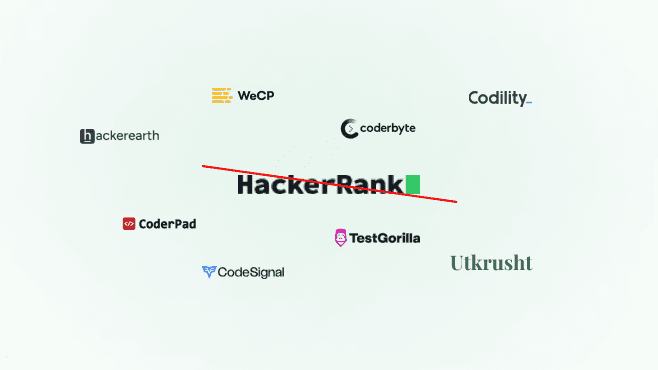
What’s changed is the number of credible options for solving that problem well. HackerRank built the category. CodeSignal, Codility, CoderPad, HackerEarth, TestGorilla, DevSkiller, Adaface, and Utkrusht AI have each carved out a specific angle on it, whether that’s live interviews, high-volume screening, or verifying that a resume actually reflects real skill.
Here are the takeaways worth carrying forward:
Map your actual bottleneck before picking a tool, not the other way around.
Prioritize resume-to-code verification if drowning in unqualified applicants is the main pain point.
Reserve senior engineering time for candidates who’ve already cleared a real skill bar.
As Utkrusht AI exemplifies through its focus on resume-to-skill verification, the future of technical hiring increasingly centers on closing the gap between what candidates claim and what they can actually demonstrate.
Start by auditing where your current process leaks the most time, whether that’s screening volume, live interview inconsistency, or resume-to-reality mismatches, then match that specific gap to the tool built for it.
Teams exploring AI-driven resume-to-code verification often start with a short trial run comparing a handful of past hires against what the tool would have flagged, which tends to make the decision obvious fast.

Zubin leverages his engineering background and decade of B2B SaaS experience to drive GTM as the Co-founder of Utkrusht. He previously founded Zaminu, served 25+ B2B clients across US, Europe and India.
Want to hire
the best talent
with proof
of skill?
Shortlist candidates with
strong proof of skill
in just 48 hours


